Author: garysagiv0045

  • Published in Asian Hospital & Healthcare Management, Issue 74

    Published in Asian Hospital & Healthcare Management, Issue 74

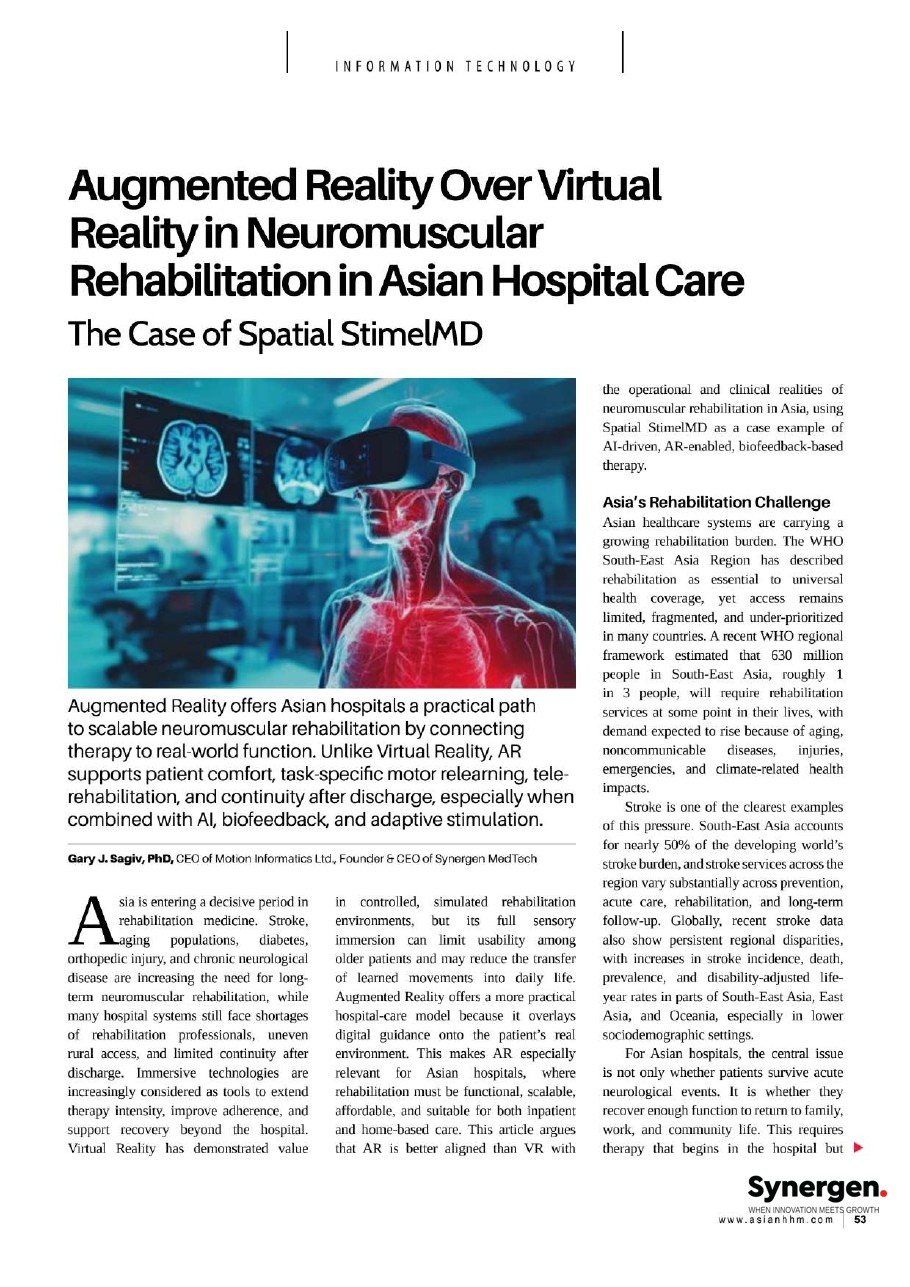
    Our founder, Gary J. Sagiv, has a new article in Asian Hospital & Healthcare Management, Issue 74, on pages 53 to 55. It is called “Augmented Reality Over Virtual Reality in Neuromuscular Rehabilitation in Asian Hospital Care: The Case of Spatial StimelMD”.

    The article asks a practical question for hospital leaders across Asia. Rehabilitation demand is rising faster than the number of therapists, so which technology can actually deliver functional recovery at scale? Gary’s answer is that Augmented Reality often suits neuromuscular rehabilitation better than Virtual Reality, because it keeps patients connected to the real world while they practise real tasks, it is more comfortable for older patients, and it is easier to use in busy hospital wards. Combined with AI and biofeedback, it can support therapy both in the clinic and at home.

    Our thanks to Debi Jones and the editorial team at Asian Hospital & Healthcare Management for their support.

    You can download the full article as a PDF below, or read the issue on the journal’s site through the Magazine page (https://www.asianhhm.com/magazine) and the Archives page (https://www.asianhhm.com/archives).

    Download the article (PDF)

    If you’d like to follow along, you can find us here:

    Website: synergenmedtech.com
    LinkedIn (Synergen page): linkedin.com/company/100981535
    YouTube: youtube.com/@synergenmedtech

  • What’s new this week in US MedTech, 12 to 19 November 2026

    What’s new this week in US MedTech, 12 to 19 November 2026

    12 to 19 November 2026

    This is the second of our Thursday series on US MedTech. It was a week in which two tubeless insulin pumps were cleared within four days of each other, Medtronic moved to buy Contego after last week’s PMA, the Hugo robot was cleared for general surgery, and Roche received a De Novo authorization for automated mass spectrometry in the routine lab.

    1. Tandem and MiniMed both receive FDA clearance for tubeless insulin pumps with up to seven days of wear

    On 12 November Tandem Diabetes Care (Nasdaq: TNDM), based in San Diego, received 510(k) clearance for a new Tandem Mobi tubeless cartridge and infusion set, which converts the current Tandem Mobi pump into a tubeless device. The company describes it as the world’s first and only tubeless automated insulin delivery system with up to seven days of wear. Its 8-K notes that the tubeless infusion set is cleared for up to seven days of wear, while the cartridge is cleared for three days of use. The pump is now cleared for both tubeless and tubed infusion, and it uses Tandem’s Control-IQ+ technology. A full US commercial launch is planned for the first half of 2027, with tubeless supplies to be sold exclusively through the pharmacy for customers with pharmacy benefits. On 16 November MiniMed (Nasdaq: MMED), based in Northridge, California, announced FDA clearance of MiniMed Fit, the company’s first tubeless insulin pump. MiniMed describes it as the world’s first and only tubeless insulin pump with up to seven days of wear and no charging or cartridge changes in that period, with a 300 unit insulin capacity, app control and SmartGuard technology. The company says FDA clearance arrived several months ahead of expectations, and a phased US launch is now expected in spring 2027, earlier than the previously communicated summer 2027 timing. At commercial launch it will offer a choice of two sensors, Simplera Sync with up to seven days of wear and Instinct, made by Abbott, with up to 15 days of wear, and it will also be available through the pharmacy channel. It matters because two established pump companies are now entering the tubeless market in the same season, each with a seven day wear claim, and patients will have more than one new option to compare with today’s three day systems.

    Source: Tandem Diabetes Care 8-K and MiniMed

    2. Medtronic to acquire Contego Medical in a deal valued at $380 million

    On 16 November Medtronic (NYSE: MDT) announced its intent to acquire Contego Medical, the Raleigh company whose Neuroguard IEP Direct System received FDA PMA approval last week. The deal is valued at $380 million, with potential payments after the acquisition, and it builds on Medtronic’s exclusive US distribution agreement with Contego, first announced in January 2025. The planned acquisition includes Neuroguard IEP Direct, which Medtronic describes as the first and only transcarotid artery revascularization system with integrated embolic protection (TCAR-IEP) in addition to flow reversal, and Contego’s Excipio thrombectomy devices. Medtronic expects to complete the transaction in the third quarter of its fiscal year, subject to customary closing conditions. It matters because a distribution partnership has turned into an acquisition, and it follows immediately after a PMA that we covered in last week’s roundup.

    Source: Medtronic

    3. Medtronic’s Hugo robot is cleared for general surgery procedures in the US

    On 17 November Medtronic announced that the FDA has cleared the Hugo robotic-assisted surgery system for use in general surgery procedures. The 510(k) covers all upper abdominal general surgical procedures, including cholecystectomy, Roux-en-Y gastric bypass, ventral hernia and small bowel resection, as well as the lower abdominal procedures of inguinal hernia and appendectomy. Combined, Medtronic says these procedures account for about 3.5 million surgeries a year in the US, more than half of all soft tissue procedures performed in the country each year. The clearance expands Hugo’s US use beyond urology. Globally, the company says Hugo procedure growth is running at more than twice the robotic surgery market and is on track to surpass 50,000 procedures by the end of the Medtronic fiscal year. It matters because general surgery is where most of the soft tissue volume sits, and Hugo can now be used in those procedures in the US, not only in urology.

    Source: Medtronic

    4. Roche receives FDA De Novo authorization for the cobas pro i 601 mass spectrometry platform

    On 16 November Roche announced that the FDA has granted De Novo authorization for the cobas pro i 601 platform with the Ionify Gabapentin assay, part of its cobas Mass Spec solution. The company says the aim is to bring mass spectrometry, which has often been limited to specialized reference laboratories and manual workflows, into routine clinical laboratories through an automated, standardized process. The Gabapentin assay adds therapeutic drug monitoring to a US menu that already includes 25-Hydroxy Vitamin D total and steroid hormone assays such as estradiol and 17-Hydroxyprogesterone. Roche will use an FDA-authorized Predetermined Change Control Plan that covers the addition of up to 22 further Ionify assays on the same platform as the plan’s requirements are met. Those additional assays are not yet available. It matters because a De Novo plus a pre-agreed change plan can shorten the path for a whole menu, not only a single test.

    Source: Roche

    5. InspireMD’s CGuard Prime is approved for TCAR, and the first US commercial cases are done

    On 12 November Miami based InspireMD (Nasdaq: NSPR) announced FDA approval of a PMA supplement for the CGuard Prime TransCarotid Stent System for use in transcarotid artery revascularization procedures, when used with an embolic protection system specified in the labeling. The company later stated that the FDA approved the device on 9 November. The approval is supported by the CGUARDIANS II pivotal trial, a prospective, multicenter, single-arm US study of 50 patients at 11 sites, using CGuard Prime with the FDA-cleared ENROUTE Transcarotid Neuroprotection System in a high surgical risk population. At 30 days the study reported 100% acute device success, with no deaths, strokes, myocardial infarctions or stent thrombosis, and complete stent patency in evaluable subjects. InspireMD estimates that more than 35,000 TCAR procedures are performed in the US each year, and says the new indication doubles the CGuard Prime platform’s total addressable market. On 18 November the company announced the first US commercial TCAR procedures with the system, performed by Dr. Brett Almond in the greater Tampa Bay area, Dr. Gregory T. Clabeaux in Buffalo, New York, and Dr. Bradley R. Grimsley in Dallas, Texas. InspireMD is separately developing SwitchGuard, its own transcarotid neuroprotection system, which is investigational and not available for sale in the United States. It matters because the US carotid market now has another approved TCAR stent option, in the same week that Medtronic moved to buy Contego.

    Source: InspireMD (approval) and InspireMD (first commercial cases)

    6. Masimo receives 510(k) clearance for smartSedLine brain monitoring during anesthesia

    On 18 November Irvine based Masimo, a Danaher company, announced FDA 510(k) clearance for smartSedLine, a next-generation brain function monitoring solution intended to help clinicians assess changes in a patient’s response to anesthesia. The company says an enhanced Patient State Index algorithm responds faster during induction and is more stable when EEG power is low. The system is available as a new module and EEG sensor, and the module is plug-and-play with a compatible monitor such as Masimo Root. Masimo says this is its seventh FDA clearance in 2026. It matters because better information on depth of sedation, especially in high risk and older patients, is a practical need in the operating room, not only a new feature on a monitor.

    Source: Masimo

    7. FDA grants three Breakthrough Device designations, for a urine iNPH test, a spinal graft extender, and a syphilis fingerstick test

    On 18 November Haifa based Biostream announced that the FDA granted Breakthrough Device Designation on 12 November for its investigational urine test to aid the diagnosis of idiopathic normal pressure hydrocephalus in patients aged 60 and older, and to help distinguish it from Alzheimer’s disease and other neurodegenerative disorders. The test measures a panel of proteins and applies an algorithm to generate a probability score. It is not currently available for sale in the United States, and the company plans a prospective clinical validation study at US academic medical centers during 2027. On 17 November Lund based Moroxite announced a second Breakthrough Device Designation, this time for Xerafuse TOB, a tobramycin-eluting, resorbable bone graft extender intended for sacrolumbar spinal fusion in patients at increased risk of infection. The company’s lead product, Xerafuse BMP, received a Breakthrough designation in 2025. A Breakthrough designation is not FDA clearance or approval. Also on 17 November Halifax based MedMira (TSXV: MIR) announced Breakthrough Device Designation for its Multiplo Complete Syphilis (TP/nTP) Antibody Test, an instrument-free fingerstick test that simultaneously detects treponemal and non-treponemal antibodies from whole blood. MedMira also said that, following the designation, FDA’s Total Product Life Cycle Advisory Program team invited the company to apply for enrollment in its TAP Pilot. It matters because Breakthrough status can speed the conversation with the FDA, but it is still only a starting point, and none of these three tests or devices is cleared for US sale on the back of this week’s news.

    Source: PR Newswire (Biostream) and Moroxite and MedMira

    Gary’s take

    This week I kept coming back to how quickly a market can fill up once the first clearance arrives. On 12 November Tandem said it had the world’s first and only tubeless automated insulin delivery system with up to seven days of wear. Four days later MiniMed said much the same about MiniMed Fit, with a 300 unit reservoir and no cartridge change for up to seven days. Both plan to launch in 2027, and both will be going after today’s tubeless market as well as each other. The fine print matters here, because Tandem’s cartridge is cleared for three days even though the infusion set can stay on for seven. In carotid care the story continued from last week: Medtronic is now buying Contego, the company whose Neuroguard IEP Direct system we wrote about after its PMA, and InspireMD has already started its first commercial TCAR cases with CGuard Prime. That is what a competitive US market looks like, and it is generally good for physicians and patients, as long as we keep reading the labels and the payment rules with the same care we give to the press releases.

    When two clearances land in the same week and both claim to be first, what do you look at first, the wear time, the clinical data, or how the device will actually be paid for and supplied? You are always welcome to write to me directly, and you can find more of my articles, and book a short introductory call, at synergenmedtech.com.

    Sources note: all items were found through a public web scan of about 12 to 19 November 2026 and each was checked against the linked source. Amounts and dates are as reported by the companies or the cited media. The Medtronic agreement to acquire Contego Medical, the vVARDIS IPO and the Remedy Robotics Series B were covered in the 10 to 17 November funding and deals edition; Contego is included here because it follows last week’s PMA and is central to this week’s US carotid story. No new CMS payment decision in this window was added, and no additional US medtech IPO pricing was confirmed beyond the vVARDIS offering already covered on Tuesday.

    If you’d like to follow along, you can find us here:

    Website: synergenmedtech.com

    LinkedIn: linkedin.com/company/100981535

    YouTube: youtube.com/@synergenmedtech
    Download the full roundup as a PDF

  • Why Asian Hospitals Say They Want Innovation, Then Refuse to Adopt It

    Why Asian Hospitals Say They Want Innovation, Then Refuse to Adopt It

    Over the past 30 years, I have sat across the table from hundreds of hospital executives, physicians and healthcare decision-makers throughout Asia.

    One thing has always fascinated me.

    Almost every hospital wants to be innovative. CEOs talk about digital transformation, AI, robotics and the latest medical technologies. Innovation appears in strategic plans, conference presentations and hospital websites.

    But when someone actually arrives with a technology that could change how patients are treated, things suddenly become complicated.

    The clinical team is interested. The department head is enthusiastic. Management agrees that the technology has potential.

    And then comes the familiar sentence.

    “We’ll need to discuss this internally.”

    Sometimes that discussion takes months. Sometimes years. Sometimes it never happens.

    So here is my question: If hospitals genuinely want innovation, why is introducing it so difficult?

    Everyone wants innovation. Nobody wants the disruption.

    I think part of the problem is that we confuse buying new technology with adopting innovation.

    Buying a new MRI system, for example, may be a major financial decision. But the hospital already understands what an MRI does, who operates it, how patients are referred and, in many cases, how the service generates revenue.

    Now introduce a technology that changes how a rehabilitation department treats patients.

    Suddenly, the questions are different.

    Who will operate it? Will the therapists need retraining? Does it change the number of patients treated each day? Who is responsible if something goes wrong? Will physicians refer patients? Does the hospital get paid for using it?

    And perhaps the most important question, although it is rarely asked openly:

    Who is going to take responsibility for making this change happen?

    A technology can be clinically excellent and still create a management headache.

    That is something many of us in the MedTech industry fail to appreciate.

    The physician loves it. The hospital does not buy it.

    I have experienced this situation more times than I care to remember.

    You demonstrate a medical device to a physician. They immediately understand its clinical potential. They ask intelligent questions, discuss possible patients and sometimes even offer to help with a clinical evaluation.

    You leave feeling you have made real progress.

    Then you discover that the physician does not control the budget.

    The department head may support the purchase but needs approval from management. Management wants financial justification. Procurement wants competitive quotations. Finance wants to know when the investment will pay for itself.

    And nobody seems to own the decision.

    This is not necessarily bureaucracy for the sake of bureaucracy. Hospitals have competing priorities, limited resources and responsibilities that go far beyond one department.

    But from the perspective of the MedTech company, it can feel like running a marathon without knowing where the finish line is.

    Clinical enthusiasm is not the same as institutional commitment.

    I have learned that if you do not understand the hospital’s decision-making structure, you are not really selling. You are just demonstrating.

    Hospitals do not buy technology. They buy solutions to problems.

    Let me give you a few examples.

    Imagine a rehabilitation department where patients wait weeks to begin treatment. The therapists are overloaded, and management is struggling to increase capacity.

    You arrive with an advanced rehabilitation system incorporating AI, biofeedback and sophisticated algorithms.

    You explain the technology. You show the clinical studies. You demonstrate the software.

    Everyone is impressed.

    But have you answered the hospital’s problem?

    Can the department treat more patients? Can therapists supervise treatment more efficiently? Can some patients continue therapy at home? What additional costs will the hospital incur?

    Now consider a sleep laboratory with patients waiting months for diagnostic studies.

    The CEO may not be particularly interested in how sophisticated your sensors are. What matters is whether your solution can reduce waiting times, increase diagnostic capacity and fit within existing reimbursement arrangements.

    Or take a hospital purchasing imported cardiovascular devices. The technology may be excellent, but if inventory costs are too high, management may be reluctant to keep products in stock.

    These are not theoretical commercial considerations. They are the kinds of problems that determine whether medical technology is actually adopted.

    The question is not whether your device is better. It is whether the hospital becomes better by using it.

    The hidden cost of change

    MedTech companies spend enormous amounts of money on product development, clinical trials and regulatory approvals.

    We calculate manufacturing costs, distributor margins, selling prices and expected revenue.

    But how often do we calculate the cost of change for the hospital?

    A new technology may require training 20 therapists, modifying treatment protocols, integrating software, educating referring physicians and reorganising patient schedules.

    Somebody has to manage all of that.

    And while the MedTech company sees an exciting new opportunity, the hospital administrator sees another project competing for already limited staff time.

    I sometimes think we underestimate how difficult it is to change established clinical habits.

    Physicians and therapists have developed methods they trust. They understand their limitations, but they also know what to expect.

    Introducing something new means asking them to move away from familiar routines.

    That takes more than a demonstration and a few published clinical studies.

    It takes leadership, training, trust and a clear reason to change.

    The CEO says yes. The department says no.

    Here is another uncomfortable reality.

    Even when senior management supports innovation, the people expected to use it may not.

    A hospital CEO might decide that introducing a new rehabilitation technology is strategically important.

    But if the therapists believe it will increase their workload, complicate treatment or reduce their professional autonomy, implementation can become very difficult.

    The opposite happens too.

    A department may desperately want new equipment, but management sees no convincing financial justification.

    Both sides may have perfectly reasonable arguments.

    The problem is that MedTech companies often approach one group and assume the others will follow.

    They will not necessarily.

    Successful adoption requires clinical, operational and financial agreement. Getting one out of three is not enough.

    MedTech companies are part of the problem

    I do not think we can blame hospitals for everything.

    Our industry has developed a habit of falling in love with its own technology.

    We talk about patents, algorithms, technical specifications, clinical superiority and regulatory milestones.

    All important, of course.

    But sometimes I wonder whether we are actually listening to the people we are trying to sell to.

    When a hospital tells us that implementation is difficult, we explain why our technology is worth the effort.

    When management says the price is too high, we show more clinical data.

    When therapists say they do not have time, we offer another demonstration.

    Perhaps we should stop talking for a moment and ask what would make adoption easier.

    Could we introduce the technology gradually? Could we train a smaller clinical team first? Could we demonstrate its effect on workflow and treatment capacity? Could we offer a commercial model that reduces the hospital’s initial financial exposure?

    And, most importantly, could we work with hospital management to establish clear measures of success before the technology is introduced?

    Innovation should not require a hospital to solve all the problems created by the company selling it.

    A message to hospital CEOs

    I also believe hospital leadership needs to take greater responsibility.

    If innovation is genuinely a strategic priority, it cannot remain a slogan.

    Someone must be responsible for evaluating new technologies, bringing together clinical and financial stakeholders and making decisions within a reasonable timeframe.

    Not every technology deserves to be adopted. Many do not.

    But a hospital should be able to distinguish between a product that lacks clinical or economic value and one that offers genuine benefits but requires organisational change.

    Rejecting a technology because it does not work is one thing.

    Rejecting it because nobody wants to change the way things have always been done is quite another.

    And this matters particularly in Asian healthcare systems facing growing patient demand, workforce pressures and uneven access to specialised services.

    Hospitals cannot solve every capacity problem simply by buying more equipment or hiring more people.

    Sometimes the way care is delivered has to change.

    Innovation is a management decision

    After three decades in MedTech, I have become convinced that developing innovative technology is often easier than getting healthcare organisations to adopt it.

    That does not mean hospitals are wrong or MedTech companies are right.

    It means both sides need to understand that innovation is not simply a product.

    It is a change in how people work, how patients are treated and how resources are managed.

    For MedTech companies, the lesson is to stop selling features and start solving the hospital’s problems.

    For hospital CEOs, the challenge is to create an organisation capable of evaluating and implementing worthwhile change, rather than simply celebrating innovation in its annual report.

    Because a hospital that talks about innovation but cannot implement it is not necessarily innovative. It is just very good at talking about it.

    And in my next article, I am going to leave the hospital boardroom for a while and talk about something equally important when doing business in Asia: food, dress codes and the cultural mistakes that can damage a relationship before you have even opened your presentation.

    If you’d like to follow along, you can find us here:

    Website: synergenmedtech.com
    LinkedIn: linkedin.com/company/100981535
    YouTube: youtube.com/@synergenmedtech
  • What’s new this week in European MedTech, 11 to 18 November 2026

    What’s new this week in European MedTech, 11 to 18 November 2026

    11 to 18 November 2026

    Welcome to our second Wednesday look at European MedTech. This week the money went into heart monitoring, hospital sensors and handheld eye imaging, the EIC picked its latest Accelerator companies, two North American companies won MDR certificates for Europe, and the Parliament’s timetable for the MDR and IVDR revision slipped into January.

    1. Kardi Ai raises €5.3M Series A for wearable heart rhythm monitoring

    On 11 November Czech startup Kardi Ai raised €5.3 million in a Series A led by German health tech fund Callisto Health, with Česká spořitelna and Slovenská sporiteľňa (through Seed Starter), BrightCap Ventures, Purple Ventures, DEPO Ventures and Garage Angels. Its platform combines an ECG chest strap, a mobile app and AI analysis of the recordings, and it works with more than 70 hospitals in the Czech Republic and more than 6,000 users. Germany is the next priority, followed by planned entries in India, the UAE and Singapore. It matters because a Central European wearables company built a real hospital base at home before heading west.

    Source: Tech.eu

    2. Akara raises $5.5M for privacy friendly AI sensors in hospitals

    On 11 November Dublin based Akara, a Trinity College Dublin spin-out, raised $5.5 million led by Locke Health, bringing its total funding to $12.3 million. VTC Ventures, the EIC Fund, CommonKind and NovaVector Holdings joined existing investors ACT, Atlantic Bridge and Enterprise Ireland. Its wall mounted thermal sensors, with AI running on the device, show how clinical spaces are used without capturing detailed images of patients or staff, and the technology is already in hospitals in Ireland, the UK and the US. It matters because hospital capacity, and not only new therapies, is now attracting European investment.

    Source: Silicon Republic

    3. Siloton wins an £8.4M Innovate UK contract for handheld retinal imaging

    On 13 November it was reported that Bristol based Siloton has secured an £8.4 million ($11.1 million) two year contract from Innovate UK, through the Contracts for Innovation: Quantum Missions Primer initiative, to develop and clinically evaluate GiraffeOCT, a handheld OCT system built on a photonic chip. Trials of the in-clinic device will run with Sunderland Specialist Eye Hospital, and the York Health Economics Consortium will estimate the savings for the NHS, where nearly 623,000 patients were waiting for ophthalmology appointments at the end of July 2026. It matters because public money is helping move eye care out of the hospital and closer to home.

    Source: The Ophthalmologist

    4. The EIC picks 35 Accelerator companies, and DiaMonTech gets €2.5M for needle free glucose monitoring

    On 16 November the European Innovation Council announced 35 start-ups and SMEs selected from 453 full applications, with €84 million in proposed grants and 32 of them to be assessed for EIC Fund equity of up to €10 million each. Health names on the list include Surgecare (France, day 1 discharge decisions after abdominal surgery), EndoGene.Bio (France, uterine diseases), THEREMIA (France, clinical intelligence in CNS) and Sia Cellboxlab (Latvia, organ-on-chip). The same day Berlin based DiaMonTech said it is receiving €2.5 million from the EIC Accelerator to build a smartphone sized prototype, the D-Pocket, that measures glucose through the skin with mid-infrared light, in an 18 month project that began on 1 October. It matters because non-dilutive EU money is still one of the few ways to fund the riskiest device work in Europe.

    Source: European Innovation Council and EIC selected companies list and DiaMonTech

    5. Two North American companies win CE marking under the MDR

    On 17 November Dallas based Newton announced CE marking under the EU MDR for its Neurolens N3 eye alignment measurement system, issued by Intertek Medical Notified Body AB, and said it expects to reach its first European markets in 2027. On 16 November Calgary based MacuMira announced MDR CE marking, as a Class IIa device, for its microcurrent treatment for dry age-related macular degeneration, which is already used in more than 300 clinics, with more than 40,000 treatments delivered, in Canada, Australia and New Zealand. It matters because both products were helping patients elsewhere before Europe.

    Source: PR Newswire (Newton) and GlobeNewswire (MacuMira)

    6. Ceroflo opens a final Irish EIIS round of up to €5.5M, with trials starting in the US and Japan

    On 13 November Galway based Ceroflo launched its third and final EIIS round, of up to €5.5 million with a deadline of 30 November, to support clinical trials of its SubMax intracranial stent for intracranial atherosclerotic disease (ICAD). The company has treated two patients so far and says it is starting with the US and Japan. It was founded by stroke interventionists from Karolinska University Hospital in Sweden, Singapore and the Royal London Hospital. It matters because an Irish stent company with European founders is choosing to start its clinical path outside Europe.

    Source: Business Post (commercial report)

    7. MDR and IVDR revision: the indicative plenary date moves to January

    The European Parliament’s Legislative Observatory now lists 18 January 2027 as the indicative plenary date for the first reading of the MDR and IVDR simplification proposal, procedure 2025/0404(COD). Earlier this month it showed 14 December 2026. The lead Public Health committee (SANT), with Oliver Schenk as rapporteur, has still not voted, and the file reads “Awaiting committee decision”. Until Parliament and Council agree a final text and it is published, the current MDR and IVDR apply in full. It matters because every month of delay is another month under today’s rules.

    Source: European Parliament Legislative Observatory and Vigilo MedTech (status on 13 November)

    8. EUDAMED: the device registration deadline is 28 November

    Under the Commission’s EUDAMED transition timeline, devices whose first units were placed on the market before mandatory use began on 28 May 2026, including legacy devices, must be registered in the UDI/Devices module by 28 November 2026 if further units are still being placed on the market. Certificates issued under the MDR and IVDR must be registered by 28 May 2027. These dates follow Commission Decision (EU) 2025/2371. It matters because ten days from now, a device missing from EUDAMED becomes a compliance problem for every manufacturer still selling it in Europe.

    Source: European Commission (EUDAMED transition timeline) and EUDAPrep

    Gary’s take

    This week two companies from North America received MDR certificates, and both were already helping patients in other countries before Europe. I keep wondering what that tells us. My honest feeling is that the MDR has gone further than it needed to, and that much of the weight it adds ends up as paperwork in Brussels rather than as safer care. Many new products never reach European patients at all, or arrive years later, and an Irish stent company starting its trials in the US and Japan is one quiet example. I am still not sure whether this is good or bad, and I understand those who say that caution protects people. But I do believe European healthcare is paying for it, and that most people have no idea. The technology world talks about this every day, yet I am not convinced that doctors, health reformers, or even the people who run the MDR can see the treatments that never arrived. With the Parliament vote now pushed into January, it feels like a good moment to ask the question openly.

    When a good device reaches patients in Canada or the US before Europe, who in Europe should be asking why? You are always welcome to write to me directly, and you can find more of my articles, and book a short introductory call, at synergenmedtech.com.

    Sources note: all items were found through a public web scan of about 11 to 18 November 2026 and each was checked against the linked source. Amounts and dates are as reported by the companies or the cited media. The Ceroflo item comes from a commercial report in the Business Post. No new EU HTA joint clinical assessment for a medical device and no new MDR notified body designation were found in this window.

    If you’d like to follow along, you can find us here:

    Website: synergenmedtech.com

    LinkedIn: linkedin.com/company/100981535

    YouTube: youtube.com/@synergenmedtech
    Download the full roundup as a PDF

  • USA and EU Are Not Always First: Think Outside the Continent

    USA and EU Are Not Always First: Think Outside the Continent

    When medical technology founders talk about going international, the conversation almost always begins with two places: the United States and the European Union. I understand why. They are large and wealthy markets, they set the regulatory standards that much of the world follows, and investors like to see them in a plan. But over many years of international business development, I have come to believe that the USA and EU are not always the right place to start, and that some of the most rewarding markets for a young company sit in Asia, Latin America and other regions that rarely appear on the first slide.

    This is not an argument against the big markets. It is an argument for thinking more widely about the order in which you approach them.

    Why the USA and EU are hard places to begin

    The United States has one of the most complex payment systems in the world, and a cleared device can wait a long time before clinicians have a reliable way to be paid for using it. Competition is intense, buyers have seen many products, and building a credible presence usually requires a local team or partners, which is expensive for a company that is still small. Europe has its own challenges. The Medical Device Regulation has made the road to a CE mark longer and more demanding than it used to be, and once you have it, you still face many different health systems, languages and purchasing practices under one regulatory roof. In fact, many manufacturers and entrepreneurs I have spoken to in the last few years have decided not to enter the EU or seek CE marking under the MDR because of the costs and complexity, and, you know what, I totally agree with them.

    The world can also change around you. In April 2025 I wrote a preliminary review of the new American tariffs on imported medical devices, and one of my conclusions was that non-US competitors, particularly in Europe and Asia, were positioned to benefit, while price sensitive markets such as Latin America and Southeast Asia would become more competitive. I noted at the time that in government tenders in countries such as India, Brazil and South Africa, even a small price difference can disqualify a bid. Whatever has changed in the details since then, the lesson has stayed with me: a company that depends on one or two markets is exposed to decisions it cannot control.

    Asia: large needs, fast decisions and real relationships

    I have spent a large part of my career in Asia, and it has taught me that many Asian markets combine enormous clinical need with a genuine openness to new technology. India has well over a billion people and a rich pool of talented and skilled healthcare professionals. After one visit to IIT and AIIMS I wrote that India is no less a start up nation of its own, and any foreign company that arrives assuming it is bringing something the country has never seen will quickly find that it is talking to people building advanced technology themselves. Most marketing executives do not understand that when you sell to India, you are not selling to 1.2 billion Indians but rather to 300 to 400 million people, similar in size to the population of the USA. Selling to India, though, is a completely different kettle of fish, and I will explain it in detail in another article.

    Southeast Asia has been just as instructive. In Indonesia, the world’s largest Muslim majority country, a company I represented received import clearance for its device through the patient work of a local partner who knew the system and stayed with the process until it was done. When it finally came through, I wrote on LinkedIn that I rarely feel so proud, and I feel it was one of my best moments (that partner is a true partner, through good times and bad)! In Thailand this August I had the honor of representing Israel at Corporate Spark 2026 in Bangkok, hosted by the National Innovation Agency, which brought together 24 global startups, and it showed me how actively some Asian governments look for foreign innovation. Japan is a very different market again, with a careful and structured way of evaluating new partners, and I will come back to what it taught me later in this series.

    Smaller Asian markets deserve attention as well. On one visit to Sri Lanka I fitted seven meetings into a single trip, including one with the healthcare arm of a conglomerate with more than eighty years of history that most people in the country know as an importer of cars. In recent years that group has brought its medical activities together under a single identity and expanded into medical devices and hospital equipment. When long established local groups start investing seriously in healthcare, it tells you that the market is changing, and it often means there are capable partners looking for new products.

    Latin America and beyond

    Latin America is another region that founders often overlook, partly because of language and partly because each country has its own regulator. In my experience the right local support makes a great difference there. When a company I represented began working in Argentina, the Israel Economic Mission played an important part in our first steps there, and I wrote formally to its head to thank him, because his understanding of the local market had been instrumental. We went on to talk with Israel’s missions in other Latin American countries as well, and the experience convinced me that a region many people consider difficult can be approached step by step with the right help. I have worked in Mexico as well, and across the region I have found that a well prepared registration file and a committed local partner open doors that a foreign company could never open alone.

    Australia is a different case again. When I visited Melbourne and Sydney in 2025, looking for partners to distribute a medical technology, I told a local newspaper that I was thinking of rural communities where a patient might have a therapist a couple of hundred kilometers away and see them once a month. Geography like that creates needs that technology can genuinely help with, and it shapes the market in ways that a plan built for Europe would miss.

    How to think outside the continent

    None of this means skipping the United States or Europe. For many devices they will be essential, and an FDA clearance or CE mark is often what makes registration elsewhere possible in the first place. Many regulators in Asia and Latin America take an existing major clearance into account, so the sequence can be designed to use one clearance as the base for several markets at once.

    What it does mean is looking at the whole map before deciding the order. A market where a committed partner is ready, where the regulator is reachable, where the need is visible and where you can afford to be present may teach you more, and earn you more credibility, than a slow and expensive first year in a market where you are one of hundreds of newcomers. Revenue and reference sites from those markets can then support the larger effort in the United States and Europe, rather than the other way round.

    At Synergen, I help medical technology companies look at that whole map with fresh eyes. If you have only ever considered the USA and EU, I would be glad to talk about what else might fit your device. Write to me at gary@synergenmedtech.com and tell me about your commercialization or international business development challenges. In the next article, I look at whether you should sell directly or through distributors once you have chosen your markets.

    All names of people and partners have been removed for privacy reasons.

  • Asia Is Not One Market. Why Do Western Healthcare Leaders Keep Treating It Like One?

    Asia Is Not One Market. Why Do Western Healthcare Leaders Keep Treating It Like One?

    As I sit here in China, something has finally struck me. After more than 30 years of living, working and travelling across Asia, I am beginning to understand just how much I still have to learn.

    I have lived in India and China and worked across nearly 30 other Asian countries, meeting hospital executives, physicians and distributors. I have negotiated deals, built partnerships, celebrated successes and made some expensive mistakes along the way.

    And yet one lesson keeps coming back to me: Western healthcare and MedTech leaders continue to treat Asia as one market. It is not. Not even close.

    I have been guilty of making assumptions myself. I thought that years of experience meant I understood how business was done. What I sometimes underestimated was the culture behind the decisions.

    Japan is not Thailand. Vietnam is not Indonesia. Hong Kong is not Mongolia. China is not Bhutan. Each has its own healthcare system, business practices and expectations.

    Culture is not an afterthought in Asian MedTech. It is where the strategy begins.

    A friendly meeting is not a purchase order

    India taught me an expensive lesson.

    I remember leaving hospital meetings convinced we had a deal. Physicians were enthusiastic, management was positive, and even the distributor was confident.

    Then nothing happened. Emails went unanswered. Purchase orders never arrived. I had mistaken enthusiasm for commitment.

    Sometimes people are simply being polite. Sometimes they genuinely like the technology but lack purchasing authority. And sometimes saying no is uncomfortable.

    So I changed my approach. Instead of asking whether they liked the product, I started asking who controlled the budget, who made the final decision and what would happen next.

    A meeting with a clear next step is worth more than a room full of compliments.

    One product, three very different markets

    In Thailand, I spent an entire day at a private hospital that was competing for international patients. Its management wanted to invest in advanced technology to differentiate its services.

    The following day, I visited a public hospital treating significantly more patients. Its management recognised the same clinical benefits but faced very different procurement restrictions.

    It was the same technology, in two hospitals, with two completely different commercial realities. I had to rethink my entire approach. One hospital was looking for a competitive advantage; the other needed a solution that could work within its procurement system. The same sales pitch simply would not work for both.

    Vietnam, a country often overlooked by Western MedTech companies, has enormous patient volumes. But clinical need does not automatically translate into purchasing power. We quickly realised that demonstrating how our technology could increase treatment capacity was far more persuasive than discussing technical specifications. We changed our pitch (and lowered our price), and the results were excellent. Our local partner was instrumental in making that happen.

    Indonesia is another market that Western companies frequently overlook. In my experience, it offers tremendous opportunities and some exceptional business partners. But selling equipment in Jakarta is one thing. Maintaining it, training clinicians and supplying consumables across thousands of islands is another.

    Here, our approach focused on accessibility, reliable support and building a relationship with a trusted local partner. The right partnership can also create opportunities in neighbouring markets such as Malaysia and Myanmar.

    The mistake Western companies repeatedly make is selling the same product using the same business model in fundamentally different markets.

    We learned to adapt, and to change our financing, training, service and implementation strategies to reflect local realities.

    Advanced hospitals can be your toughest customers

    Singapore, Japan, China, South Korea and Hong Kong have sophisticated healthcare systems. But sophistication does not guarantee accessibility. Japan may require extensive evaluation and institutional consensus. In South Korea, reimbursement can determine commercial viability. In Hong Kong and China, an enthusiastic physician does not necessarily control purchasing decisions.

    Even excellent international clinical evidence may not be enough. Hospitals may require local validation, economic justification or changes to existing clinical workflows.

    Proving your technology works is only half the job. You must prove it works within the hospital’s clinical and financial reality.

    Mongolia: what does innovation really mean?

    During COVID, I visited Mongolia under exceptional circumstances, when I was the only foreigner permitted to enter the country. I even had the opportunity to meet the country’s Health Minister. The experience reinforced something our industry often overlooks.

    In a country with vast distances and limited access to specialised healthcare outside major cities, portability, reliability and technical support may matter far more than sophisticated features.

    Imagine two clinical devices. One offers advanced capabilities but requires highly trained operators and constant technical support. The other is simpler, portable and reliable enough to operate in smaller facilities.

    Which delivers greater value?

    Perhaps the most innovative device is not the one with the most features. It is the one that actually reaches the patient.

    Hospitals love innovation, until it requires change

    Asian hospital executives love talking about innovation. It appears in strategic plans, conference presentations and annual reports. But implementing innovation often means retraining staff, changing workflows and challenging established practices.

    I visited a private hospital in Nepal that had invested in impressive diagnostic equipment while continuing to use traditional rehabilitation methods. The contrast was striking. Investing in diagnostic technology strengthened an existing service, while introducing new rehabilitation technology would have meant changing how the department operated.

    Hospitals often prefer technology that improves what they already do over technology that changes how they do it.

    But MedTech companies are equally responsible.

    We spend millions developing technology, obtaining regulatory approvals and demonstrating clinical benefits. Then we arrive expecting hospitals to recognise how brilliant our products are.

    Why should they reorganise themselves around our technology? Instead, we should be asking what keeps hospital management awake at night.

    Are rehabilitation departments overloaded? Are patients waiting nine months for sleep studies?

    Are imported Western stents so expensive that hospitals avoid holding inventory and order them only when needed? Are stroke patients reaching hospitals within the critical treatment window for thrombolysis, or is an earlier warning and referral system needed?

    These are real clinical, operational and commercial challenges.

    Hospital CEOs want better outcomes, greater efficiency and financial sustainability. Physicians want clinical value without unnecessary complexity. And at the same time we are talking about AI, robotics and algorithms.

    Perhaps hospitals are not rejecting innovation. Perhaps they are rejecting the additional problems that come with it.

    The successful approach starts with understanding the hospital’s problem, not demonstrating the product.

    Asia doesn’t need another MedTech sales pitch

    Appointing a distributor, translating a presentation and adjusting prices is not a market-entry strategy. Nor does a hospital’s enthusiasm for innovation mean it is prepared to adopt it.

    Success in Asian MedTech is not necessarily about having the most advanced technology. It is about understanding the culture, the people and the problems well enough to make that technology work.

    After more than 30 years, I am still learning. And perhaps that is Asia’s most valuable lesson:

    The moment you believe you understand Asia is probably the moment you are about to make your next expensive mistake.

    And if you think understanding the market is difficult, wait until you try to understand why hospitals that desperately need innovation are so reluctant to adopt it. That is a story for my next article.

    If you’d like to follow along, you can find us here:

    Website: synergenmedtech.com
    LinkedIn: linkedin.com/company/100981535
    YouTube: youtube.com/@synergenmedtech
  • What’s new this week in Asian MedTech, 9 to 16 November 2026

    What’s new this week in Asian MedTech, 9 to 16 November 2026

    What's new this week in Asian MedTech

    9 to 16 November 2026

    A week with a strong Japanese and Korean flavour. Boston Medical Sciences raised a large Series B for AI colon cancer screening without laxatives, and Sysmex teamed up with London's Hologen to launch Saibogen, a Singapore based joint venture that reads more from routine blood counts. In Korea, Raywatt won a US FDA clearance and a Series B for its high speed coronary OCT, MedInTech closed a Series C for robotic endoscopy, and Lunit took its imaging AI into a Saudi government health system. Australia's Nanosonics widened its US clearance for endoscope cleaning, and in China, Osmunda raised money to build out medtech development and manufacturing infrastructure while Mingshi passed RMB 500 million in total funding for a visual cortex implant.

    1. Boston Medical Sciences raises ¥5.55 billion in a Series B for laxative free AI colon screening

    On 13 November Tokyo based Boston Medical Sciences, led by CEO Masaki Okamoto, announced a ¥5.55 billion Series B through a third party share allotment, co led by Japan Growth Capital Investment Corporation (managed by Nomura SPARX Investment), Global Brain and Beyond Next Ventures. The company was founded in April 2023 by physicians teaching and researching at Harvard Medical School and Massachusetts General Hospital, and is developing a "laxative free virtual endoscopy" that uses AI to clean the bowel virtually on CT images and help detect polyps. In Japan it was designated for priority review as software as a medical device and has completed its domestic clinical trial, and in the US it received FDA Breakthrough Device Designation in May 2026 and was accepted into the TAP pilot programme in June. The money goes to R&D, clinical evidence, Japanese and US regulatory work, preparation for launch in Japan and business development mainly in the US. It matters because the biggest barrier to colon cancer screening is the preparation, not the scan, and a Japanese team is tackling it for both home and US markets at the same time.

    Source: Boston Medical Sciences press release (PR TIMES)

    2. Sysmex and Hologen launch Saibogen, a Singapore based AI joint venture for "blood intelligence"

    On 9 November Kobe based Sysmex (President Iwane Matsui) and London based Hologen (CEO Roland Tegeder) announced Saibogen Pte. Ltd., a joint venture incorporated in Singapore on 2 November and led by CEO Leila Luheshi. Saibogen will apply Hologen's Large Medicine Models, generative AI trained on real world healthcare data, to the proprietary data produced by Sysmex hematology analyzers, which run about 3 billion tests a year, to extract new biological insight with no new instruments, reagents or samples. Its products will be delivered as software exclusively through Sysmex analyzers, and its first offerings will be for research use only. It matters because one of Japan's diagnostics leaders is betting that the next value in a mature test sits in the data it already collects, and it chose Singapore as the base to do it.

    Source: Sysmex

    3. Raywatt wins US FDA 510(k) clearance and a KRW 13 billion Series B for high speed coronary OCT

    On 12 November Korean imaging company Raywatt said its FASTER OCT imaging system (RV201) and four single use Chouette imaging catheters received FDA 510(k) clearance on 11 November US time, about nine months after filing. The system spins the catheter 400 times a second to image a coronary artery in about 0.5 seconds, works with saline as well as contrast, and is cleared as a Class II device for imaging coronary arteries of 2.0 to 3.5 mm in patients undergoing interventional procedures. The company says it is the first Korean developed intravascular OCT to win FDA clearance. On 16 November Raywatt added that it had raised a KRW 13 billion Series B from nine investors including InterVest, Life Asset Management and Hyundai Technology Investment, bringing total funding above KRW 23.5 billion, to fund US studies, CE MDR in 2027 and extension of the platform into cerebral vessels. CEO Jinyong Ha called the clearance proof that a Korean OCT has crossed the threshold of the US market. It matters because intravascular imaging is now a Class 1 guideline recommendation in complex stenting, and a new Asian competitor has entered a field long led by a few global players.

    Source: Financial News (News1) and Seoul Shinmun

    4. MedInTech closes a KRW 33.8 billion Series C to grow robotic endoscopy toward surgical robots

    On 16 November Korean startup MedInTech was reported to have closed a KRW 33.8 billion Series C, co led by existing investor Atinum Investment and new investor KB Investment. Founded in 2020, the company commercialised INTION S, a motorised AI endoscope system launched in Korea in June 2026, which cuts the weight of the control section from 610 g to 350 g and the force needed on the control wheels by up to 85%, with AI functions that help steer the scope and keep a lesion centred on screen. Before this round it had raised KRW 28 billion in total private funding up to its 2024 Series B and won large government R&D projects. The new money goes into a wider robotic endoscope line and development of a surgical robot. It matters because flexible endoscopy has been dominated by three Japanese companies for decades, and a Korean team is challenging them through motorisation and physical AI rather than optics alone.

    Source: theBell and Pharm Edaily

    5. Lunit will supply its imaging AI to Saudi Arabia's Ministry of National Guard Health Affairs

    On 9 November Seoul based Lunit announced that it will supply Lunit INSIGHT CXR for chest X ray and Lunit INSIGHT MMG for mammography to Saudi Arabia's Ministry of National Guard Health Affairs (MNGHA), a large government health system with major hospitals in Riyadh and Jeddah. The deployment will run through solutions by stc, the ICT arm of stc Group, as systems integrator, and the AI results will sit inside MNGHA's existing PACS workflow. It builds on Lunit's earlier Saudi work with SEHA Virtual Hospital and Dr. Sulaiman Al Habib Medical Group. CEO Brandon Suh said the aim is to widen access to AI powered cancer screening across the Middle East. It matters because Korean medical AI companies are increasingly winning national scale deals in the Gulf, often through a local integrator.

    Source: Lunit

    6. Nanosonics secures a second US FDA 510(k) clearance for its CORIS endoscope cleaner

    On 11 November Sydney based Nanosonics (ASX: NAN) announced that the FDA had granted a second 510(k) clearance for its CORIS System, an automated cleaner for the internal channels of flexible endoscopes, adding a number of high volume colonoscopes and gastroscopes to the devices it can reprocess. It builds on the earlier De Novo authorisation and a first 510(k) clearance. CEO and President Michael Kavanagh called it an important milestone and part of the planned US launch activities. It matters because channel cleaning is the critical first step in reprocessing reusable endoscopes, and every added scope model widens the market an Australian company can address in the US.

    Source: Kalkine (ASX announcement summary) and Market Index

    7. Osmunda raises an RMB 100 million Series D to build medtech development and manufacturing infrastructure

    On 13 November VCBeat reported that Guangzhou Osmunda Medical Device Technology (奥咨达), the medtech CRO and CXO platform founded in 2004 by regulatory expert Dr. Zhang Feng and Ms. Pan Wei, closed an RMB 100 million Series D, invested solely by the Lishui Green Valley Talent Osmunda fund. The money will build a headquarters manufacturing plant for contract production under China's MAH system, a provincial proof of concept centre and pilot workshop, a global AI platform for medtech innovation and its own medtech large language model, OSMED, and AI agents. The company says it has served more than 5,000 clients and helped obtain more than 2,500 NMPA registrations, 300 FDA registrations and 800 CE certificates. It matters because China's MAH system lets innovators register products without owning a factory, and service platforms that combine regulatory, development and production are becoming core infrastructure for Chinese startups going abroad.

    Source: VCBeat and PEdaily

    8. Mingshi passes RMB 500 million in total funding for a visual cortex prosthesis

    On 10 November Suzhou based Mingshi Naoji Technology (明视脑机), a start up about two years old, said it had closed pre-A and pre-A+ rounds, bringing total funding to more than RMB 500 million (about US$70 million). Round sizes were not disclosed. Shanghai Science and Technology Innovation Group and Minhang district's state owned fund co led the pre-A+ round, and Puhua Capital led the pre-A round. The company is building a visual prosthesis that bypasses the eye and optic nerve and stimulates the visual cortex directly, and says seven investigator initiated human experiments have caused no serious adverse events, with participants perceiving simple shapes. These are company claims, not peer reviewed results. The money is for a 1,024 channel system, registration testing and multicentre trials over the next one to two years. It matters because China's vision restoration BCI field now has well funded players at both the retina and the cortex.

    Source: NeuroTechGuide and VCBeat weekly funding roundup

    Gary's take

    I am writing this from China, and what strikes me this week is how much of Asia's medtech story is now about software and data on top of hardware. Sysmex is not selling a new analyser, it is reading more from the three billion blood counts it already runs. Boston Medical Sciences is using AI to remove the part of colon screening people hate most. MedInTech is motorising a Japanese dominated instrument so that AI can actually steer it. As someone who has spent years around cardiology, I was especially happy to see Raywatt get both its FDA clearance and its Series B in the same week, because that is exactly the combination a young device company needs to start a US journey properly. And from where I sit in China, Osmunda reminds me that the quiet infrastructure behind registration and manufacturing is what lets so many startups move fast. I fly to Japan at the end of the month for my fourth visit, and I am looking forward to hearing these stories first hand. My advice stays the same: in Asia, the winners pair real evidence with the right local partner, one market at a time.

    Which of these Asian stories matters most for your company, and is there a country or category you would like me to cover in more depth next week? You are always welcome to write to me directly, and you can find more of my articles, and book a short introductory call, at synergenmedtech.com.

    If you'd like to follow along, you can find us here:

    Website synergenmedtech.com
    LinkedIn linkedin.com/company/100981535
    YouTube youtube.com/@synergenmedtech

  • What’s new this week in Indian MedTech, 8 to 15 November 2026

    What’s new this week in Indian MedTech, 8 to 15 November 2026

    What’s new this week in Indian MedTech

    8 to 15 November 2026

    A week when policy and plain economics did most of the talking in Indian MedTech. The government extended the medical devices PLI scheme to 2035-36 with about Rs 2,700 crore still available, trade investigators recommended a five-year anti-dumping duty on examination gloves from Thailand and Malaysia, and Poly Medicure and Shalby told investors how they plan to grow and cut costs. On the startup side, Rymo Technologies brought in 1Crowd for affordable robotic rehabilitation and Froncort.AI won USD 2.3 million from Google.org, while cardiologists in Kerala asked for a review of the curbs on reprocessing single-use devices and doctors questioned the health claims of Deepinder Goyal’s Temple wearable.

    1. Government extends the medical devices PLI scheme to 2035-36, with about Rs 2,700 crore available
    On 10 November the Department of Pharmaceuticals invited fresh applications under the Production Linked Incentive Scheme for Promoting Domestic Manufacturing of Medical Devices (PLI-MD), now extended to 2035-36, with approximately Rs 2,700 crore of outlay to be used. Applicants get three years to set up facilities in four target segments: consumables, disposables and implants; critical components; high-end devices at a nascent stage of local manufacturing; and high-end devices that are only assembled in India today. Average tapering incentives are about 5%, 9%, 9% and 6% respectively. The minimum sales threshold to claim incentives has been dropped, the minimum investment requirement has been trimmed, and the application window will stay open for a long period. The government says the first phase led to domestic manufacturing of more than 60 high-end devices and components, including 1.5T MRI, CT scanners, LINAC and cath labs, with production worth over Rs 16,000 crore. The Indian Express noted that almost 80% of the original Rs 3,420 crore outlay had gone unused. It matters because the new rules openly target components and high-end equipment such as 3T MRI, PET-CT and ultrasound probes, which is exactly where India still imports most of what it uses.
    Source: Press Information Bureau and The Indian Express

    2. DGTR recommends a five-year anti-dumping duty on medical examination gloves from Thailand and Malaysia
    Medical Buyer reported on 10 November that the Directorate General of Trade Remedies, the investigation arm of the commerce ministry, has recommended a definitive anti-dumping duty on medical examination rubber gloves originating in or exported from Thailand and Malaysia. The proposed duty ranges from USD 442 to USD 565 per one lakh pieces, about Rs 42,650 to Rs 54,520, and would apply for five years. The recommendation is not automatically binding and now goes to the Ministry of Finance for a final decision. It matters because gloves are one of the highest volume consumables any hospital buys, so a notified duty would protect Indian makers but could raise landed costs for importers, distributors and hospital procurement teams.
    Source: Medical Buyer

    3. Rymo Technologies brings in 1Crowd to make robotic rehabilitation more affordable
    On 12 November early-stage fund 1Crowd said it has invested in Rymo Technologies, a Navi Mumbai company founded in 2020 by Chirag Shah, its CEO, and Abhishek Rai, which builds robotic and AI-assisted rehabilitation systems for patients recovering from neurological and orthopaedic conditions. The amount was not disclosed. Rymo’s portfolio spans robotic rehabilitation systems such as the flagship Mobi-L, balance trainers, XR and VR based therapy, and upcoming functional electrical stimulation devices. 1Crowd noted that imported robotic rehabilitation systems can cost Rs 1 to 1.5 crore and said Rymo’s solutions are about ten times more affordable. Co-Founder and Partner Natasha Kothari said healthcare and medtech make up about 20% of the 1Crowd portfolio. Rymo raised a seed round of about Rs 10 crore led by IAN Group in March 2026. It matters because rehabilitation is a huge, underserved need in India, and a device priced for smaller physiotherapy centres and mid-sized hospitals can reach patients that imported machines never will.
    Source: The Hindu BusinessLine and Inc Business

    4. Froncort.AI wins USD 2.3 million from Google.org for AI-based disease surveillance
    On 10 November Inc42 reported that Froncort.AI, founded in 2024 by physician-scientist Dr Ujjwal Rao, has secured USD 2.3 million (about Rs 21.5 crore) from Google.org, plus USD 200,000 in Google Cloud credits and pro bono support from Google’s AI specialists. It is one of 15 organisations selected globally for Google.org’s Impact Challenge: AI for Government Innovation. The money will build mAI-NETRA, a mobile version of its AI-NETRA platform, which combines government health data, satellite imagery and Google’s Earth AI models to point frontline workers to high-risk clusters. In a validation study with Maharashtra’s state TB programme, the company says teams found a similar number of confirmed pulmonary TB cases while screening two-thirds fewer people, and cost per confirmed case fell from about USD 29,000 to USD 10,000. The platform will extend to TB, leprosy, malaria, dengue, cholera and leptospirosis, and will be released as an open-source blueprint for governments. Froncort.AI also runs RegDoc, a regulatory submissions platform used by device makers and pharma companies. It matters because it shows how Indian AI teams are finding non-dilutive global money by solving public health problems at state scale.
    Source: Inc42

    5. Poly Medicure targets doubling revenue by FY30 and welcomes PLI 2.0
    On 14 November Medical Buyer, citing CNBC-TV18, reported that Poly Medicure Managing Director Himanshu Baid expects the company to double revenue by FY30, with 80% to 90% of growth from existing businesses and 10% to 15% from acquisitions, though no new acquisition is in the pipeline. Priorities are widening orthopaedics across trauma, joints and implants, and moving in cardiology towards interventional and eventually structural heart products. Baid said the extended PLI scheme covers most of what Poly Medicure makes and plans to launch in the next one to two years, and called component manufacturing one of its biggest opportunities. He also said Chinese renal products are being routed through FTA partner countries such as Malaysia at zero customs duty, and that an anti-dumping investigation has been initiated. In its Q2 FY27 call transcript filed on 11 November, the company reported consolidated H1 FY27 revenue of Rs 1,106 crore, up 31%. It matters because one of India’s largest device exporters is publicly tying its growth plan to PLI 2.0 and to trade remedies, which tells you where the industry’s lobbying energy is going.
    Source: Medical Buyer and Kalkine

    6. Shalby expects its new supply chain to cut implant manufacturing costs by a further 30% to 40%
    Medical Buyer reported on 13 November that Shalby Limited told investors in its Q2 FY27 call that a new MedTech supply chain should cut current implant manufacturing cost by a further 30% to 40%, after costs had already fallen by more than half since it acquired its US implant facility in 2021. Management expects the savings to start reaching the profit and loss account in Q4 FY27, with a full-quarter effect in Q1 FY28. MedTech EBITDA was Rs 36 lakh in Q2 FY27, up from Rs 16 lakh the quarter before, its fifth consecutive EBITDA-positive quarter, and MedTech inventory days fell to 784 from about 1,200 a year earlier. Shalby also cited approvals in Malaysia, Argentina and Nepal and said it expects an NPPA implant price revision around mid-November, which was management’s expectation rather than a confirmed decision. It matters because a hospital group that owns a US FDA implant line is trying to make the economics work by moving manufacturing cost, the same question every Indian orthopaedic maker faces against imported brands.
    Source: Medical Buyer

    7. Kerala cardiologists ask DGHS to review curbs on reprocessing single-use devices
    On 10 November Medical Buyer carried a PTI report that the Cardiological Society of India’s Kerala Chapter, at its annual conference, sought a review of DGHS restrictions on reprocessing medical devices labelled for single use. Chapter president Dr Asokan P K and organising chairman Dr Prathap Kumar N said the cost of complex angioplasty, especially procedures needing several specialised devices, often exceeds government insurance packages, and asked whether select catheters, guidewires and other equipment could be safely reprocessed under scientifically validated protocols. Dr Prathap Kumar stressed that patient safety must remain paramount, with validated sterilisation, functional testing and strict regulatory oversight. Medical Buyer followed up on 13 November with concerns over the impact of the ban on dialysis and cardiac care costs in Kerala. It matters because device makers, hospitals and regulators are now in an open debate about safety versus affordability, and the outcome will shape demand for disposables across India.
    Source: Medical Buyer (PTI) and Medical Buyer

    8. Doctors question claims of Deepinder Goyal’s Temple wearable and call for regulator review
    On 12 November Reuters, carried by The Hindu, reported that Temple, a head-worn wearable developed by Deepinder Goyal, co-founder of Eternal, the parent of Zomato, has drawn criticism from doctors over claims that its BrainFlow feature tracks blood flow to the brain in real time. The device weighs under 2 grams, sticks to the temple and costs Rs 85,000 (about USD 907). Hepatologist Dr Cyriac Philips, known as “TheLiverDoc”, called it “the biggest health scam”, and paediatrician and nephrologist Dr Sanjeev Bagai said it had “no formal approval or clearance”. Goyal says Temple is a fitness tracker and wellness device, not a medical one, while the company said some metrics would eventually need regulatory approval. Temple raised USD 54 million in February at a valuation of about USD 190 million, and Goyal said it has received orders from more than 62 countries since 1 November. It matters because the line between wellness gadget and medical device is now a public question in India, and CDSCO’s answer will matter to every wearable startup.
    Source: The Hindu (Reuters) and Medical Buyer

    Gary’s take
    I lived in India and have worked with Indian teams for many years, and this week felt very familiar to me. The headlines were about policy and money, but the real story is cost. PLI 2.0 finally gives makers three years to build and stops punishing them with sales thresholds, which is what the industry asked for, and Poly Medicure said so plainly. The glove duty, the Chinese renal products coming in through Malaysia and Shalby’s push to take 30% to 40% out of implant costs are all the same conversation: can India make good devices at a price Indian hospitals and patients can afford? Rymo’s rehabilitation robots at a tenth of the imported price are a lovely answer to that question. The Kerala cardiologists and the Temple debate remind me of the other half, which is trust. Affordability without safety, or bold claims without evidence, will not last. If you are building or selling in India, plan for both from day one.

    Which of these Indian stories matters most for your company, and is there a state, therapy area or company type you would like me to cover in more depth next week? You are always welcome to write to me directly, and you can find more of my articles, and book a short introductory call, at synergenmedtech.com.

    Sources note: all items were found through a public web scan of the week and each was checked against the linked original source. Poly Medicure’s half-year figures come from its Q2 FY27 earnings call held on 5 November, with the transcript filed on 11 November. The Shalby call date was not stated in the source.

    If you’d like to follow along, you can find us here:

    Website: synergenmedtech.com
    LinkedIn: linkedin.com/company/100981535
    YouTube: youtube.com/@synergenmedtech
  • What’s new this week in Israeli MedTech, 7 to 14 November 2026

    What’s new this week in Israeli MedTech, 7 to 14 November 2026

    What’s new this week in Israeli MedTech

    7 to 14 November 2026

    A week of deals, data and a hard lesson. Laguna Health found a US buyer that wants to grow its team in Tel Aviv, a Tokyo company agreed to acquire brain AI pioneer InnerEye, Clalit won Google.org backing for a voice assistant that works over a landline, Weizmann and the Hebrew University published a breast cancer blood test in Nature, BrainsWay and InMode reported their third quarters, Nanox added a reseller in Greece, and Art Medical reminded us how much rides on a single FDA decision.

    Deals and exits

    1. Elligint Health acquires Laguna Health and plans to double its Israeli team

    On 12 November Elligint Health, a New Jersey provider of care management and utilization management technology for US health plans, announced that it has acquired Laguna Health, a conversational AI company for health plan care teams. Ctech reported the deal at an estimated tens of millions of dollars, although the value was not disclosed. Laguna was founded in 2020 by Yoni Stein and Yael Peled-Adam, has raised about $30 million from investors including Pitango, LionBird, Arkin, HC9 and SemperVirens, and will stay in Israel as a wholly owned subsidiary and Elligint’s AI development arm, with Stein remaining CEO. Elligint plans to double the current team of about 20 people in Tel Aviv. It matters because a partnership announced only on 6 October turned into an acquisition within weeks, and the buyer is investing in the Israeli team rather than moving it.

    Source: Elligint Health and Ctech

    2. Tokyo’s Bio Search agrees to acquire Israeli brain AI company InnerEye

    On 9 November Bio Search, a Tokyo developer of biological sensing devices, medical equipment and data analysis platforms, announced a share exchange agreement to acquire 100% of InnerEye, the Herzliya company led by CEO Uri Antman that analyses EEG signals in real time. InnerEye was founded in 2014 by Prof. Amir Geva of Ben-Gurion University and Prof. Leon Deouell of the Hebrew University of Jerusalem. Closing depends on approvals from Israeli authorities and is planned between December 2026 and early January 2027, and Bio Search says it is working toward a NASDAQ listing in 2028. No value or exchange ratio was disclosed. It matters because a Japanese company is choosing Israeli academic science as the core of its global healthcare and brain tech platform.

    Source: Bio Search and Unite.AI

    Health systems and research

    3. Google.org gives Clalit $2 million for an AI voice assistant that works on any phone

    On 9 November Google.org awarded Clalit Health Services a two year, $2 million grant to build a conversational AI platform for its roughly five million members. The system will help patients schedule appointments, complete pre visit intake and symptom triage, and receive follow up guidance in multiple languages and regional dialects, and it will work over standard mobile phones and landlines as well as connected devices. Clalit plans a pilot before a national rollout and intends to release parts of the architecture as open source. It matters because Israel’s largest health provider is designing digital access for the patients who usually get left behind, those without a smartphone or a reliable internet connection.

    Source: The Jerusalem Post and Ctech

    4. Weizmann and Hebrew University blood test detects early breast cancer with 95% accuracy

    On 11 November researchers from the labs of Prof. Efrat Shema at the Weizmann Institute of Science and Prof. Guy Ron at the Hebrew University of Jerusalem published in Nature a blood test that reads the epigenetic tags on nucleosomes released into the bloodstream. Tested on samples from 77 breast cancer patients followed for at least five years at the Mayo Clinic in Florida and 30 healthy women, the AI models reached 95% accuracy in detecting early stage breast cancer and 81% accuracy in telling apart patients whose cancer returned from those whose cancer did not. The work was done with physicians at Kaplan Medical Center, and Sheba and Kaplan helped expand the blood sample set to 188 patients. It matters because it is still research, not a clinical test, but it shows strong performance regardless of breast density, which is exactly where mammography struggles.

    Source: Weizmann Institute of Science and Nature

    Company results and market access

    5. BrainsWay grows Q3 revenue 34% to $18.1 million

    On 10 November BrainsWay reported third quarter revenue of $18.1 million, up 34% from $13.5 million, with operating income up 107% to $2.6 million, net income of $2.2 million and $6.2 million of operating cash flow. The company shipped 130 Deep TMS systems in the quarter, up 44%, bringing its installed base to about 2,080 systems, and sold 54 OCD coils. It now expects full year 2026 results at the upper end of guidance. It matters because an Israeli neurostimulation company is showing that growing reimbursement coverage and a recurring revenue model can turn into real profitability.

    Source: GlobeNewswire (BrainsWay)

    6. InMode holds Q3 revenue at $92.1 million with record Asia sales

    On 11 November Yokneam based InMode reported third quarter GAAP revenue of $92.1 million, broadly in line with $93.2 million a year earlier, GAAP net income of $18.9 million and a cash position of $512.7 million. Revenue in Asia reached another quarterly record, consumables and service revenue fell 3% to $19.3 million, and the company reaffirmed full year revenue guidance of $365 million to $375 million after an initial launch of Morpheus8 Max. It matters because a mature Israeli aesthetics leader is finding its growth in Asia, while its US capital equipment revenue slipped to $42.7 million from $45.2 million.

    Source: PR Newswire (InMode)

    7. Nanox appoints Medworks to resell its HealthOST bone health AI in Greece

    On 13 November Nanox announced a non exclusive distribution agreement with Medworks for Nanox.AI in Greece, starting with HealthOST, its FDA cleared and CE marked AI software for bone health. The agreement builds on an existing deployment in Athens, and Medworks will provide local sales, technical support, applications and customer service. It matters because adding a local partner with service capability is often what turns a single reference site into a real national presence.

    Source: GlobeNewswire (Nanox)

    A hard lesson

    8. Art Medical turns to the court after an FDA setback

    On 10 November Ctech and TheMarker reported that Netanya based Art Medical, which has raised about $100 million since it was founded in 2008, filed for a temporary trustee and a stay of proceedings at the Central District Court. According to the filing, the FDA rejected a submission in October on the pathway for novel devices, after which investors stopped funding, leaving liabilities approaching $15 million. Its smART+ platform for managing nutrition in ventilated ICU patients bolds AMAR approval in Israel, a CE mark and UK registration, and the company employs 53 people. It matters because a product already used in leading Israeli hospitals could not survive without the US market, and that is a risk every founder should plan for early.

    Source: Ctech and TheMarker

    Gary’s take

    What touches me most this week is the contrast between Laguna and Art Medical. Laguna found a partner, earned its trust over a few weeks of working together and became the AI engine of a larger US group, while Art Medical had a product used in leading Israeli hospitals and still could not continue once one FDA decision went the wrong way. That is why I always tell founders to plan the US regulatory path, and the money behind it, long before they need it. I was also glad to see Bio Search choose InnerEye, because Japanese partners take time to decide and they value deep science, and to see Clalit build AI for the patient who only has a landline, which is what access should really mean.

    Which of these Israeli stories matters most for your company, and is there an area you would like me to cover in more depth next week? You are always welcome to write to me directly, and you can find more of my articles, and book a short introductory call, at synergenmedtech.com.

    Sources note: all items were found through a public web scan of the week and each was checked against the linked original source.

    If you’d like to follow along, you can find us here:

    Website: synergenmedtech.com
    LinkedIn: linkedin.com/company/100981535
    YouTube: youtube.com/@synergenmedtech
    Download the full roundup as a PDF

  • What’s new this week in MedTech, 7 to 13 November 2026

    What’s new this week in MedTech, 7 to 13 November 2026

    7 to 13 November 2026

    A week shaped by the heart and by the money behind new therapies. Abbott won approval on both sides of the Atlantic for a new defibrillation lead, Johnson & Johnson backed a prostate cancer ablation company, Oura moved from measuring health into delivering care, and AHA 2026 gave us a voice based heart failure study worth reading closely, while a large insulin pump correction and a new FDA guidance on emergency tests reminded us that safety and preparedness never stand still.

    1. Abbott wins FDA approval and CE mark for the UltiSynq defibrillation lead

    On 10 November Abbott announced FDA approval and CE marking for UltiSynq, a lead built for implantation in the left bundle branch area so that one lead can deliver both conduction system pacing and defibrillation with compatible ICD or CRT-D systems. In the ASCEND CSP trial, implantation succeeded in 202 of 205 patients, 86% achieved left bundle branch pacing or likely pacing, the three month major complication free rate was 97.5%, and defibrillation succeeded in all 120 patients who completed testing. It matters because physicians in the US and Europe implant about 150,000 and 140,000 ICDs a year respectively, and a purpose built lead removes the need for an extra pacing lead in many of those patients.

    Source: Cardiac Rhythm News and MedTech Dive

    2. Johnson & Johnson leads a financing round in Francis Medical for prostate cancer ablation

    On 10 November Francis Medical said Johnson & Johnson Innovation, JJDC, is leading a strategic financing that gives the company enough capital to reach its planned PMA submission for the management of clinically localized prostate cancer. The amount was not disclosed. Its Vanquish water vapor ablation system has had 510(k) clearance for prostate tissue ablation since November 2025, and the VAPOR 2 pivotal study is enrolling 235 patients at 26 US sites, with 91% of the first 110 showing no clinically significant MRI visible cancer in the treated area. It matters because a strategic investor is funding a company through the long PMA road from a tissue ablation tool to a cancer indication.

    Source: Francis Medical and MedTech Dive

    3. Oura agrees to acquire Counsel Health, moving from wearable insight to physician care

    On 10 November Oura announced a definitive agreement to acquire Counsel Health, the AI native, physician supervised care platform it has partnered with since May 2026, so that members can go from a change spotted by the ring to answers and care from a licensed physician inside the Oura App. Counsel physicians can diagnose, treat, order labs and prescribe when appropriate, and the deal is expected to close near the end of this year. Financial terms were not given in the announcement. It matters because a consumer wearable company is buying its way into clinical care, which changes how it will be viewed by regulators, payers and hospital partners.

    Source: Oura

    4. Cordio Medical reports DETECT-HF voice based heart failure results at AHA 2026

    On 9 November Cordio Medical presented DETECT-HF as Late Breaking Science at AHA 2026 in Chicago. In 563 patients at 46 sites, the HearO smartphone voice system detected 52 of 76 first heart failure events, a sensitivity of 68.4%, with the lower confidence bound of 58.0% just below the 60% target, while the unexplained alert rate of 2.65 per patient year met its goal of fewer than three, adherence to daily recordings was 85%, and events were flagged on average 24.1 days before clinical presentation. HearO is not cleared for sale in the US. It matters because it shows both the promise of hardware free remote monitoring and how carefully investors and regulators will read the endpoints.

    Source: JACC: Heart Failure and PR Newswire (Cordio Medical)

    5. Tandem Diabetes Care issues a correction for more than 80,900 Mobi insulin pumps

    MedTech Dive reported on 11 November that Tandem’s correction covers more than 80,900 Mobi pumps, mostly in the US, because a false occlusion alarm can suspend insulin delivery until the user acknowledges it. As of 29 October the company had received reports of 230 adverse events needing medical intervention or hospitalization, with no deaths reported, and users have been told they may keep using the pump but must respond to every occlusion alarm and keep a backup way to deliver insulin. It matters because a single mechanical issue at this scale touches patients, clinicians and the payers who fund connected diabetes devices.

    Source: MedTech Dive

    6. FDA cuts the analytical tests needed for emergency IVDs from 15 to five

    On 10 November FDA published final guidance on validating certain in vitro diagnostic tests for emerging pathogens during a Section 564 declared emergency, reducing the recommended analytical studies from 15 to five and supporting pre EUA and EUA submissions. It matters because diagnostic companies can now plan a much leaner validation package before the next outbreak, rather than building one under pressure once it starts.

    Source: Federal Register and RAPS

    7. Kardi Ai raises CZK 130M Series A to take AI ECG monitoring into Europe and Asia

    On 11 November the Czech company Kardi Ai announced a CZK 130 million Series A led by Callisto Health at a post round valuation of CZK 600 million, which it describes as the largest round to date among Czech medtech startups. It already operates in Czechia, Slovakia, Poland, Romania and Bulgaria, received an MD-15 import licence from India’s CDSCO in July 2026, holds a UAE Ministry of Health and Prevention registration, and is still working on approval in Singapore as its gateway to Southeast Asia. It matters because it is a clear example of a small European company planning its market access country by country, with registrations in hand before the money arrives.

    Source: Unite.AI

    8. Baird Medical enters South Korea through a partnership with ALLIS MED

    On 12 November Baird Medical (Nasdaq: BDMD) announced that ALLIS MED will act as its Korea License Holder, managing submissions to the Ministry of Food and Drug Safety, and will become the exclusive distributor of its microwave ablation products once certification is received. Thyroid tumor ablation in South Korea is mainly done with radiofrequency today, and Baird says it has entered Argentina, Egypt, Pakistan and Vietnam so far in 2026. It matters because using the local distributor as license holder is a practical way into a regulated Asian market, and it is a model I often discuss with companies planning their first steps in Asia.

    Source: GlobeNewswire (Baird Medical)

    Gary’s take

    What I take from this week is that the hard part is rarely the first clearance, it is everything that comes after it, and Francis Medical is a good example, because a 510(k) for a tool got them into the market while the real prize, a cancer indication, still needs a full PMA and a strategic partner patient enough to fund it. Cordio’s results are worth reading carefully too, because a study that meets one endpoint and narrowly misses another can still be a strong story, as long as the team explains it honestly to regulators and investors. And having spent more than 30 years working across Asia, I was glad to see the Baird and Kardi Ai stories, because they show what I keep telling founders: choose the right local partner, let them hold the licence where that makes sense, and build your registrations market by market before you scale.

    Which of these developments matters most for your company, and is there an area you would like me to cover in more depth next week? You are always welcome to write to me directly, and you can find more of my articles, and book a short introductory call, at synergenmedtech.com.

    If you’d like to follow along, you can find us here:

    Website: synergenmedtech.com
    LinkedIn: linkedin.com/company/100981535
    YouTube: youtube.com/@synergenmedtech

    Sources note: all items were found through a public web scan of the week and each was checked against the linked original source.

    Download the full roundup as a PDF