Category: Business of MedTech

  • Published in Asian Hospital & Healthcare Management, Issue 74

    Published in Asian Hospital & Healthcare Management, Issue 74

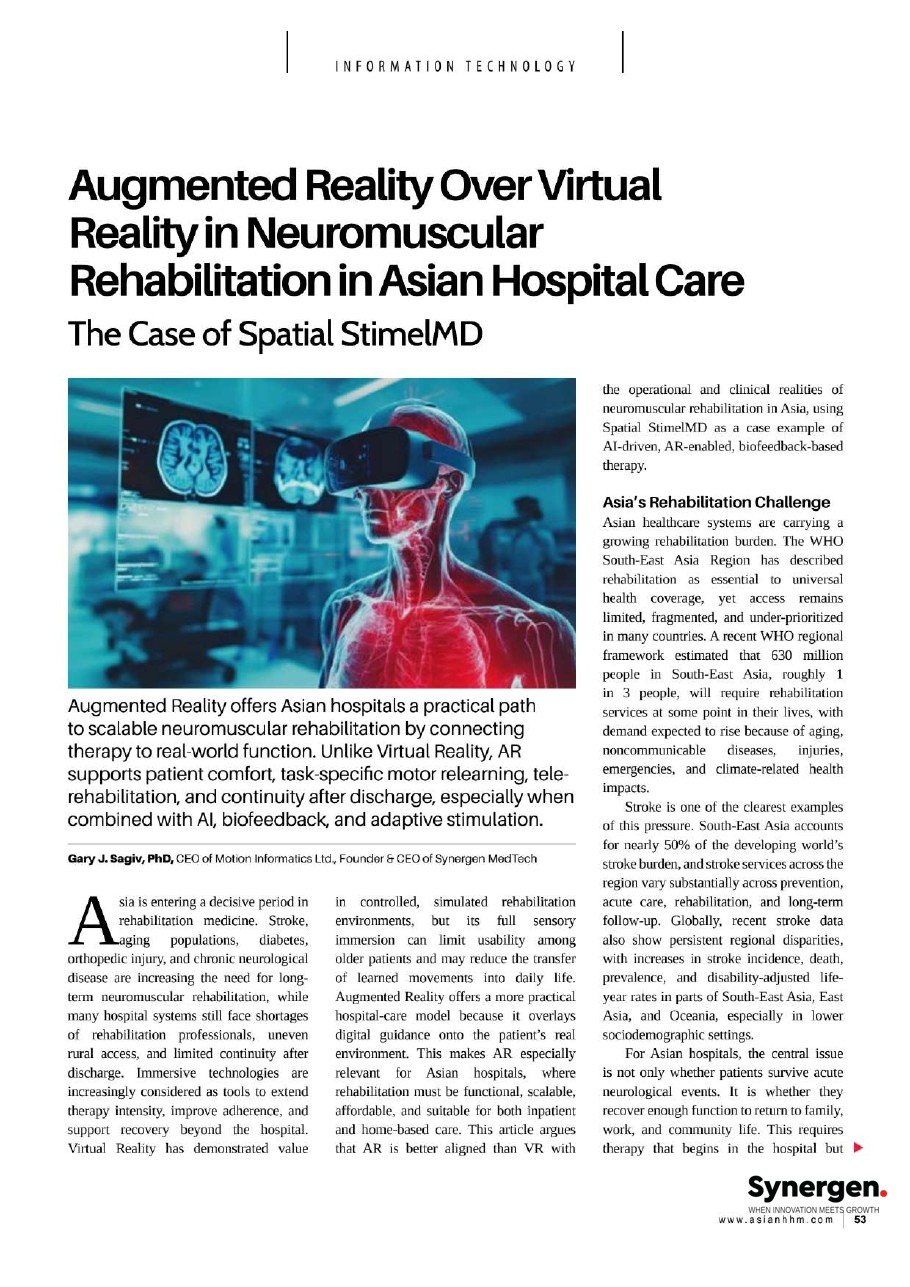
    Our founder, Gary J. Sagiv, has a new article in Asian Hospital & Healthcare Management, Issue 74, on pages 53 to 55. It is called “Augmented Reality Over Virtual Reality in Neuromuscular Rehabilitation in Asian Hospital Care: The Case of Spatial StimelMD”.

    The article asks a practical question for hospital leaders across Asia. Rehabilitation demand is rising faster than the number of therapists, so which technology can actually deliver functional recovery at scale? Gary’s answer is that Augmented Reality often suits neuromuscular rehabilitation better than Virtual Reality, because it keeps patients connected to the real world while they practise real tasks, it is more comfortable for older patients, and it is easier to use in busy hospital wards. Combined with AI and biofeedback, it can support therapy both in the clinic and at home.

    Our thanks to Debi Jones and the editorial team at Asian Hospital & Healthcare Management for their support.

    You can download the full article as a PDF below, or read the issue on the journal’s site through the Magazine page (https://www.asianhhm.com/magazine) and the Archives page (https://www.asianhhm.com/archives).

    Download the article (PDF)

    If you’d like to follow along, you can find us here:

    Website: synergenmedtech.com
    LinkedIn (Synergen page): linkedin.com/company/100981535
    YouTube: youtube.com/@synergenmedtech

  • Why Asian Hospitals Say They Want Innovation, Then Refuse to Adopt It

    Why Asian Hospitals Say They Want Innovation, Then Refuse to Adopt It

    Over the past 30 years, I have sat across the table from hundreds of hospital executives, physicians and healthcare decision-makers throughout Asia.

    One thing has always fascinated me.

    Almost every hospital wants to be innovative. CEOs talk about digital transformation, AI, robotics and the latest medical technologies. Innovation appears in strategic plans, conference presentations and hospital websites.

    But when someone actually arrives with a technology that could change how patients are treated, things suddenly become complicated.

    The clinical team is interested. The department head is enthusiastic. Management agrees that the technology has potential.

    And then comes the familiar sentence.

    “We’ll need to discuss this internally.”

    Sometimes that discussion takes months. Sometimes years. Sometimes it never happens.

    So here is my question: If hospitals genuinely want innovation, why is introducing it so difficult?

    Everyone wants innovation. Nobody wants the disruption.

    I think part of the problem is that we confuse buying new technology with adopting innovation.

    Buying a new MRI system, for example, may be a major financial decision. But the hospital already understands what an MRI does, who operates it, how patients are referred and, in many cases, how the service generates revenue.

    Now introduce a technology that changes how a rehabilitation department treats patients.

    Suddenly, the questions are different.

    Who will operate it? Will the therapists need retraining? Does it change the number of patients treated each day? Who is responsible if something goes wrong? Will physicians refer patients? Does the hospital get paid for using it?

    And perhaps the most important question, although it is rarely asked openly:

    Who is going to take responsibility for making this change happen?

    A technology can be clinically excellent and still create a management headache.

    That is something many of us in the MedTech industry fail to appreciate.

    The physician loves it. The hospital does not buy it.

    I have experienced this situation more times than I care to remember.

    You demonstrate a medical device to a physician. They immediately understand its clinical potential. They ask intelligent questions, discuss possible patients and sometimes even offer to help with a clinical evaluation.

    You leave feeling you have made real progress.

    Then you discover that the physician does not control the budget.

    The department head may support the purchase but needs approval from management. Management wants financial justification. Procurement wants competitive quotations. Finance wants to know when the investment will pay for itself.

    And nobody seems to own the decision.

    This is not necessarily bureaucracy for the sake of bureaucracy. Hospitals have competing priorities, limited resources and responsibilities that go far beyond one department.

    But from the perspective of the MedTech company, it can feel like running a marathon without knowing where the finish line is.

    Clinical enthusiasm is not the same as institutional commitment.

    I have learned that if you do not understand the hospital’s decision-making structure, you are not really selling. You are just demonstrating.

    Hospitals do not buy technology. They buy solutions to problems.

    Let me give you a few examples.

    Imagine a rehabilitation department where patients wait weeks to begin treatment. The therapists are overloaded, and management is struggling to increase capacity.

    You arrive with an advanced rehabilitation system incorporating AI, biofeedback and sophisticated algorithms.

    You explain the technology. You show the clinical studies. You demonstrate the software.

    Everyone is impressed.

    But have you answered the hospital’s problem?

    Can the department treat more patients? Can therapists supervise treatment more efficiently? Can some patients continue therapy at home? What additional costs will the hospital incur?

    Now consider a sleep laboratory with patients waiting months for diagnostic studies.

    The CEO may not be particularly interested in how sophisticated your sensors are. What matters is whether your solution can reduce waiting times, increase diagnostic capacity and fit within existing reimbursement arrangements.

    Or take a hospital purchasing imported cardiovascular devices. The technology may be excellent, but if inventory costs are too high, management may be reluctant to keep products in stock.

    These are not theoretical commercial considerations. They are the kinds of problems that determine whether medical technology is actually adopted.

    The question is not whether your device is better. It is whether the hospital becomes better by using it.

    The hidden cost of change

    MedTech companies spend enormous amounts of money on product development, clinical trials and regulatory approvals.

    We calculate manufacturing costs, distributor margins, selling prices and expected revenue.

    But how often do we calculate the cost of change for the hospital?

    A new technology may require training 20 therapists, modifying treatment protocols, integrating software, educating referring physicians and reorganising patient schedules.

    Somebody has to manage all of that.

    And while the MedTech company sees an exciting new opportunity, the hospital administrator sees another project competing for already limited staff time.

    I sometimes think we underestimate how difficult it is to change established clinical habits.

    Physicians and therapists have developed methods they trust. They understand their limitations, but they also know what to expect.

    Introducing something new means asking them to move away from familiar routines.

    That takes more than a demonstration and a few published clinical studies.

    It takes leadership, training, trust and a clear reason to change.

    The CEO says yes. The department says no.

    Here is another uncomfortable reality.

    Even when senior management supports innovation, the people expected to use it may not.

    A hospital CEO might decide that introducing a new rehabilitation technology is strategically important.

    But if the therapists believe it will increase their workload, complicate treatment or reduce their professional autonomy, implementation can become very difficult.

    The opposite happens too.

    A department may desperately want new equipment, but management sees no convincing financial justification.

    Both sides may have perfectly reasonable arguments.

    The problem is that MedTech companies often approach one group and assume the others will follow.

    They will not necessarily.

    Successful adoption requires clinical, operational and financial agreement. Getting one out of three is not enough.

    MedTech companies are part of the problem

    I do not think we can blame hospitals for everything.

    Our industry has developed a habit of falling in love with its own technology.

    We talk about patents, algorithms, technical specifications, clinical superiority and regulatory milestones.

    All important, of course.

    But sometimes I wonder whether we are actually listening to the people we are trying to sell to.

    When a hospital tells us that implementation is difficult, we explain why our technology is worth the effort.

    When management says the price is too high, we show more clinical data.

    When therapists say they do not have time, we offer another demonstration.

    Perhaps we should stop talking for a moment and ask what would make adoption easier.

    Could we introduce the technology gradually? Could we train a smaller clinical team first? Could we demonstrate its effect on workflow and treatment capacity? Could we offer a commercial model that reduces the hospital’s initial financial exposure?

    And, most importantly, could we work with hospital management to establish clear measures of success before the technology is introduced?

    Innovation should not require a hospital to solve all the problems created by the company selling it.

    A message to hospital CEOs

    I also believe hospital leadership needs to take greater responsibility.

    If innovation is genuinely a strategic priority, it cannot remain a slogan.

    Someone must be responsible for evaluating new technologies, bringing together clinical and financial stakeholders and making decisions within a reasonable timeframe.

    Not every technology deserves to be adopted. Many do not.

    But a hospital should be able to distinguish between a product that lacks clinical or economic value and one that offers genuine benefits but requires organisational change.

    Rejecting a technology because it does not work is one thing.

    Rejecting it because nobody wants to change the way things have always been done is quite another.

    And this matters particularly in Asian healthcare systems facing growing patient demand, workforce pressures and uneven access to specialised services.

    Hospitals cannot solve every capacity problem simply by buying more equipment or hiring more people.

    Sometimes the way care is delivered has to change.

    Innovation is a management decision

    After three decades in MedTech, I have become convinced that developing innovative technology is often easier than getting healthcare organisations to adopt it.

    That does not mean hospitals are wrong or MedTech companies are right.

    It means both sides need to understand that innovation is not simply a product.

    It is a change in how people work, how patients are treated and how resources are managed.

    For MedTech companies, the lesson is to stop selling features and start solving the hospital’s problems.

    For hospital CEOs, the challenge is to create an organisation capable of evaluating and implementing worthwhile change, rather than simply celebrating innovation in its annual report.

    Because a hospital that talks about innovation but cannot implement it is not necessarily innovative. It is just very good at talking about it.

    And in my next article, I am going to leave the hospital boardroom for a while and talk about something equally important when doing business in Asia: food, dress codes and the cultural mistakes that can damage a relationship before you have even opened your presentation.

    If you’d like to follow along, you can find us here:

    Website: synergenmedtech.com
    LinkedIn: linkedin.com/company/100981535
    YouTube: youtube.com/@synergenmedtech
  • USA and EU Are Not Always First: Think Outside the Continent

    USA and EU Are Not Always First: Think Outside the Continent

    When medical technology founders talk about going international, the conversation almost always begins with two places: the United States and the European Union. I understand why. They are large and wealthy markets, they set the regulatory standards that much of the world follows, and investors like to see them in a plan. But over many years of international business development, I have come to believe that the USA and EU are not always the right place to start, and that some of the most rewarding markets for a young company sit in Asia, Latin America and other regions that rarely appear on the first slide.

    This is not an argument against the big markets. It is an argument for thinking more widely about the order in which you approach them.

    Why the USA and EU are hard places to begin

    The United States has one of the most complex payment systems in the world, and a cleared device can wait a long time before clinicians have a reliable way to be paid for using it. Competition is intense, buyers have seen many products, and building a credible presence usually requires a local team or partners, which is expensive for a company that is still small. Europe has its own challenges. The Medical Device Regulation has made the road to a CE mark longer and more demanding than it used to be, and once you have it, you still face many different health systems, languages and purchasing practices under one regulatory roof. In fact, many manufacturers and entrepreneurs I have spoken to in the last few years have decided not to enter the EU or seek CE marking under the MDR because of the costs and complexity, and, you know what, I totally agree with them.

    The world can also change around you. In April 2025 I wrote a preliminary review of the new American tariffs on imported medical devices, and one of my conclusions was that non-US competitors, particularly in Europe and Asia, were positioned to benefit, while price sensitive markets such as Latin America and Southeast Asia would become more competitive. I noted at the time that in government tenders in countries such as India, Brazil and South Africa, even a small price difference can disqualify a bid. Whatever has changed in the details since then, the lesson has stayed with me: a company that depends on one or two markets is exposed to decisions it cannot control.

    Asia: large needs, fast decisions and real relationships

    I have spent a large part of my career in Asia, and it has taught me that many Asian markets combine enormous clinical need with a genuine openness to new technology. India has well over a billion people and a rich pool of talented and skilled healthcare professionals. After one visit to IIT and AIIMS I wrote that India is no less a start up nation of its own, and any foreign company that arrives assuming it is bringing something the country has never seen will quickly find that it is talking to people building advanced technology themselves. Most marketing executives do not understand that when you sell to India, you are not selling to 1.2 billion Indians but rather to 300 to 400 million people, similar in size to the population of the USA. Selling to India, though, is a completely different kettle of fish, and I will explain it in detail in another article.

    Southeast Asia has been just as instructive. In Indonesia, the world’s largest Muslim majority country, a company I represented received import clearance for its device through the patient work of a local partner who knew the system and stayed with the process until it was done. When it finally came through, I wrote on LinkedIn that I rarely feel so proud, and I feel it was one of my best moments (that partner is a true partner, through good times and bad)! In Thailand this August I had the honor of representing Israel at Corporate Spark 2026 in Bangkok, hosted by the National Innovation Agency, which brought together 24 global startups, and it showed me how actively some Asian governments look for foreign innovation. Japan is a very different market again, with a careful and structured way of evaluating new partners, and I will come back to what it taught me later in this series.

    Smaller Asian markets deserve attention as well. On one visit to Sri Lanka I fitted seven meetings into a single trip, including one with the healthcare arm of a conglomerate with more than eighty years of history that most people in the country know as an importer of cars. In recent years that group has brought its medical activities together under a single identity and expanded into medical devices and hospital equipment. When long established local groups start investing seriously in healthcare, it tells you that the market is changing, and it often means there are capable partners looking for new products.

    Latin America and beyond

    Latin America is another region that founders often overlook, partly because of language and partly because each country has its own regulator. In my experience the right local support makes a great difference there. When a company I represented began working in Argentina, the Israel Economic Mission played an important part in our first steps there, and I wrote formally to its head to thank him, because his understanding of the local market had been instrumental. We went on to talk with Israel’s missions in other Latin American countries as well, and the experience convinced me that a region many people consider difficult can be approached step by step with the right help. I have worked in Mexico as well, and across the region I have found that a well prepared registration file and a committed local partner open doors that a foreign company could never open alone.

    Australia is a different case again. When I visited Melbourne and Sydney in 2025, looking for partners to distribute a medical technology, I told a local newspaper that I was thinking of rural communities where a patient might have a therapist a couple of hundred kilometers away and see them once a month. Geography like that creates needs that technology can genuinely help with, and it shapes the market in ways that a plan built for Europe would miss.

    How to think outside the continent

    None of this means skipping the United States or Europe. For many devices they will be essential, and an FDA clearance or CE mark is often what makes registration elsewhere possible in the first place. Many regulators in Asia and Latin America take an existing major clearance into account, so the sequence can be designed to use one clearance as the base for several markets at once.

    What it does mean is looking at the whole map before deciding the order. A market where a committed partner is ready, where the regulator is reachable, where the need is visible and where you can afford to be present may teach you more, and earn you more credibility, than a slow and expensive first year in a market where you are one of hundreds of newcomers. Revenue and reference sites from those markets can then support the larger effort in the United States and Europe, rather than the other way round.

    At Synergen, I help medical technology companies look at that whole map with fresh eyes. If you have only ever considered the USA and EU, I would be glad to talk about what else might fit your device. Write to me at gary@synergenmedtech.com and tell me about your commercialization or international business development challenges. In the next article, I look at whether you should sell directly or through distributors once you have chosen your markets.

    All names of people and partners have been removed for privacy reasons.

  • Asia Is Not One Market. Why Do Western Healthcare Leaders Keep Treating It Like One?

    Asia Is Not One Market. Why Do Western Healthcare Leaders Keep Treating It Like One?

    As I sit here in China, something has finally struck me. After more than 30 years of living, working and travelling across Asia, I am beginning to understand just how much I still have to learn.

    I have lived in India and China and worked across nearly 30 other Asian countries, meeting hospital executives, physicians and distributors. I have negotiated deals, built partnerships, celebrated successes and made some expensive mistakes along the way.

    And yet one lesson keeps coming back to me: Western healthcare and MedTech leaders continue to treat Asia as one market. It is not. Not even close.

    I have been guilty of making assumptions myself. I thought that years of experience meant I understood how business was done. What I sometimes underestimated was the culture behind the decisions.

    Japan is not Thailand. Vietnam is not Indonesia. Hong Kong is not Mongolia. China is not Bhutan. Each has its own healthcare system, business practices and expectations.

    Culture is not an afterthought in Asian MedTech. It is where the strategy begins.

    A friendly meeting is not a purchase order

    India taught me an expensive lesson.

    I remember leaving hospital meetings convinced we had a deal. Physicians were enthusiastic, management was positive, and even the distributor was confident.

    Then nothing happened. Emails went unanswered. Purchase orders never arrived. I had mistaken enthusiasm for commitment.

    Sometimes people are simply being polite. Sometimes they genuinely like the technology but lack purchasing authority. And sometimes saying no is uncomfortable.

    So I changed my approach. Instead of asking whether they liked the product, I started asking who controlled the budget, who made the final decision and what would happen next.

    A meeting with a clear next step is worth more than a room full of compliments.

    One product, three very different markets

    In Thailand, I spent an entire day at a private hospital that was competing for international patients. Its management wanted to invest in advanced technology to differentiate its services.

    The following day, I visited a public hospital treating significantly more patients. Its management recognised the same clinical benefits but faced very different procurement restrictions.

    It was the same technology, in two hospitals, with two completely different commercial realities. I had to rethink my entire approach. One hospital was looking for a competitive advantage; the other needed a solution that could work within its procurement system. The same sales pitch simply would not work for both.

    Vietnam, a country often overlooked by Western MedTech companies, has enormous patient volumes. But clinical need does not automatically translate into purchasing power. We quickly realised that demonstrating how our technology could increase treatment capacity was far more persuasive than discussing technical specifications. We changed our pitch (and lowered our price), and the results were excellent. Our local partner was instrumental in making that happen.

    Indonesia is another market that Western companies frequently overlook. In my experience, it offers tremendous opportunities and some exceptional business partners. But selling equipment in Jakarta is one thing. Maintaining it, training clinicians and supplying consumables across thousands of islands is another.

    Here, our approach focused on accessibility, reliable support and building a relationship with a trusted local partner. The right partnership can also create opportunities in neighbouring markets such as Malaysia and Myanmar.

    The mistake Western companies repeatedly make is selling the same product using the same business model in fundamentally different markets.

    We learned to adapt, and to change our financing, training, service and implementation strategies to reflect local realities.

    Advanced hospitals can be your toughest customers

    Singapore, Japan, China, South Korea and Hong Kong have sophisticated healthcare systems. But sophistication does not guarantee accessibility. Japan may require extensive evaluation and institutional consensus. In South Korea, reimbursement can determine commercial viability. In Hong Kong and China, an enthusiastic physician does not necessarily control purchasing decisions.

    Even excellent international clinical evidence may not be enough. Hospitals may require local validation, economic justification or changes to existing clinical workflows.

    Proving your technology works is only half the job. You must prove it works within the hospital’s clinical and financial reality.

    Mongolia: what does innovation really mean?

    During COVID, I visited Mongolia under exceptional circumstances, when I was the only foreigner permitted to enter the country. I even had the opportunity to meet the country’s Health Minister. The experience reinforced something our industry often overlooks.

    In a country with vast distances and limited access to specialised healthcare outside major cities, portability, reliability and technical support may matter far more than sophisticated features.

    Imagine two clinical devices. One offers advanced capabilities but requires highly trained operators and constant technical support. The other is simpler, portable and reliable enough to operate in smaller facilities.

    Which delivers greater value?

    Perhaps the most innovative device is not the one with the most features. It is the one that actually reaches the patient.

    Hospitals love innovation, until it requires change

    Asian hospital executives love talking about innovation. It appears in strategic plans, conference presentations and annual reports. But implementing innovation often means retraining staff, changing workflows and challenging established practices.

    I visited a private hospital in Nepal that had invested in impressive diagnostic equipment while continuing to use traditional rehabilitation methods. The contrast was striking. Investing in diagnostic technology strengthened an existing service, while introducing new rehabilitation technology would have meant changing how the department operated.

    Hospitals often prefer technology that improves what they already do over technology that changes how they do it.

    But MedTech companies are equally responsible.

    We spend millions developing technology, obtaining regulatory approvals and demonstrating clinical benefits. Then we arrive expecting hospitals to recognise how brilliant our products are.

    Why should they reorganise themselves around our technology? Instead, we should be asking what keeps hospital management awake at night.

    Are rehabilitation departments overloaded? Are patients waiting nine months for sleep studies?

    Are imported Western stents so expensive that hospitals avoid holding inventory and order them only when needed? Are stroke patients reaching hospitals within the critical treatment window for thrombolysis, or is an earlier warning and referral system needed?

    These are real clinical, operational and commercial challenges.

    Hospital CEOs want better outcomes, greater efficiency and financial sustainability. Physicians want clinical value without unnecessary complexity. And at the same time we are talking about AI, robotics and algorithms.

    Perhaps hospitals are not rejecting innovation. Perhaps they are rejecting the additional problems that come with it.

    The successful approach starts with understanding the hospital’s problem, not demonstrating the product.

    Asia doesn’t need another MedTech sales pitch

    Appointing a distributor, translating a presentation and adjusting prices is not a market-entry strategy. Nor does a hospital’s enthusiasm for innovation mean it is prepared to adopt it.

    Success in Asian MedTech is not necessarily about having the most advanced technology. It is about understanding the culture, the people and the problems well enough to make that technology work.

    After more than 30 years, I am still learning. And perhaps that is Asia’s most valuable lesson:

    The moment you believe you understand Asia is probably the moment you are about to make your next expensive mistake.

    And if you think understanding the market is difficult, wait until you try to understand why hospitals that desperately need innovation are so reluctant to adopt it. That is a story for my next article.

    If you’d like to follow along, you can find us here:

    Website: synergenmedtech.com
    LinkedIn: linkedin.com/company/100981535
    YouTube: youtube.com/@synergenmedtech
  • How to Select the Right International Market for Your Medical Device

    How to Select the Right International Market for Your Medical Device

    When founders show me their international plans, there is often a map with a lot of flags on it. I understand the instinct, because the need for good medical technology is everywhere and every country looks like an opportunity from a distance. But international market entry for a medical device is expensive in time, money and attention, and a small company can usually do only a few countries properly at once. Choosing which ones, and in what order, is one of the most important commercial decisions a young company makes.

    I have worked on products that reached customers in 117 countries, and I have learned that the right first market is rarely the biggest one or the most exciting one. It is the one where the clearance you hold, the money that pays for care and the people who will actually sell for you all line up. This is where a phrase I learned nearly 25 years ago from a consultant makes the most sense: make friends before you need them. It is also where Synergen can help, because we already have the friends!

    Start with the clearance you already hold

    The first filter is regulatory, and it is the one founders most often leave until too late. Every market has its own registration process, and some of them take far longer than anyone expects. If your device already has an FDA clearance or a CE mark, it makes sense to look first at the markets that accept or rely on that clearance, because sales can begin sooner while longer registrations run in the background. Remember, though, that outside the USA an FDA clearance is only the start of the process, and today it is becoming much harder to enter many countries, because local registration is more demanding than ever.

    I also encourage companies to build one master regulatory file from the beginning. When the core documentation is kept in one place and kept current, each new country becomes a gap analysis rather than a completely new project, and that changes the economics of entering the third, fifth and tenth market. Many years ago, on behalf of a company I represented at the time, I published a notice on LinkedIn looking for a Chinese regulatory expert with experience of submissions to the Chinese authority, because it was clear that some markets simply cannot be approached without real local regulatory knowledge. That is worth knowing before a country goes on the list, not after.

    Who pays for care in your target market

    The second filter is money, and specifically whose money. A device that is reimbursed in one country may have to be paid for out of pocket in another, and that changes everything about price, positioning and the speed of adoption. On a trip through Southeast Asia in 2024 for a Synergen client, I noted that there is very little private pay in Thailand, and in Vietnam I wrote quite bluntly in my report that the regulatory process would be very difficult and long and that price sensitivity was high. Neither observation made those countries wrong for the product, but both meant that the business model had to be designed for them rather than copied from somewhere else. As for Vietnam, I must add in retrospect that, thanks to an excellent distributor we brought on board, we were able to overcome many of those barriers, and it has become one of the best successes for that company.

    At the end of that report I wrote a sentence that I now use with almost every client: we need to ask ourselves if these countries are real, viable opportunities. I asked whether there was a pricing model and a minimum volume that could make the opportunity viable for all parties. I asked which medical devices had already succeeded there, and in what volumes. And I asked how long it would realistically take to get through regulation and then win over doctors and patients. None of those questions had easy answers, but asking them before signing anything saved a great deal of disappointment later.

    International market entry depends on real demand

    Need and demand are different things, and confusing them is one of the most common mistakes I see. A country can have an enormous medical need and still have very little demand for your particular device, because clinicians do not know the technology, cannot be trained on it, or cannot fit it into the way they work.

    An example from my own experience in rehabilitation illustrates the point. In 2024 we ran a small telephone survey of 20 physical therapists, most of them in Bangkok, and only 15 percent of them had ever used robotic rehabilitation products. When we asked why, they talked about cost, lack of training, thin evidence and the fact that the systems could not easily be moved. The need for rehabilitation was obvious, but the survey told us that a company entering that market would have to invest in education and training before it could expect orders. That is the kind of finding that should shape a market plan, and it cost very little to obtain.

    Can you be there in person?

    The third filter is presence, and it is the one that small companies most often overestimate. Every market you enter will need visits, training and attention for years, and a distributor in a country you never visit will eventually stop prioritizing you. Before a country goes on the list, it is worth asking honestly who in your company will travel there, how often, and who will answer the distributor’s questions when the time difference means your office is asleep. If the answer is the same two people who are already covering five other markets, the new country will suffer, and so will the existing ones. My personal rule for success is a minimum of two visits a year, and even better, a visit every quarter if possible, even if it is only for one day!

    Preparation also differs from country to country. Some markets expect a short and precise presentation, others want to see the device working on real patients before they believe anything, and some want months of relationship building before a serious commercial conversation even begins. None of these is better than the others, but each one asks for a different kind of preparation and a different budget of time. If you cannot prepare properly for the way a market makes decisions, it is probably not your next market yet.

    Using the help that already exists

    Founders often do not realize how much support is available for this decision. Export institutes, economic missions in embassies, trade fairs and industry associations all hold knowledge about markets that a small company could never gather alone, and most of them are glad to share it with a company that arrives with good questions. A few phone calls before the ranking is finished can save months of travel later.

    The most useful thing you can do is to turn the map into a short, honest ranking. Put each candidate market through the same questions about clearance, payment, demand and presence, choose two or three that pass, and do those well before adding more. A company that wins two markets properly is in a far stronger position, with investors and with the next distributor, than one with ten signed agreements and no reorders.

    If you are trying to decide where your device should go next, I would be glad to look at the options with you. Write to me at gary@synergenmedtech.com and tell me about your commercialization or international business development challenges. In the next article, I explain why the USA and the EU are not always the right place to start.

    All names of people and partners have been removed for privacy reasons.

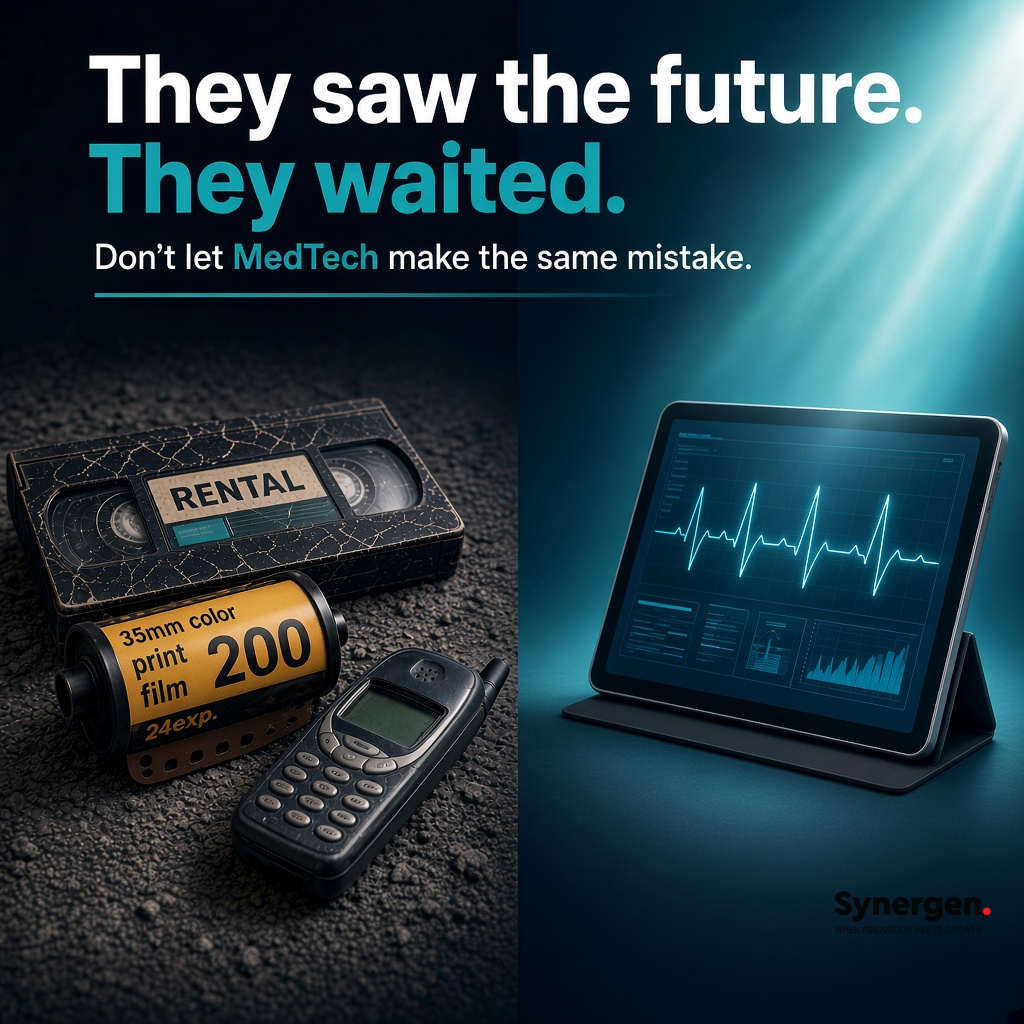
  • They Saw the Future. They Waited.

    They Saw the Future. They Waited.

    Kodak helped invent the digital camera. Blockbuster was offered a partnership with Netflix. Nokia held almost 40% of the world’s phone market. All three saw the future coming, and all three chose to protect what was already working. That one mistake cost them everything.

    I see the same pattern in MedTech all the time. A company has a great product, a loyal group of physicians and a sales model that once worked well. Then reimbursement changes, a competitor moves to home care, or AI changes what buyers expect, and the team waits a little too long because the old way still pays the bills.

    I lived this from the other side. When I opened Itamar Medical’s first US office with the first WatchPAT, there was no CPT code and the sleep societies opposed home sleep testing. The market looked closed. We bet on where care was going, not where it was, and that bet paid off.

    That is what we do at Synergen MedTech Consultants. We help MedTech companies look honestly at where their market is heading, then build the strategy, the business development plan and the funding to get there first. Sometimes that means rethinking the go-to-market model. Sometimes it means a grant application that pays for the next product. And sometimes it simply means asking the hard question before the market asks it for you.

    The future does not wait. If you would like a fresh pair of eyes on where your company is heading, I’d be glad to talk.

    #MedTech #Innovation #Strategy #BusinessDevelopment #HealthTech

    If you’d like to follow along, you can find us here:

    Website synergenmedtech.com
    LinkedIn linkedin.com/company/100981535
    YouTube youtube.com/@synergenmedtech

  • International Business Development for MedTech Companies: Where Should You Start?

    International Business Development for MedTech Companies: Where Should You Start?

    I was born in South Africa and moved to Israel with my family when I was fifteen, and later I studied and worked in the United States, the United Kingdom, China and India. Living between countries early in life probably explains why international business development has always felt natural to me, but I have learned that it does not feel natural to most medical technology founders. For many of them, going international is something that happens after the product is finished. In my experience, the companies that succeed abroad start thinking about it much earlier, and they start in a more modest and more deliberate way than most people expect.

    So in this second article of the series I want to answer the question founders ask me most often once they accept that a good product is not enough: where do we actually start?

    Why international business development comes early for MedTech

    For companies from a small home market, international business is not a choice. Israel, Cyprus, Greece and many of the smaller EU countries are good examples. Many of them have sophisticated health systems, and Israel in particular has a remarkable number of medical technology companies. But for most of these companies, the domestic market can only ever be a reference site and a place to gather early experience. The real business has to be built abroad, which means international planning belongs in the first business plan rather than in the third.

    Even companies from large markets benefit from thinking internationally early. Regulatory work done with several countries in mind is far cheaper than regulatory work redone later. Clinical evidence designed with the expectations of more than one market in mind travels further. And the relationships that eventually lead to distribution agreements usually take years to mature, so the first conversations should happen long before the first order is needed.

    Start with an honest look at your readiness

    Before choosing any country, I ask a company to look honestly at itself. Is the device cleared somewhere, or close to clearance? Is there clinical evidence that a foreign physician would find convincing? Is there material, in English at least, that explains the product clearly to a distributor who has never heard of you? Is the product stable enough to be supported from thousands of kilometers away? And, perhaps the question founders least like to hear, is there someone in the company with the time and experience to travel, build relationships and follow up for several years?

    A company that answers no to most of these questions is not ready to sign distributors, but it is ready to start learning. That learning stage is valuable in itself. It is the time to attend the right trade fairs, talk to clinicians in two or three candidate markets, understand who pays for care in each of them, and meet potential partners without any pressure to sign.

    Resist the temptation to go everywhere at once

    Many years ago, for a company I represented at the time, I published a short LinkedIn article announcing that we were starting outreach to international distributors in the EU, the US and Asia. Looking at it today, I recognize the instinct very well, because almost every young company has it. You want to be everywhere, because every region looks promising and nobody wants to miss an opportunity.

    The advice I give founders now is to resist that instinct. A small company cannot support partners on three continents at once, and a distributor who feels unsupported quickly loses interest. It is far better to choose a few markets, enter them properly and use the results to earn the next ones. The way you choose those markets is important enough that I have given it its own article, which comes next in this series.

    Build the foundations once

    There are a few things worth building before the first market is chosen, because every later market will rely on them. The first is a regulatory file that is organized so that each new country can be added with a gap analysis rather than a completely new project. The second is a clear and simple commercial story: what the device does, which patients it helps, and why it matters to the person paying for it, told in a way that a distributor can repeat to a hospital. The third is a basic understanding of your own economics, so that you know what price a partner in another country would need in order to make a fair margin.

    None of this needs to be perfect. It needs to exist, because without it every international conversation starts from zero, and partners notice when a company has not done its homework.

    Use networks that already exist

    Founders often underestimate how much help is available at the start. Trade fairs, export institutes, embassies and industry associations exist precisely to connect companies with markets abroad. I serve as Director of Israel for FABA, the Federation of Asian Biotech Associations, whose flagship event, BioAsia, is held every year in Hyderabad, and through that role I see how much an introduction from a trusted network can shorten the first steps into a new region. A warm introduction from someone a distributor already trusts is worth far more than a hundred cold emails.

    The first step is a conversation

    When I describe the international work we do at Synergen, I say that we take a device that works into markets where it sells, one country at a time. The phrase “one country at a time” is deliberate. International business development is built from a long series of conversations, with clinicians, regulators, distributors and buyers, and each of them teaches you something about the next one.

    My PhD was in international law, and people sometimes ask what that has to do with business. More than you might think. Both are about understanding people, competing interests and decisions made under uncertainty, and both reward patience and preparation more than enthusiasm. That is the spirit in which I would encourage any founder to begin: with a few honest questions about readiness, a short list of candidate markets, and the willingness to go and listen before trying to sell.

    If you are trying to work out where your company’s international business should begin, I would be glad to talk it through. Write to me at gary@synergenmedtech.com and tell me about your commercialization or international business development challenges. In the next article, I look at how to choose the right international market for your device.

    All names of people and partners have been removed for privacy reasons.

    Website: synergenmedtech.com | LinkedIn: linkedin.com/company/100981535 | YouTube: youtube.com/@synergenmedtech

  • Why Healthcare Business Development Requires More Than a Great Product

    Why Healthcare Business Development Requires More Than a Great Product

    I have spent about 30 years turning ideas into businesses, most of them in medical technology, and I have worked on more than 20 medical products along the way, from software to cardiovascular and neurological devices. If I had to sum up what those years taught me about healthcare business development in one sentence, it would be a line I wrote on my own website: I have seen excellent technologies fail commercially, and relatively ordinary products become successful businesses, and the difference often has very little to do with the technology itself.

    That is a hard thing to say to an inventor who has given years of their life to a device, and I say it gently. But I think it is the most useful place to begin this series, because almost every other lesson about business development and marketing in our industry follows from it.

    A great product is where the work starts

    Founders usually come to business development after years of engineering, clinical work and regulatory effort, and it is natural for them to believe that the product will speak for itself once it is ready. In most industries a better product does have a good chance of winning. In healthcare it is only the entry ticket. A clinician may love your device and still be unable to use it, because the hospital has no budget line for it, because nobody will pay for the procedure, or because it does not fit into a working day that is already full.

    The people who decide whether a medical device succeeds are many, and they rarely sit in the same room. There is the physician or therapist who uses it, the administrator who controls the budget, the payer who decides whether the treatment is covered, the regulator in each country, and in most international markets a distributor who decides whether your product deserves attention next to everything else they carry. Healthcare business development is the work of understanding each of those people, what they need to hear and what they are risking by saying yes, and then building a path that makes sense for all of them at once.

    What I learned from selling without a code

    My clearest lesson in this came early in my career, when I established and led the US subsidiary of a medical device company I worked for. We built it into a solid business within three years, despite the fact that there was no CPT code for the procedure, which meant that clinicians had no simple way to be paid for using the device. These products had over 50 peer reviewed publications but no direct code. The AMA was against us, the Societies were against us, the leading physicians were against us, because we would cut their income by up to 80%. No one would support us, but we went forward and in the end succeeded and today, these technologies have overtaken the traditional ones.

    People sometimes assume there must have been a clever trick behind that. There was no trick. When the payment system has not caught up with your technology, you are selling clinical value and economics directly to the people who live with the problem every day, one site at a time, and every satisfied clinician becomes the reason the next one agrees to listen. Because of having no code, we could not sell to the traditional market, and had to find alternative markets. Not easy, but we did it and we reached sales in the millions of dollars.

    What that experience taught me was humility about the product. The device was good, but it was the work around it that made the business: understanding how each clinic was run, what it cost them to adopt something new, and which arguments mattered to the person who signed the order. Since then, the first questions I ask about any medical technology are about the world around the device, who will pay for it and what evidence that payer will need to see, because the answers usually shape the clinical study, the price and often the product itself.

    Healthcare business development is built on relationships

    The second thing a great product cannot do on its own is build trust. In my experience, healthcare is one of the most relationship driven industries in the world, because the people buying are responsible for patients, and they are understandably careful about who they let into that responsibility. A hospital department will often prefer a supplier it has known for years over a better product from a company it has never met, and a distributor will think very carefully before putting its own reputation behind a newcomer.

    That means business development in healthcare is slow in a way that can frustrate founders who come from faster industries. Relationships with distributors, hospitals and regulators take years to build, and they have to be started well before you need an order. The companies I have seen do this well begin talking to the people who will eventually buy and sell their product long before the design is frozen, and they keep showing up in person, even when there is nothing new to announce.

    Development and entrepreneurship together

    Some years ago I coined a word for the combination of skills this requires: Developeneurship, a fusion of development and entrepreneurship. Entrepreneurship is the moment of seeing an opportunity, and development is everything that has to happen afterwards for that opportunity to become real. Can you develop the product to the point where it is safe and manufacturable? Can you find customers in markets you have never worked in? And can you survive long enough to build a sustainable business while all of that is happening?

    Very few founding teams are strong at both, and that is no criticism of anyone. Most medical technology companies are started by brilliant engineers and clinicians, and what they usually lack is someone who has already taken a product through clearance and into distribution in several countries. Recognizing that gap early is one of the most valuable things a founder can do, because it changes who you hire, who you ask for advice and how you plan your first years.

    What a business development plan should answer

    In practice, I encourage founders to treat business development as a discipline from the very beginning rather than an activity that starts after launch. A good plan answers a small number of honest questions. Who will pay for this, in each market where you want to sell? What evidence will they need to see? Which markets come first, and why those? Who will sell the product there, and what will they need from you to do it with confidence? And who in your company has the time and experience to build those relationships over several years?

    None of these questions has a quick answer, and most young companies cannot answer all of them on the day they start. That is perfectly normal. What matters is that they are asked early, while there is still time to shape the product, the study and the budget around the answers. Has it always worked for me? Absolutely not. I have had successes and failures, and more unexpected challenges than I care to remember, but almost every failure I have seen, my own included, began with a belief that the product would be enough.

    Over the next articles in this series I want to follow that path step by step, from deciding where to start internationally, through choosing markets, partners and commercial models, to building the relationships and the launch that turn a good device into a business.

    At Synergen MedTech Consultants, this is the work I do every day with medical technology companies. If your product is ready but the business around it is not yet clear, I would be glad to talk. Write to me at gary@synergenmedtech.com and tell me about your commercialization or international business development challenges. In the next article, I look at where international business development should actually start.

    All names of people and partners have been removed for privacy reasons.

    Website: synergenmedtech.com | LinkedIn: linkedin.com/company/100981535 | YouTube: youtube.com/@synergenmedtech