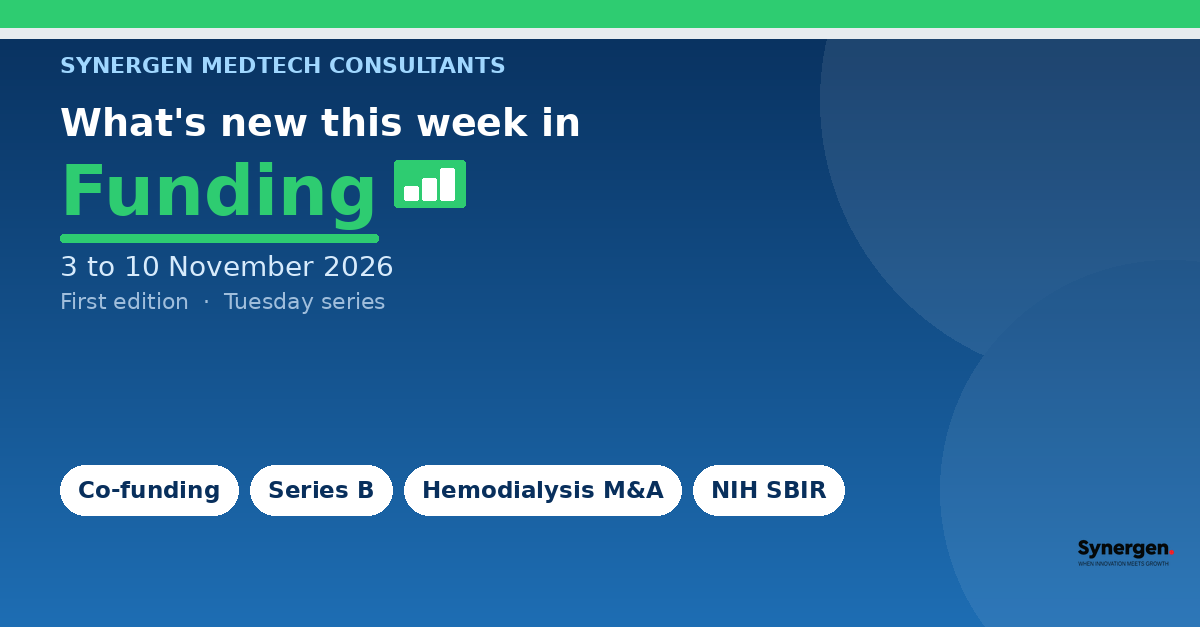
3 to 10 November 2026
This is the first of a new Tuesday series on MedTech funding and deals. It was a heavy week for capital: Boston Scientific and Blackstone agreed a large co-funding package for a heart pump, GE HealthCare led a major Series B for AI robotic imaging in the cath lab, Chinese investors put close to RMB 1 billion into brain computer interfaces, Rockwell Medical agreed to buy a global hemodialysis business, and two listed Chinese device groups took a large strategic stake that may lead to a merger. NIH grants also backed smaller device teams in respiratory monitoring and Parkinson’s neuromodulation.
1. Boston Scientific and Blackstone Life Sciences agree up to $455M to co-fund the Vitalyst heart pump
On 2 November, just as this week opened, Blackstone Life Sciences announced a collaboration under which it will provide up to $455 million to co-fund development of Boston Scientific’s VITALYST Temporary Percutaneous Transvalvular Circulatory Support System for acute myocardial infarction cardiogenic shock. It is the first time the two have co-funded a Boston Scientific product. Blackstone may receive regulatory and commercial milestone payments of up to about 2.5 times the capital it provides, plus royalties on net sales, and Boston Scientific has said it expects to start those payments in 2030. It matters because a capital heavy late stage device programme is being financed by sharing cost with a deep pocketed partner, rather than by a conventional equity round.
Source: Blackstone and MedTech Dive
2. Laza Medical raises up to $160M Series B led by GE HealthCare for AI robotic cath lab imaging
On 4 November Laza Medical, a Shifamed portfolio company based in Los Gatos, California, announced a Series B structured financing of up to $160 million led by GE HealthCare, with returning investors Unorthodox Ventures, PA MedTech and AMED also participating. The money will advance its AI powered robotic imaging system for cardiac interventions. The Laza Medical System is under development and is not approved for commercial sale in any geography. It matters because a large imaging group is putting serious capital behind an AI robotics startup, and it was one of the week’s biggest device financings.
Source: PR Newswire (Laza Medical)
3. Rockwell Medical agrees to buy Vantive’s hemodialysis business for a $125M base price
On 3 November Rockwell Medical (Nasdaq: RMTI) announced an Equity and Asset Purchase Agreement with Vantive Limited to acquire Vantive’s hemodialysis concentrates, HD machines including the AK-98, water treatment systems, and related consumables and technical services, together with Vantive’s one million square foot manufacturing campus in Medolla, Italy. The base purchase price is $125 million, financed through two $50 million term loans from Vantive and a $25 million convertible note, and Vantive may receive up to $45 million more in contingent consideration based on revenue and EBITDA milestones. The combined business is projected to generate annual revenue between $400 million and $450 million, and the deal is expected to close in mid-2027, subject to regulatory approvals and other closing conditions. Vantive’s dialyzer portfolio, including the Theranova dialyzer, is not included. It matters because a focused US dialysis supplier is using an acquisition, largely financed by the seller, to become a much larger global hemodialysis manufacturer.
Source: Rockwell Medical and PR Newswire (Vantive)
4. Zylox-Tonbridge and GL Capital invest about HK$1.482 billion in LifeTech Scientific
On 6 November Zylox-Tonbridge Medical Technology (HKEX: 2190) and GL Capital announced they will jointly invest approximately HK$1.482 billion in LifeTech Scientific (HKEX: 1302) through GL Lighthouse Two Investment Limited, which will subscribe for newly issued shares representing about 16.7% of LifeTech’s enlarged share capital and become its largest single shareholder. Zylox-Tonbridge will hold a 60% stake in Lighthouse Two through an investment of about HK$889 million. In a related transaction, GL Capital will subscribe for 39.8 million newly issued Zylox-Tonbridge shares at HK$22 per share, about 10.8% of the enlarged share capital, at a 13.5% premium to the closing price on the announcement date. Zylox-Tonbridge also intends to pursue a potential merger with LifeTech, with the aim of building an integrated vascular and structural heart intervention platform in China. It matters because two listed Chinese device groups are using a large strategic stake, and a possible later merger, to put peripheral, neurovascular, aortic and structural heart products under one roof.
Source: PR Newswire (Zylox-Tonbridge)
5. Nanochap closes an RMB 500M Series C+ for its retinal vision implant
On 3 November Hangzhou based Nanochap Electronics said it had closed an RMB 500 million Series C+ round led by Gaorong Ventures, with PICC Equity, Monolith, C&D Emerging Investment, Orient Jiafu, Danhe Capital and Hangzhou Industrial Investment Group joining, and existing shareholders including Legend Capital increasing their stakes. It is the company’s second round of 2026 after an RMB 300 million strategic round in May, bringing total funding to RMB 1 billion. Its E-BCI system pairs a 3 by 3 millimetre retinal implant with camera glasses, a registration trial is under way at three hospitals with three patients implanted so far, and the company aims for 30 implants in 2026 and to seek commercial approval in 2027. It matters because vision restoration is becoming its own funded category inside China’s fast growing BCI sector.
Source: Inside BCI
6. Active Technology raises an RMB 464M Angel+ round for invasive BCI
On 4 November Shanghai Active Technology (主动科技), a Lingang Laboratory spinout founded in February 2026, announced an RMB 464 million (about $69.3 million) Angel+ round co led by Gaorong Ventures, SDIC Pilot Fund and Shanghai Science and Technology Venture Capital, with eight new investors and three existing shareholders joining. Together with its RMB 330 million angel round announced on 3 August, it has raised about RMB 800 million (about $119 million) in under three months, which Chinese media describe as a record for the angel stage in China’s BCI field. Its lead product, Tianshu, is a motor BCI aimed at movement and speech loss after stroke, spinal cord injury and ALS, and no human implant has yet been reported. It matters because Chinese investors are now paying later stage prices for very early implantable neurotech.
Source: VCBeat and GS MedTech Funding Tracker
7. Shanghai Yingjiexin closes an RMB 200M Series B for injection pens and autoinjectors
On 5 November Shanghai Yingjiexin Medical Technology (Enjosim Medical) announced an RMB 200 million Series B (about $27.5 million) led by CICC Capital, with Zhuhai Technology Industry Group, CoStone Capital, Qiming Venture Partners and others joining, and existing backer Photon Venture Capital reinvesting. The company makes disposable prefilled pens, reusable injection pens and autoinjectors for biologics such as GLP-1 drugs, insulin and growth hormone, and says the money funds overseas registration and global production capacity. It matters because the GLP-1 boom is pulling Chinese drug delivery hardware makers into global supply chains, where the pharma partner, not the device maker, usually carries the filing.
Source: MedDevice Startups and GS MedTech Funding Tracker
8. OSSTEC closes $8M to take its cementless partial knee toward first US cases
On 3 November London based OSSTEC, a 2021 spinout from Imperial College London, announced it had closed $8 million led by EMBRYO Ventures, with participation from Neovate Capital, New Wave Ventures, Oxford Technology Innovation Finance and Empirical Ventures. The capital will take ASCENT, its cementless fixed bearing partial knee system, and its CLARITY instrumentation through FDA clearance to first in human procedures in the United States, planned for the first half of 2027, and will also advance a 3D printed fixation platform. ASCENT and CLARITY are not cleared by the FDA and are not available for sale in the United States. It matters because European orthopedic innovation is still finding the capital to cross the Atlantic, one clearance and one first case at a time.
Source: Business Wire (OSSTEC)
9. NIH SBIR awards back respiratory monitoring and Parkinson’s neuromodulation
On 5 November Baltimore based Linshom Medical announced a $3.5 million SBIR Phase 2B grant from the National Institutes of Health, National Heart, Lung and Blood Institute, to add wireless portable continuous respiratory monitoring and to run a multicenter clinical trial on the medical and economic benefits of earlier detection of respiratory decline. On 9 November Cambridge, Massachusetts based Highland Instruments announced a Phase IIB SBIR award from the National Institute of Neurological Disorders and Stroke for ESStim, its noninvasive neuromodulation platform for postural instability in Parkinson’s disease, with about $1.5 million in current year funding and about $1.4 million in recommended future support, for up to about $2.9 million in total, subject to availability of funds and satisfactory progress. ESStim has not been approved by the FDA for a specific clinical indication and is not in commercial distribution. It matters because non dilutive US grant money is still doing real work for smaller device teams, especially where the clinical path is long and a large commercial raise is not yet obvious.
Source: Linshom Medical (EIN Presswire) and Highland Instruments
Gary’s take
What the money is telling us this week is that the biggest cheques are going to hard, capital heavy devices: a late stage heart pump, AI robotic imaging in the cath lab, and implantable brain interfaces in China, some of them still at a very early clinical stage. I also notice how deals are being structured, not only how large they are. Boston Scientific is sharing the cost of Vitalyst with Blackstone rather than carrying the whole programme on its own balance sheet, and Rockwell is buying a global dialysis business largely with seller financing. That tells me boards are looking for ways to move big assets without stretching the equity story too far. In China, Zylox-Tonbridge and LifeTech are using a large strategic stake, and talking about a possible merger, to build a broader vascular platform, which is a reminder that scale and a complete portfolio still matter there. The quieter NIH grants to Linshom and Highland are a useful counterpoint, because not every important programme needs a nine figure round, and non dilutive money remains a serious tool for smaller teams. My advice is to look as closely at the structure of a deal as at the headline number, because that is often where the real signal sits.
Which of these funding stories matters most for your company, and is there a type of deal you would like me to cover in more depth next week? You are always welcome to write to me directly, and you can find more of my articles, and book a short introductory call, at synergenmedtech.com.
If you’d like to follow along, you can find us here:
Website: synergenmedtech.com
LinkedIn: linkedin.com/company/100981535
YouTube: youtube.com/@synergenmedtech
Sources note: all items were found through a public web scan of about 3 to 10 November 2026 and each was checked against the linked source. Amounts and dates are as reported by the companies or the cited media. The Boston Scientific and Blackstone agreement was announced on 2 November, just as this window opened.
Leave a Reply