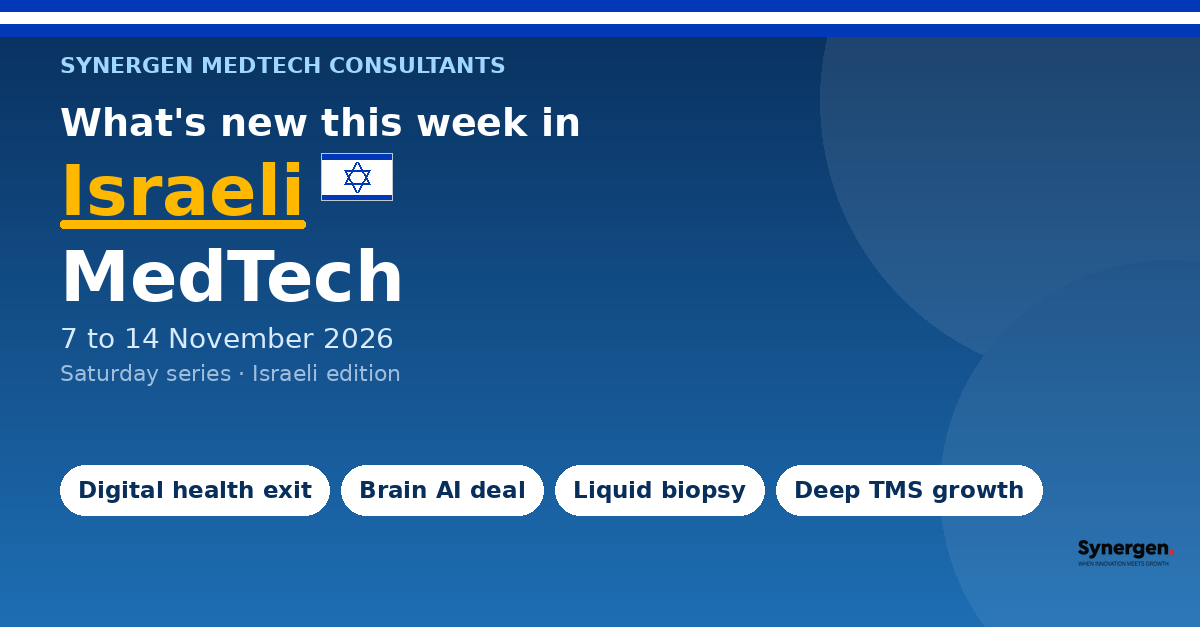
What’s new this week in Israeli MedTech
7 to 14 November 2026
A week of deals, data and a hard lesson. Laguna Health found a US buyer that wants to grow its team in Tel Aviv, a Tokyo company agreed to acquire brain AI pioneer InnerEye, Clalit won Google.org backing for a voice assistant that works over a landline, Weizmann and the Hebrew University published a breast cancer blood test in Nature, BrainsWay and InMode reported their third quarters, Nanox added a reseller in Greece, and Art Medical reminded us how much rides on a single FDA decision.
Deals and exits
1. Elligint Health acquires Laguna Health and plans to double its Israeli team
On 12 November Elligint Health, a New Jersey provider of care management and utilization management technology for US health plans, announced that it has acquired Laguna Health, a conversational AI company for health plan care teams. Ctech reported the deal at an estimated tens of millions of dollars, although the value was not disclosed. Laguna was founded in 2020 by Yoni Stein and Yael Peled-Adam, has raised about $30 million from investors including Pitango, LionBird, Arkin, HC9 and SemperVirens, and will stay in Israel as a wholly owned subsidiary and Elligint’s AI development arm, with Stein remaining CEO. Elligint plans to double the current team of about 20 people in Tel Aviv. It matters because a partnership announced only on 6 October turned into an acquisition within weeks, and the buyer is investing in the Israeli team rather than moving it.
Source: Elligint Health and Ctech
2. Tokyo’s Bio Search agrees to acquire Israeli brain AI company InnerEye
On 9 November Bio Search, a Tokyo developer of biological sensing devices, medical equipment and data analysis platforms, announced a share exchange agreement to acquire 100% of InnerEye, the Herzliya company led by CEO Uri Antman that analyses EEG signals in real time. InnerEye was founded in 2014 by Prof. Amir Geva of Ben-Gurion University and Prof. Leon Deouell of the Hebrew University of Jerusalem. Closing depends on approvals from Israeli authorities and is planned between December 2026 and early January 2027, and Bio Search says it is working toward a NASDAQ listing in 2028. No value or exchange ratio was disclosed. It matters because a Japanese company is choosing Israeli academic science as the core of its global healthcare and brain tech platform.
Source: Bio Search and Unite.AI
Health systems and research
3. Google.org gives Clalit $2 million for an AI voice assistant that works on any phone
On 9 November Google.org awarded Clalit Health Services a two year, $2 million grant to build a conversational AI platform for its roughly five million members. The system will help patients schedule appointments, complete pre visit intake and symptom triage, and receive follow up guidance in multiple languages and regional dialects, and it will work over standard mobile phones and landlines as well as connected devices. Clalit plans a pilot before a national rollout and intends to release parts of the architecture as open source. It matters because Israel’s largest health provider is designing digital access for the patients who usually get left behind, those without a smartphone or a reliable internet connection.
Source: The Jerusalem Post and Ctech
4. Weizmann and Hebrew University blood test detects early breast cancer with 95% accuracy
On 11 November researchers from the labs of Prof. Efrat Shema at the Weizmann Institute of Science and Prof. Guy Ron at the Hebrew University of Jerusalem published in Nature a blood test that reads the epigenetic tags on nucleosomes released into the bloodstream. Tested on samples from 77 breast cancer patients followed for at least five years at the Mayo Clinic in Florida and 30 healthy women, the AI models reached 95% accuracy in detecting early stage breast cancer and 81% accuracy in telling apart patients whose cancer returned from those whose cancer did not. The work was done with physicians at Kaplan Medical Center, and Sheba and Kaplan helped expand the blood sample set to 188 patients. It matters because it is still research, not a clinical test, but it shows strong performance regardless of breast density, which is exactly where mammography struggles.
Source: Weizmann Institute of Science and Nature
Company results and market access
5. BrainsWay grows Q3 revenue 34% to $18.1 million
On 10 November BrainsWay reported third quarter revenue of $18.1 million, up 34% from $13.5 million, with operating income up 107% to $2.6 million, net income of $2.2 million and $6.2 million of operating cash flow. The company shipped 130 Deep TMS systems in the quarter, up 44%, bringing its installed base to about 2,080 systems, and sold 54 OCD coils. It now expects full year 2026 results at the upper end of guidance. It matters because an Israeli neurostimulation company is showing that growing reimbursement coverage and a recurring revenue model can turn into real profitability.
Source: GlobeNewswire (BrainsWay)
6. InMode holds Q3 revenue at $92.1 million with record Asia sales
On 11 November Yokneam based InMode reported third quarter GAAP revenue of $92.1 million, broadly in line with $93.2 million a year earlier, GAAP net income of $18.9 million and a cash position of $512.7 million. Revenue in Asia reached another quarterly record, consumables and service revenue fell 3% to $19.3 million, and the company reaffirmed full year revenue guidance of $365 million to $375 million after an initial launch of Morpheus8 Max. It matters because a mature Israeli aesthetics leader is finding its growth in Asia, while its US capital equipment revenue slipped to $42.7 million from $45.2 million.
Source: PR Newswire (InMode)
7. Nanox appoints Medworks to resell its HealthOST bone health AI in Greece
On 13 November Nanox announced a non exclusive distribution agreement with Medworks for Nanox.AI in Greece, starting with HealthOST, its FDA cleared and CE marked AI software for bone health. The agreement builds on an existing deployment in Athens, and Medworks will provide local sales, technical support, applications and customer service. It matters because adding a local partner with service capability is often what turns a single reference site into a real national presence.
Source: GlobeNewswire (Nanox)
A hard lesson
8. Art Medical turns to the court after an FDA setback
On 10 November Ctech and TheMarker reported that Netanya based Art Medical, which has raised about $100 million since it was founded in 2008, filed for a temporary trustee and a stay of proceedings at the Central District Court. According to the filing, the FDA rejected a submission in October on the pathway for novel devices, after which investors stopped funding, leaving liabilities approaching $15 million. Its smART+ platform for managing nutrition in ventilated ICU patients bolds AMAR approval in Israel, a CE mark and UK registration, and the company employs 53 people. It matters because a product already used in leading Israeli hospitals could not survive without the US market, and that is a risk every founder should plan for early.
Gary’s take
What touches me most this week is the contrast between Laguna and Art Medical. Laguna found a partner, earned its trust over a few weeks of working together and became the AI engine of a larger US group, while Art Medical had a product used in leading Israeli hospitals and still could not continue once one FDA decision went the wrong way. That is why I always tell founders to plan the US regulatory path, and the money behind it, long before they need it. I was also glad to see Bio Search choose InnerEye, because Japanese partners take time to decide and they value deep science, and to see Clalit build AI for the patient who only has a landline, which is what access should really mean.
Which of these Israeli stories matters most for your company, and is there an area you would like me to cover in more depth next week? You are always welcome to write to me directly, and you can find more of my articles, and book a short introductory call, at synergenmedtech.com.
Sources note: all items were found through a public web scan of the week and each was checked against the linked original source.
If you’d like to follow along, you can find us here:
Website: synergenmedtech.com
LinkedIn: linkedin.com/company/100981535
YouTube: youtube.com/@synergenmedtech
Leave a Reply