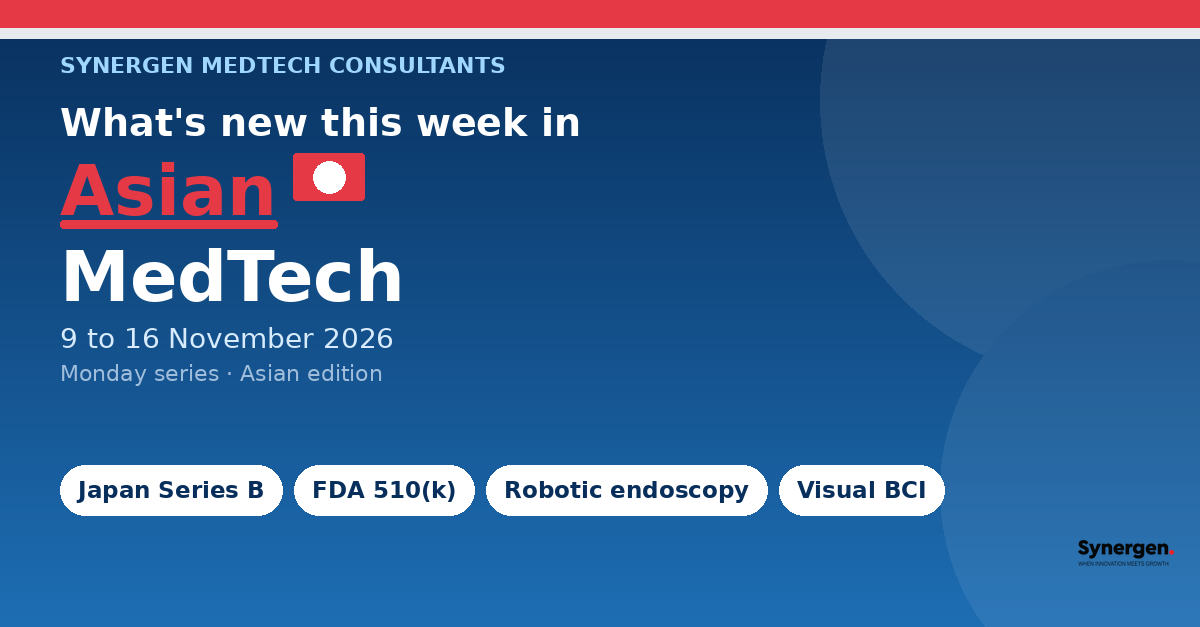
What's new this week in Asian MedTech
9 to 16 November 2026
A week with a strong Japanese and Korean flavour. Boston Medical Sciences raised a large Series B for AI colon cancer screening without laxatives, and Sysmex teamed up with London's Hologen to launch Saibogen, a Singapore based joint venture that reads more from routine blood counts. In Korea, Raywatt won a US FDA clearance and a Series B for its high speed coronary OCT, MedInTech closed a Series C for robotic endoscopy, and Lunit took its imaging AI into a Saudi government health system. Australia's Nanosonics widened its US clearance for endoscope cleaning, and in China, Osmunda raised money to build out medtech development and manufacturing infrastructure while Mingshi passed RMB 500 million in total funding for a visual cortex implant.
1. Boston Medical Sciences raises ¥5.55 billion in a Series B for laxative free AI colon screening
On 13 November Tokyo based Boston Medical Sciences, led by CEO Masaki Okamoto, announced a ¥5.55 billion Series B through a third party share allotment, co led by Japan Growth Capital Investment Corporation (managed by Nomura SPARX Investment), Global Brain and Beyond Next Ventures. The company was founded in April 2023 by physicians teaching and researching at Harvard Medical School and Massachusetts General Hospital, and is developing a "laxative free virtual endoscopy" that uses AI to clean the bowel virtually on CT images and help detect polyps. In Japan it was designated for priority review as software as a medical device and has completed its domestic clinical trial, and in the US it received FDA Breakthrough Device Designation in May 2026 and was accepted into the TAP pilot programme in June. The money goes to R&D, clinical evidence, Japanese and US regulatory work, preparation for launch in Japan and business development mainly in the US. It matters because the biggest barrier to colon cancer screening is the preparation, not the scan, and a Japanese team is tackling it for both home and US markets at the same time.
Source: Boston Medical Sciences press release (PR TIMES)
2. Sysmex and Hologen launch Saibogen, a Singapore based AI joint venture for "blood intelligence"
On 9 November Kobe based Sysmex (President Iwane Matsui) and London based Hologen (CEO Roland Tegeder) announced Saibogen Pte. Ltd., a joint venture incorporated in Singapore on 2 November and led by CEO Leila Luheshi. Saibogen will apply Hologen's Large Medicine Models, generative AI trained on real world healthcare data, to the proprietary data produced by Sysmex hematology analyzers, which run about 3 billion tests a year, to extract new biological insight with no new instruments, reagents or samples. Its products will be delivered as software exclusively through Sysmex analyzers, and its first offerings will be for research use only. It matters because one of Japan's diagnostics leaders is betting that the next value in a mature test sits in the data it already collects, and it chose Singapore as the base to do it.
Source: Sysmex
3. Raywatt wins US FDA 510(k) clearance and a KRW 13 billion Series B for high speed coronary OCT
On 12 November Korean imaging company Raywatt said its FASTER OCT imaging system (RV201) and four single use Chouette imaging catheters received FDA 510(k) clearance on 11 November US time, about nine months after filing. The system spins the catheter 400 times a second to image a coronary artery in about 0.5 seconds, works with saline as well as contrast, and is cleared as a Class II device for imaging coronary arteries of 2.0 to 3.5 mm in patients undergoing interventional procedures. The company says it is the first Korean developed intravascular OCT to win FDA clearance. On 16 November Raywatt added that it had raised a KRW 13 billion Series B from nine investors including InterVest, Life Asset Management and Hyundai Technology Investment, bringing total funding above KRW 23.5 billion, to fund US studies, CE MDR in 2027 and extension of the platform into cerebral vessels. CEO Jinyong Ha called the clearance proof that a Korean OCT has crossed the threshold of the US market. It matters because intravascular imaging is now a Class 1 guideline recommendation in complex stenting, and a new Asian competitor has entered a field long led by a few global players.
Source: Financial News (News1) and Seoul Shinmun
4. MedInTech closes a KRW 33.8 billion Series C to grow robotic endoscopy toward surgical robots
On 16 November Korean startup MedInTech was reported to have closed a KRW 33.8 billion Series C, co led by existing investor Atinum Investment and new investor KB Investment. Founded in 2020, the company commercialised INTION S, a motorised AI endoscope system launched in Korea in June 2026, which cuts the weight of the control section from 610 g to 350 g and the force needed on the control wheels by up to 85%, with AI functions that help steer the scope and keep a lesion centred on screen. Before this round it had raised KRW 28 billion in total private funding up to its 2024 Series B and won large government R&D projects. The new money goes into a wider robotic endoscope line and development of a surgical robot. It matters because flexible endoscopy has been dominated by three Japanese companies for decades, and a Korean team is challenging them through motorisation and physical AI rather than optics alone.
Source: theBell and Pharm Edaily
5. Lunit will supply its imaging AI to Saudi Arabia's Ministry of National Guard Health Affairs
On 9 November Seoul based Lunit announced that it will supply Lunit INSIGHT CXR for chest X ray and Lunit INSIGHT MMG for mammography to Saudi Arabia's Ministry of National Guard Health Affairs (MNGHA), a large government health system with major hospitals in Riyadh and Jeddah. The deployment will run through solutions by stc, the ICT arm of stc Group, as systems integrator, and the AI results will sit inside MNGHA's existing PACS workflow. It builds on Lunit's earlier Saudi work with SEHA Virtual Hospital and Dr. Sulaiman Al Habib Medical Group. CEO Brandon Suh said the aim is to widen access to AI powered cancer screening across the Middle East. It matters because Korean medical AI companies are increasingly winning national scale deals in the Gulf, often through a local integrator.
Source: Lunit
6. Nanosonics secures a second US FDA 510(k) clearance for its CORIS endoscope cleaner
On 11 November Sydney based Nanosonics (ASX: NAN) announced that the FDA had granted a second 510(k) clearance for its CORIS System, an automated cleaner for the internal channels of flexible endoscopes, adding a number of high volume colonoscopes and gastroscopes to the devices it can reprocess. It builds on the earlier De Novo authorisation and a first 510(k) clearance. CEO and President Michael Kavanagh called it an important milestone and part of the planned US launch activities. It matters because channel cleaning is the critical first step in reprocessing reusable endoscopes, and every added scope model widens the market an Australian company can address in the US.
Source: Kalkine (ASX announcement summary) and Market Index
7. Osmunda raises an RMB 100 million Series D to build medtech development and manufacturing infrastructure
On 13 November VCBeat reported that Guangzhou Osmunda Medical Device Technology (奥咨达), the medtech CRO and CXO platform founded in 2004 by regulatory expert Dr. Zhang Feng and Ms. Pan Wei, closed an RMB 100 million Series D, invested solely by the Lishui Green Valley Talent Osmunda fund. The money will build a headquarters manufacturing plant for contract production under China's MAH system, a provincial proof of concept centre and pilot workshop, a global AI platform for medtech innovation and its own medtech large language model, OSMED, and AI agents. The company says it has served more than 5,000 clients and helped obtain more than 2,500 NMPA registrations, 300 FDA registrations and 800 CE certificates. It matters because China's MAH system lets innovators register products without owning a factory, and service platforms that combine regulatory, development and production are becoming core infrastructure for Chinese startups going abroad.
8. Mingshi passes RMB 500 million in total funding for a visual cortex prosthesis
On 10 November Suzhou based Mingshi Naoji Technology (明视脑机), a start up about two years old, said it had closed pre-A and pre-A+ rounds, bringing total funding to more than RMB 500 million (about US$70 million). Round sizes were not disclosed. Shanghai Science and Technology Innovation Group and Minhang district's state owned fund co led the pre-A+ round, and Puhua Capital led the pre-A round. The company is building a visual prosthesis that bypasses the eye and optic nerve and stimulates the visual cortex directly, and says seven investigator initiated human experiments have caused no serious adverse events, with participants perceiving simple shapes. These are company claims, not peer reviewed results. The money is for a 1,024 channel system, registration testing and multicentre trials over the next one to two years. It matters because China's vision restoration BCI field now has well funded players at both the retina and the cortex.
Source: NeuroTechGuide and VCBeat weekly funding roundup
Gary's take
I am writing this from China, and what strikes me this week is how much of Asia's medtech story is now about software and data on top of hardware. Sysmex is not selling a new analyser, it is reading more from the three billion blood counts it already runs. Boston Medical Sciences is using AI to remove the part of colon screening people hate most. MedInTech is motorising a Japanese dominated instrument so that AI can actually steer it. As someone who has spent years around cardiology, I was especially happy to see Raywatt get both its FDA clearance and its Series B in the same week, because that is exactly the combination a young device company needs to start a US journey properly. And from where I sit in China, Osmunda reminds me that the quiet infrastructure behind registration and manufacturing is what lets so many startups move fast. I fly to Japan at the end of the month for my fourth visit, and I am looking forward to hearing these stories first hand. My advice stays the same: in Asia, the winners pair real evidence with the right local partner, one market at a time.
Which of these Asian stories matters most for your company, and is there a country or category you would like me to cover in more depth next week? You are always welcome to write to me directly, and you can find more of my articles, and book a short introductory call, at synergenmedtech.com.
If you'd like to follow along, you can find us here:
Website synergenmedtech.com
LinkedIn linkedin.com/company/100981535
YouTube youtube.com/@synergenmedtech
Leave a Reply