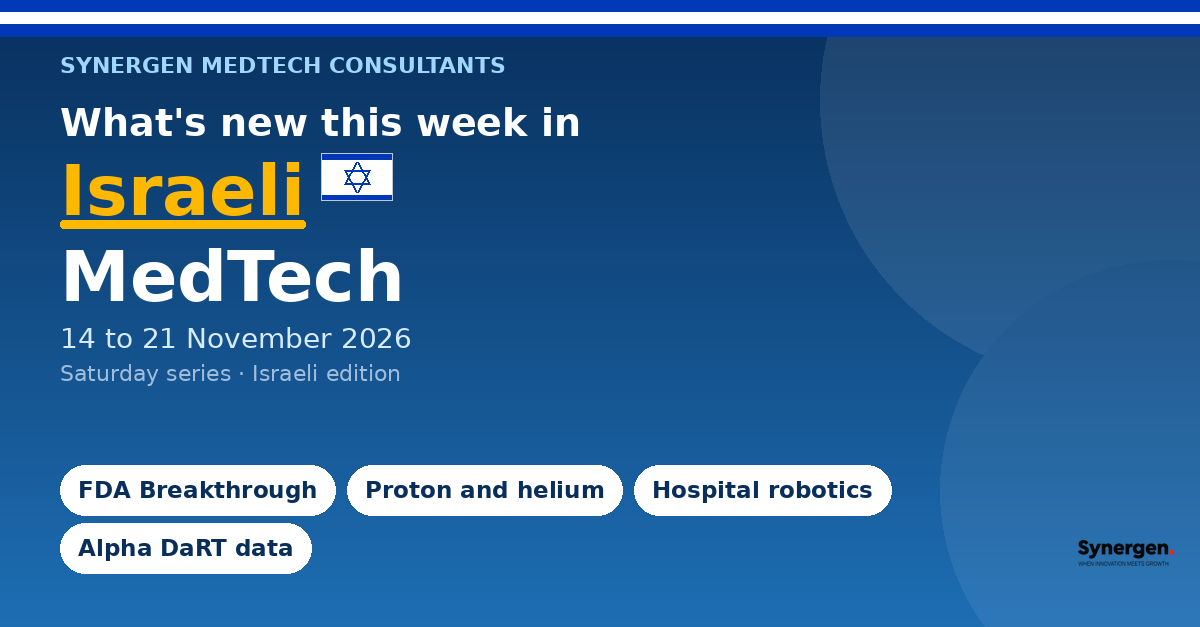
What’s new this week in Israeli MedTech
14 to 21 November 2026
A quieter week for big rounds, but a week full of signals. Biostream won FDA Breakthrough status for a urine test that could find a treatable cause of dementia, P-Cure brought MD Anderson in as a partner for helium ion therapy, Sheba showed what vendor neutral hospital robotics looks like, Meir Medical Center put IVF instructions on the patient’s phone, ALZAI’s Alzheimer’s risk model was reported to have passed 1.6 million patient records, Alpha Tau and IceCure reported their numbers, and Beyeonics Surgical reminded us that great technology still needs a market and the money to reach it.
Regulatory milestones
1. Biostream receives FDA Breakthrough Device Designation for a urine test for a treatable cause of dementia
On 18 November Haifa based Biostream announced that the FDA granted Breakthrough Device Designation, on 12 November, to its urine test for idiopathic normal pressure hydrocephalus (iNPH), one of the few reversible causes of dementia, which is often mistaken for Alzheimer’s or Parkinson’s disease. The test measures a panel of proteins and applies a proprietary algorithm to give a probability score for patients aged 60 and older. Founded in 2025 by CEO Dr. Meital Segev-Bar, Alex Dehtar and neurosurgeon Dr. Daniel Dubinski, the company has raised $1.5 million in pre-seed funding from ICI Fund, HiCenter Ventures and US angels, has clinical studies running with University Medicine Rostock and Rambam Health Care Campus, and, according to Ctech, is raising a $3.2 million seed round alongside an Israel Innovation Authority grant. A prospective validation study at US academic centers is planned for 2027. It matters because a startup with three employees has won priority engagement with the FDA very early, and for this condition the bottleneck is diagnosis, since the company says shunt surgery improves symptoms in 70 to 90% of patients.
Source: PR Newswire (Biostream) and Ctech
Partnerships and hospitals
2. P-Cure and MD Anderson will develop a compact proton and helium ion therapy system
On 15 November P-Cure, whose compact upright proton therapy system is FDA cleared, announced a strategic collaboration with The University of Texas MD Anderson Cancer Center to develop a single platform that can deliver both proton and helium ion treatments. The partners will first evaluate P-Cure’s existing upright proton system and then run preclinical and clinical studies on helium ions. Today only the Heidelberg Ion-Beam Therapy Center in Germany treats patients with helium, so success would mean the first helium particle therapy platform in North America, and the agreement includes payments to MD Anderson tied to clinical milestones and commercial sales. Nearly 200 patients, including more than 30 children, have been treated on P-Cure’s system at Hadassah since 2023, and the company employs 100 people, about half of them in Israel. It matters because a leading US cancer center as a development partner is exactly how you build the evidence regulators and payers will ask for, and the compact upright design goes after the space and cost barriers that keep particle therapy in so few hospitals.
Source: Ctech
3. Sheba runs robots from different makers under one Israeli orchestration platform
On 17 November Gix Internet (Nasdaq: GIXI, TASE: GIX) announced that an Ottonomy autonomous delivery robot has entered service at Sheba Medical Center alongside the hospital’s existing delivery robots, all managed through deliverz.ai, its wholly owned company, whose robot agnostic platform also assigns missions to human couriers. The deployment builds on deliverz.ai’s chemotherapy medication deliveries at Sheba and its recent expansion into blood and bone marrow transport, and the platform is now being introduced to US healthcare organizations under software as a service and robotics as a service models. “The future of hospital logistics automation cannot be dependent on a single robot manufacturer,” said Michal Kaplansky, Sheba’s Head of Innovation for Human Experience, Operations and Logistics. It matters because hospitals are starting to buy the coordination layer rather than one vendor’s hardware, and a live reference at Israel’s largest hospital is what US buyers will want to see.
Source: GlobeNewswire (Gix Internet)
4. Meir Medical Center brings Fertilai into its IVF unit
On 17 November Meir Medical Center, part of Clalit, announced a pilot with Israeli digital health startup Fertilai in its IVF unit, making it the first Clalit hospital to use the system. Patients who agree receive an SMS link to a secure app that puts their treatment instructions, medication and test schedule, and results on their phone, in line with Clalit’s information security standards. Prof. Amir Wiser, head of the IVF unit, said the goal is to give patients peace of mind and a sense of control, without the worry of missing an injection or a test, while nurses spend less time on routine phone calls. It matters because fertility treatment is full of strict schedules and anxiety, and a pilot inside Israel’s largest health provider is the kind of reference a young digital health company needs before it goes abroad.
Source: Maariv
AI and research
5. ALZAI Health’s Alzheimer’s risk model is reported to have passed validation on 1.6 million records
On 18 November TPS reported that ALZAI Health has completed large scale validation of its AI model for identifying people at higher risk of Alzheimer’s disease years before symptoms, using more than 1.6 million patient records from Israel and the United States. The model reads routine blood tests, existing diagnoses and demographic data already in the electronic medical record, without needing brain scans at the first stage. The research began at Clalit’s Beilinson Hospital with Dr. Amir Glik and a team from Ariel University, the company was formed with Mor Research Applications and Ariel Scientific Innovation, and it listed on the TSX Venture Exchange about two months ago, raising about CAD 7.5 million (about US$5.25 million). The US part of the validation, on more than 1.1 million patients, was first announced by the company in July, and ALZAI describes the tool as risk screening, not a diagnosis. It matters because it is screening at population scale with data health systems already hold, and once again Israeli HMO data is the engine behind a global digital health company.
Source: JNS (TPS) and ALZAI Health
Company results
6. Alpha Tau reports strong early glioblastoma data and FDA approval to expand the trial
On 19 November Jerusalem based Alpha Tau Medical (Nasdaq and TASE: DRTS) reported its third quarter and new interim results from the US REGAIN trial of Alpha DaRT in recurrent glioblastoma, presented at SNO 2026: all eight treated patients are alive, median overall survival has not been reached, and the first six evaluable patients showed a 100% objective response rate, including five complete responses, at 6.9 months median follow up. The FDA approved expanding REGAIN from 10 to up to 20 patients, which the company believes may support a market submission, and enrollment of 48 patients across 10 centers in the US, Canada and Israel was completed in the IMPACT pancreatic cancer pilot. Alpha Tau ended the quarter with $99.8 million in cash, deposits and restricted deposits, and reported a nine month net loss of $98.9 million, of which $58.5 million was net financial expenses. It matters because these are very small patient numbers, but an Israeli radiation therapy is now on a defined FDA path in one of the hardest cancers there is.
Source: GlobeNewswire (Alpha Tau)
7. IceCure grows US sales 83% and widens its reach to 21 states
On 18 November Caesarea based IceCure Medical (Nasdaq: ICCM) reported revenue of about $2.6 million for the first nine months of 2026, up 26% from $2.1 million, with US sales of its ProSense cryoablation system up 83% and its US commercial presence growing from 11 to 21 states. The company received approval from China’s National Medical Products Administration to market ProSense as a Class III device, signed an exclusive distributor in the Netherlands, and treated the first patient in its ChoICE post marketing study in low risk breast cancer at West Cancer Center in Germantown, Tennessee. Net loss for the nine months was $12.9 million, compared with $10.8 million, and cash stood at about $8.2 million on 30 September. It matters because US adoption is being built state by state with clinical data behind it, and the China approval opens a door in Asia, although the cash position means the next steps have to be chosen carefully.
Source: IceCure Medical
A hard lesson
8. Elbit spin-off Beyeonics Surgical files for insolvency
On 15 November Ctech reported that Tirat Carmel based Beyeonics Surgical, spun off from Elbit Systems in 2018, asked the Haifa District Court to open insolvency proceedings and appoint a temporary trustee, with debt of about NIS 17.5 million ($5.47 million), most of it shareholder loans, and cash of about NIS 164,700. The company developed a head mounted visor to replace surgical microscopes, sold an ophthalmic visualization system between 2018 and 2021, then shifted to navigation for spinal surgery, which never reached sales, and it could not find an investor or a buyer. The filing also lists a contingent liability of about $1.89 million to the Israel Innovation Authority for grants it received. It matters because a pivot resets the clock on regulation, clinical work and sales, and every pivot needs fresh money behind it.
Source: Ctech
Gary’s take
This week I kept coming back to Biostream, a team of three that went to the FDA early, with a clear clinical question, and came back with Breakthrough status while still raising its seed round. That is the kind of early regulatory thinking I always encourage, because it shapes the clinical study, the investor story and the reimbursement plan all at once. P-Cure did something similar by choosing MD Anderson as its partner, and IceCure’s China approval reminded me how much patient, local work stands behind every door that opens in Asia. Beyeonics is the other side of the story: wonderful technology from Elbit, a pivot from the eye to the spine, and in the end not enough runway, with a grant liability still on the books. Grants are a gift to Israeli founders, my friends, but please plan the whole road, the money, the market and the obligations, before you need them.
Which of these Israeli stories matters most for your company, and is there an area you would like me to cover in more depth next week? You are always welcome to write to me directly, and you can find more of my articles, and book a short introductory call, at synergenmedtech.com.
Sources note: all items were found through a public web scan of 14 to 21 November 2026 and each was checked against the linked original source. Amounts and dates are as reported by the companies or the cited media.
If you’d like to follow along, you can find us here:
Website synergenmedtech.com
LinkedIn linkedin.com/company/100981535
YouTube youtube.com/@synergenmedtech
Leave a Reply