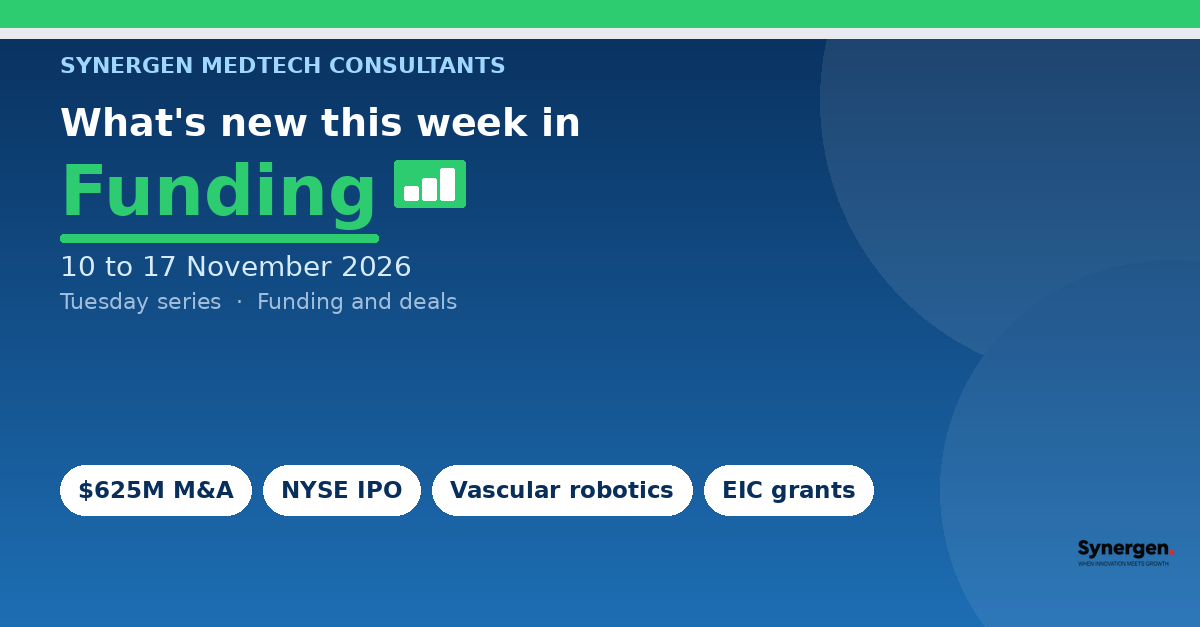
10 to 17 November 2026
This week the money followed two clear lines. Large buyers paid for assets that already reach patients, with Oura agreeing to buy Counsel Health for $625 million in cash and Medtronic moving to acquire Contego Medical, its carotid distribution partner, in a deal valued at $380 million. At the same time, investors kept backing robotics and imaging inside the blood vessels, from Remedy Robotics and Mosaic in the US to Mediintech and Raywatt in Korea. vVARDIS took a dental medtech company onto the New York Stock Exchange, and the European Innovation Council announced a new round of Accelerator grants.
1. Oura agrees to buy Counsel Health for $625M in cash
On 10 November Oura announced a definitive agreement to acquire Counsel Health, an AI native primary care company that combines medical AI with in house physicians, for $625 million in cash, subject to purchase price adjustments. Counsel’s service has been available inside the Oura App, and members can move from an Oura insight to a chat with Counsel’s medical AI and then to a board certified physician who can diagnose, prescribe and refer. Oura said it expects the deal to close before the end of the calendar year, and it reported fiscal fourth quarter revenue of $533 million, up 153% year over year. It matters because a consumer wearable company is spending real cash to own the care that follows the data, not only the data itself.
Source: Counsel Health and TechCrunch
2. Medtronic to acquire Contego Medical in a deal valued at $380M
On 16 November Medtronic (NYSE: MDT) announced its intent to acquire Contego Medical, a privately held company focused on carotid artery disease and peripheral thrombectomy. The deal builds on the exclusive US distribution agreement the two companies first announced in January 2025, and it includes Contego’s recently FDA approved Neuroguard IEP Direct System for transcarotid artery revascularization with integrated embolic protection, as well as its Excipio thrombectomy devices. Medtronic said the acquisition is valued at $380 million with potential payments after closing, and it expects to complete it in the third quarter of its fiscal year, subject to customary closing conditions. It matters because a distribution partnership turned into an acquisition, which is still one of the most reliable exit paths for a focused device company.
Source: Medtronic
3. vVARDIS prices a $175M IPO on the New York Stock Exchange
On 13 November Swiss dental medtech company vVARDIS Holding AG, maker of the Curodont brand of non invasive cavity treatments, announced the pricing of its initial public offering of 9,722,223 Class A shares at $18.00 per share, about $175 million in gross proceeds, with trading on the NYSE under the symbol VVVV from 13 November. Trade press noted that the price was below the $21 to $24 range in the preliminary prospectus, while the number of shares offered was increased. It matters because the IPO window is open for medtech, but investors are still setting the price.
Source: vVARDIS and Securities.io
4. Remedy Robotics raises a $62M Series B for AI enabled endovascular robotics
On 16 November San Francisco based Remedy Robotics announced a $62 million Series B led by DCVC, with new investors UC Investments, Skip Capital and the Australian pension fund Hostplus, and existing investors Build Collective by Tony Fadell, Blackbird, Divergent Capital and KdT Ventures. The money supports a planned pivotal trial in partnership with the University of California, progress toward FDA approval for neurovascular intervention, and deployment of prototype N1 Systems with clinical partners, including SVIN Mission Thrombectomy and the Australian Stroke Alliance. The N1 System is under development and is not available for sale or clinical use in any jurisdiction. It matters because remote and robotic stroke intervention is being funded as a way to reach patients who live far from a specialist centre.
Source: PR Newswire (Remedy Robotics)
5. Mosaic emerges from stealth with a $47M seed round for surgical robotics
On 10 November San Francisco based Mosaic Intelligence Labs came out of stealth with $47 million in seed funding from investors including 8VC, Fundomo, Lingotto Innovation and Obvious Ventures. Founded by Dr. Ileana Pirozzi and Dr. Alison Mackanic, who met during their doctoral studies at Stanford, the company is building sensing enabled robotic systems that give physicians a continuously updated 3D picture of the vessel and the instrument during endovascular procedures, with less reliance on X ray imaging. It matters because a seed round of this size, for a company that has only just come out of stealth, shows how much conviction investors now have in AI guided navigation.
Source: Business Wire (Mosaic) and Guided Solutions
6. Luminoah raises a $25M Series B for its FDA cleared enteral feeding system
On 10 November Charlottesville, Virginia based Luminoah announced a $25 million Series B led by Sandbox Clinical Ventures, with the Blue Venture Fund, GV, Sands Capital, the Texas Medical Center Venture Fund, the CU Healthcare Innovation Fund, the American Gastroenterological Association GI Opportunity Fund and existing investors. The round includes $20 million in new equity and $5 million of converted notes, and it will expand distribution of Luminoah Flow, cleared by FDA in April 2026, through home medical equipment suppliers and health systems, scale manufacturing and develop its clinician data platform. It matters because it is commercial money for a home care device that is already cleared, not another bet on a prototype.
Source: Luminoah
7. EnVision Endoscopy closes an $11.5M Series A with Olympus participating
On 10 November Waltham, Massachusetts based EnVision Endoscopy announced an oversubscribed $11.5 million Series A led by Puma Venture Capital, with UTEC, Olympus Corporation of the Americas and MassVentures, and said it had completed its first 50 patient procedures with the SimpleStitch Suturing System. SimpleStitch received FDA clearance in 2025, works with standard flexible endoscopes, and began a limited US market release in 2026. It matters because a leading endoscope maker is investing early in a tool that could make endoscopic suturing available beyond expert centres.
Source: PR Newswire (EnVision Endoscopy)
8. Korea backs robotic endoscopy and vascular imaging: Mediintech and Raywatt
On 17 November Korean media reported that Mediintech raised KRW 33.8 billion in a Series C co led by Atinum Investment and KB Investment, with Smilegate Investment, SL Investment, ICF (Nextrans), Wooshin Venture Investment and new investor K2 Investment Partners, bringing its total funding to about KRW 62.2 billion. The company sells the INTION S AI robotic endoscope and will use the money to move into treatment and surgical robots, and it plans to close the round with more investment within the year. On 16 November Raywatt announced a KRW 13 billion Series B from nine investors including Intervest, Life Asset Management and Hyundai Technology Investment, taking its total above KRW 23.5 billion, to expand its high speed FASTER intravascular OCT system into neurovascular imaging, pursue FDA clearance and grow overseas. It matters because Korea is producing a steady pipeline of device companies that sell at home and in Asia first and then aim at the US.
Source: Venture Square (Mediintech) and Seoul Shinmun (Raywatt)
9. Osmunda closes an RMB 100M Series D for its medical device CXO platform in China
On 13 November Guangzhou Osmunda Medical Device Technology (奥咨达), founded in 2004 and one of China’s first medical device CRO companies, said it had closed an RMB 100 million Series D, invested solely by the Lishui Lügu Talent Osmunda New Fund. The money will build an MAH manufacturing plant at its headquarters, a provincial proof of concept centre and pilot workshop, and a medical device AI platform with a vertical large language model. The company says it has served more than 5,000 device clients and helped bring more than 3,600 new devices to market. It matters because, under China’s marketing authorization holder system, investors are funding the shared infrastructure that lets small device teams register and manufacture without building everything themselves.
Source: PEdaily and Zhitong Caijing
10. EIC Accelerator selects 35 companies for €84M in grants, and DiaMonTech confirms €2.5M
On 16 November the European Innovation Council announced that 35 start ups and SMEs from 17 countries were selected in its latest Accelerator round, from 453 full applications, with a total proposed grant amount of €84 million and 32 of them to be assessed for EIC Fund equity of up to €10 million each. One example on the list is a microbiome enabled organ on chip company, Sia Cellboxlab from Latvia. On the same day German trade press reported that Berlin based DiaMonTech is receiving €2.5 million from the EIC Accelerator to develop a smartphone sized prototype of its non invasive infrared glucose measurement technology; Enterprise Europe Network reports the grant was signed in September and started on 1 October. It matters because European non dilutive money, often paired with equity, is still one of the best value sources of capital for deep tech medical devices.
Source: European Innovation Council and Monitor Versorgungsforschung (DiaMonTech)
Gary’s take
What the money is telling us this week is that buyers want things that already work in the real world, and they are willing to pay for them. Medtronic is buying Contego after almost two years of selling its products as the exclusive US distributor, which is a reminder that a good distribution deal is often the first chapter of an acquisition, and Oura, a wearables company I follow closely, is paying $625 million in cash to own the care that comes after the ring spots a change. On the venture side, the strongest theme was robotics and imaging inside the blood vessels, with Remedy, Mosaic, Raywatt and Mediintech all raising in the same week, and some of those cheques are going to systems that are still in development and not yet on sale. I was also glad to see vVARDIS get its IPO done, although pricing below the range tells me public investors are open again but still disciplined. For smaller teams, the EIC round and grants like DiaMonTech’s show that non dilutive money remains a serious tool, especially when it is paired with private capital. My advice this week is to think early about who your natural partner or buyer could be, because that relationship often shapes the exit long before the term sheet arrives.
Which of these deals matters most for your company, and is there a type of deal you would like me to cover in more depth next week? You are always welcome to write to me directly, and you can find more of my articles, and book a short introductory call, at synergenmedtech.com.
If you’d like to follow along, you can find us here:
Website: synergenmedtech.com
LinkedIn: linkedin.com/company/100981535
YouTube: youtube.com/@synergenmedtech
Sources note: all items were found through a public web scan of about 10 to 17 November 2026 and each was checked against the linked source. Amounts and dates are as reported by the companies or the cited media; Korean and Chinese amounts are given in local currency as reported.
Leave a Reply