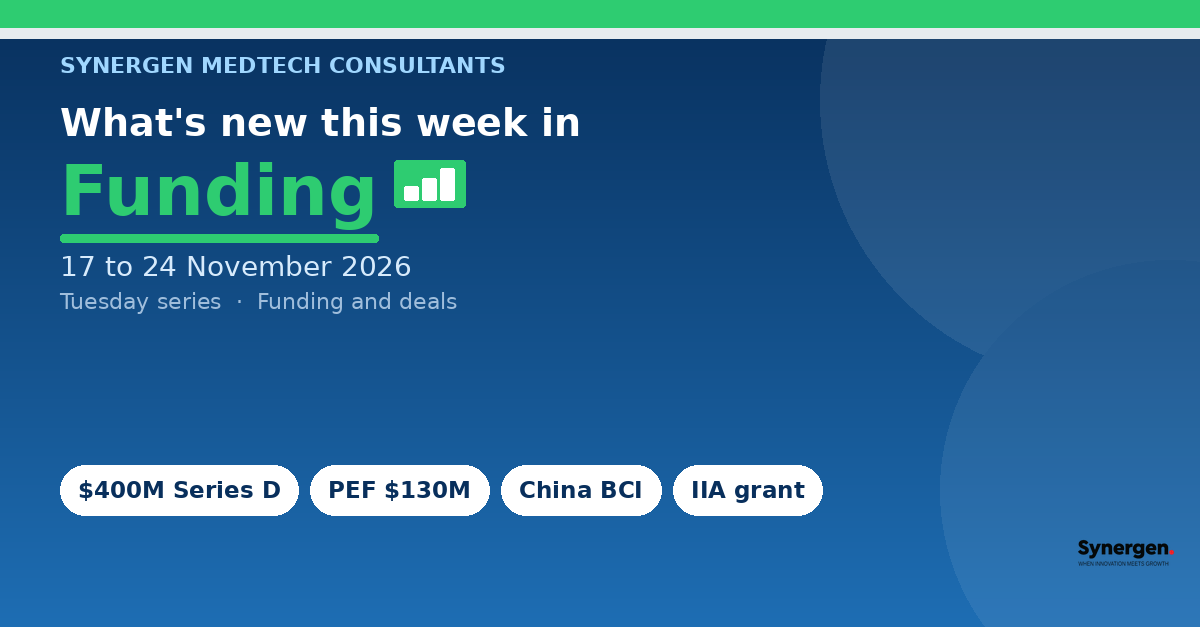
17 to 24 November 2026
This week the largest cheques went to companies that already reach patients, or are about to. Science Corporation raised $400 million to roll out its Prima retinal implant in Europe, where it has a CE mark, and to prepare a US launch through the Humanitarian Device Exemption, and a person familiar with the deal told TechCrunch the investors valued the company at $3.5 billion. Galvanize Therapeutics, already selling its Aliya pulsed electric field system, closed an oversubscribed $130 million Series D. At the same time, investors kept backing robotics, imaging AI and brain interfaces, from Apricity in Ohio and Soombit AI in Korea to a cluster of Chinese BCI rounds, and grant money showed up in a serious way from the Gates Foundation, the Israel Innovation Authority and the Australian government.
1. Science Corporation raises a $400M Series D to take Prima from Europe to the US
On 17 November Science Corporation, founded in 2021 by former Neuralink president Max Hodak, announced a $400 million Series D, bringing its total funding to more than $900 million, with participation from Khosla Ventures, the Ackman Oxman Institute, Tenet Healthcare, 885 Capital, Y Combinator and PLC Neurotech, among others. A person familiar with the deal told TechCrunch the investors valued the company at $3.5 billion. Prima, a retinal implant used with camera glasses, is CE marked to restore form vision (the ability to read letters, numbers and words) in people blinded by certain types of late-stage macular degeneration, and the company said the round comes a few months after its European commercial launch; TechCrunch reported the device is already available in Germany. The new capital will accelerate availability across Europe, prepare a US launch through the FDA Humanitarian Device Exemption pathway, and fund further work on its biohybrid neural interface. It matters because the company chose Europe first, and is now using a narrower US path rather than waiting for a full PMA.
Source: Science Corporation and TechCrunch
2. Galvanize Therapeutics raises a $130M Series D for pulsed electric field ablation
On 16 November, just as this week opened, Redwood City based Galvanize Therapeutics announced the close of an oversubscribed $130 million Series D led by HealthQuest Capital, with new investors Olympus Innovation Ventures and Braidwell LP, and existing investors including Sofinnova Partners, Norwest, Elevage Medical Technologies, Ally Bridge Group, Perceptive Advisors, Janus Henderson Investors, Longaeva Partners, Fidelity Management & Research Company and T. Rowe Price Associates. The Aliya PEF System is 510(k) cleared in the United States for the surgical ablation of soft tissue (the next-generation Aliya EX generator was cleared in May 2026), and the company said more than 4,000 procedures have been performed and more than 300 patients have been enrolled in its PROPEL registry. Proceeds will support commercial expansion of Aliya, more clinical evidence, advancement of RheOx for chronic bronchitis, and next-generation PEF products, and HealthQuest founder Garheng Kong will join the board. Aliya is not currently commercially available outside the US. It matters because this is growth money for a device that is already cleared and selling, not another bet on a prototype.
Source: PR Newswire (Galvanize Therapeutics) and MedTech Dive
3. Apricity Robotics raises a $16.1M Series A for a robotic ultrasound assistant
On 23 November Dublin, Ohio based Apricity Robotics announced a $16.1 million Series A led by JumpStart Ventures, with participation from private funds advised by The O.H.I.O. Fund, Orlando Health Ventures, JobsOhio Ventures, University Hospitals Ventures and others, bringing its total funding to $19.1 million including earlier seed funding and grants from the US National Science Foundation. The Robotic Ultrasound Assistant mounts to a hospital’s existing ultrasound cart, from any manufacturer, and holds and positions the probe during cardiac exams while the sonographer directs the scan. The money will complete development, expand clinical evaluations with health system partners including University Hospitals, and support regulatory submissions; the RUA is an investigational device and is not available for sale in the United States. It matters because the raise is aimed at a workforce problem, sonographer strain and shortages, rather than at replacing the person in the room.
Source: Business Wire (Apricity Robotics)
4. Soombit AI raises KRW 12 billion in a Series A to move from chest X ray to CT and MRI
On 17 November Korean startup Soombit AI said it had raised KRW 12 billion (about US$9.1 million) in a Series A led by SV Investment, with Altos Ventures, Kiwoom Investment and iM Investment Partners. Altos was the sole investor in its KRW 5 billion seed round in 2024, and the company was also picked for the Ministry of SMEs and Startups’ Scale-up TIPS program, which can add up to KRW 3 billion of R&D funding over three years. Founded in July 2024 by CEO Woong Bae and other Kakao Brain alumni, it sells AIRead-CXR, which drafts chest X ray reports covering at least 57 findings in one to two seconds and in April received Class 3 approval from Korea’s Ministry of Food and Drug Safety. The money goes into AIRead-CT for brain, chest and abdomen and pelvis, which the company plans to show at RSNA 2026 in Chicago (29 November to 2 December), and into FDA and CE work. It matters because a Korean generative AI imaging company is using a home approval as the launch pad for the US and Europe.
Source: WOWTALE and Financial News
5. China puts more money into brain interfaces: Qingshi Yongjun, Intellizon and Zhongke Borui
On 18 November Hangzhou based Qingshi Yongjun (é’石永隽) was reported to have closed a Series A of several hundred million yuan (exact amount not disclosed), led by Shenzhen Capital Group, with Puhua Capital, Songhe Capital, Dongfang Jiafu, Longtian Fund, Shenzhen High Tech Investment, Yinxinggu Capital and Oufang Angel joining. The company, set up in December 2024 by Zhejiang University’s invasive BCI team and led by founder Wang Yueming, is developing a miniature wireless closed loop system for severe treatment resistant depression; both of its Class III devices are still in registration trials and filing. On 19 November Suzhou based Intellizon Medical (ç‘žæ„æ—è”) announced a Pre-A+ round of nearly RMB 100 million, co led by Puhua Capital and Furong Investment, with Green Pine Capital (Songhe) and Beijing Industrial Investment, to take its brain-spine interface into clinical trials, scale a modular implantable bidirectional BCI platform, and open work on language decoding, visual restoration and depression. On 20 November Beijing based Zhongke Borui (ä¸ç§‘æé”, also known as CASIBRAIN) announced a Series B+ of nearly RMB 100 million from Houji Capital and Muhua Kechuang, for non invasive brain oxygen monitors already used in more than 600 hospitals, with CE marking, and for more production and overseas channels. It matters because Chinese investors are funding both ambitious implants that are still in trials and bedside brain monitoring that hospitals are already buying.
Source: OFweek (Qingshi Yongjun), Puhua Capital (Intellizon) and Zhitong Finance (Zhongke Borui)
6. Exo receives an $11.6M Gates Foundation grant for AI powered handheld ultrasound
On 19 November Santa Clara based Exo announced an $11.6 million grant from the Gates Foundation to advance a more affordable, multi-use handheld ultrasound system for frontline healthcare workers in low and middle income countries, with on-device AI that guides image acquisition and interpretation and does not need an internet connection. The work draws on the same silicon and AI platform Exo is developing for handheld ultrasound and OEM-integrated systems. It matters because a large non dilutive grant is being used to take a commercial imaging platform into places where equipment cost and specialist shortages usually close the door.
Source: Exo and Business Wire
7. Adenocyte wins a second Israel Innovation Authority grant of up to $3.3M
On 23 November Jerusalem based Adenocyte announced that the Israel Innovation Authority approved a grant of up to $3.3 million (NIS 13 million) under the Startup Fund’s Round A framework, to accelerate clinical rollout and commercialization of its LINFU platform for early pancreatic cancer detection. The non dilutive award supplements the company’s $10 million Series A and, with earlier IIA support, is meant to finance about 24 months of work to complete R&D, run clinical studies and expand access in the US and Israel. Adenocyte said all components of the LINFU procedure are FDA cleared, that the procedure is already used at clinical sites in New York, California and Florida, and that it is preparing implementation at Shaare Zedek Hospital in Jerusalem; it also has a laboratory partnership with Quest Diagnostics and said the procedure is reimbursed under existing CPT codes for patients at elevated risk. It matters because Israeli non dilutive money is being used to scale a test that already has a US reimbursement path, not only to fund the first experiment.
Source: PR Newswire (Adenocyte)
8. Anjiechang raises RMB 50 million in a Series B for electrosurgical workstations
On 23 November VCBeat reported that Chengdu based Anjiechang (安æ·ç•…, also written Ajshine), founded in 2018, closed an RMB 50 million Series B, invested solely by HM Capital, after earlier rounds from Pumen Technology (Lifotronic, 688389.SH) and Daotong Capital (Dalton Venture). The company makes electrosurgical energy workstations for endoscopy and surgery, plus argon, cryo and waterjet systems, holds 6 Class III and 10 Class II registrations in China, and said its systems are installed in more than 3,000 hospitals. It started CE and FDA work in 2026, and founder and chairman Su Zhen said the goal is to take the platform into operating rooms in more countries, including Belt and Road markets, Asia-Pacific, Europe and the United States. It matters because a Chinese company that already sells at home is now putting money behind the registrations it will need to sell abroad.
Source: VCBeat
9. Laronix raises an oversubscribed A$5M pre-Series A for AI voice restoration
On 23 November Brisbane based Laronix, which also has a US office in White Plains, New York, announced an oversubscribed A$5 million pre-Series A backed by Seefeld Investors and Singapore’s 12 Ventures, plus Kristy Chong (Modibodi) and Dr Elaine Saunders and Dr Peter Blamey (Blamey Saunders Hearing). The funds will support expansion in Australia, the US and Europe and the planned 2027 launch of MIRA Voice, a non invasive voice box for a wider group of patients who temporarily cannot speak, including in the ICU and in Parkinson’s. Its first product, AVA Voice, a non invasive artificial larynx for laryngectomy patients, is already sold in Australia and the US, where it is FDA registered and used in more than 40 hospitals. It matters because this is commercial-stage money for a company that already sells in two markets and is now widening the indication and the geography.
Source: Startup Daily and Business News Australia
10. EMVision wins an A$3M Australian grant to take its portable brain scanner into traumatic brain injury
On 20 November Sydney based EMVision Medical Devices (ASX: EMV) said it had been awarded a $3 million non dilutive grant under Round 19 of the Australian Government’s Cooperative Research Centres Projects (CRC-P) program, to develop and clinically test its First Responder portable brain scanner for suspected traumatic brain injury, mainly to detect bleeding inside the skull, using the same device it is building for stroke. This is separate from a $3 million CRC-P grant it received in 2025 for the emu Regional Benefits Study. The study protocol and ethics are planned for the first half of 2027, with activation in the second half. It matters because a second indication on the same device widens the use case, and the money does not cost the company equity.
Source: EMVision ASX announcement and Kalkine
Gary’s take
What the money is telling us this week is that the really large cheques are going to companies that already have something in patients, or are very close. Science Corporation raised $400 million, and a person familiar with the deal told TechCrunch the company is now valued at $3.5 billion, to roll Prima out in Europe, where it already has a CE mark, and to take it to the US through the Humanitarian Device Exemption, which is a smarter first US path than a lot of founders assume. Galvanize, which is already selling its Aliya pulsed electric field system, closed an oversubscribed $130 million Series D, and that is growth money, not a bet on a prototype. On the venture side, robotics and brain interfaces kept drawing capital, from Apricity’s ultrasound assistant and Soombit AI’s move from chest X ray into CT and MRI, to a cluster of Chinese BCI rounds at Qingshi Yongjun, Intellizon and Zhongke Borui. I was also glad to see serious non dilutive money this week: the Gates Foundation putting $11.6 million behind Exo’s handheld ultrasound for lower income countries, the Israel Innovation Authority backing Adenocyte with a grant of up to $3.3 million, and Australia giving EMVision another A$3 million to take the same portable brain scanner from stroke into traumatic brain injury. My advice this week is to look hard at grants and at Europe as a first market, because both showed up again and again in the deals that actually closed.
Which of these deals matters most for your company, and is there a type of deal you would like me to cover in more depth next week? You are always welcome to write to me directly, and you can find more of my articles, and book a short introductory call, at synergenmedtech.com.
If you’d like to follow along, you can find us here:
Website: synergenmedtech.com
LinkedIn: linkedin.com/company/100981535
YouTube: youtube.com/@synergenmedtech
Sources note: all items were found through a public web scan of about 17 to 24 November 2026 and each was checked against the linked source. Galvanize announced its round on 16 November, just as this week opened, and was not in the previous funding roundup. Amounts and dates are as reported by the companies or the cited media; Korean, Chinese and Australian amounts are given in local currency as reported. The $3.5 billion Science Corporation valuation was reported by TechCrunch, attributed to a person familiar with the deal, and was not stated in the company’s own announcement.
Leave a Reply