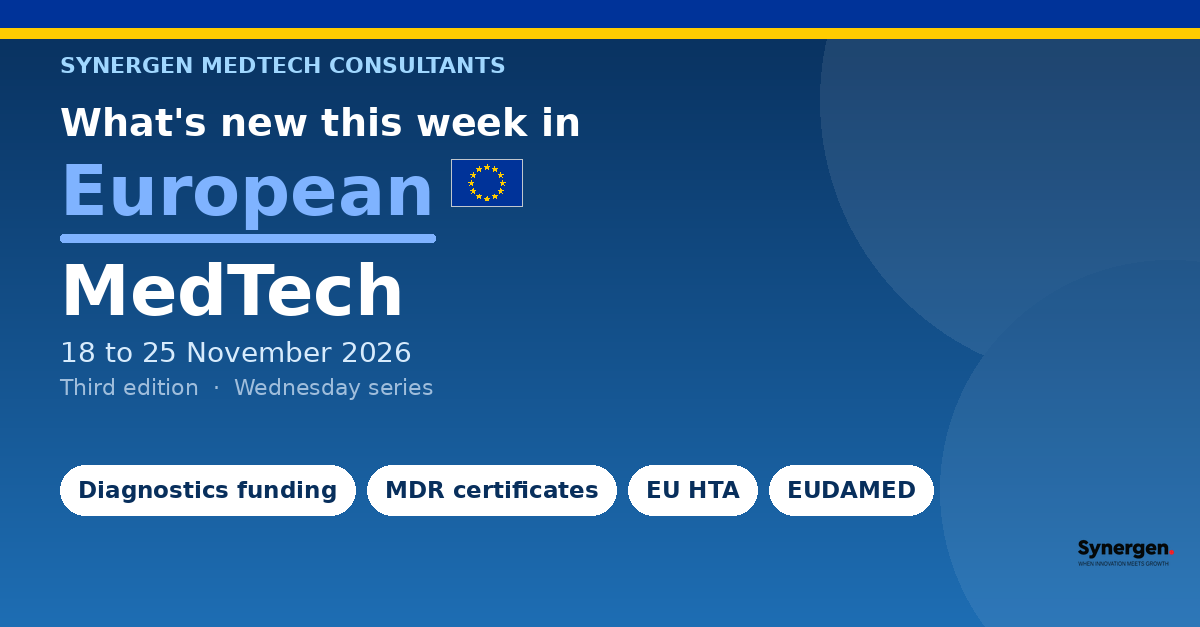
18 to 25 November 2026
Here’s our third Wednesday look at European MedTech. This week the money went into blood tests for drug safety, AI for medical software paperwork, camera based vital signs and cancer pathology, a Finnish hospital AI got its MDR certificate, the EU picked a third device for joint clinical assessment, and the EUDAMED registration deadline lands this Saturday.
1. Tagomics closes a $13M seed extension, with Werfen’s venture arm coming in
On 24 November Cambridge based Tagomics announced a $13 million (£10 million) seed extension, co-led by new investor We Venture Capital, the corporate venture arm of diagnostics company Werfen, and existing investor Calculus Capital, with IQ Capital, Mercia Ventures, Illumina Ventures and Meltwind also taking part. Total funding is now $25 million (£19 million). The money goes into LiquiPath, its blood based platform for monitoring drug safety across several organs, and into cancer diagnostic tests. It matters because a big diagnostics player chose to back a young UK company early.
Source: Tagomics
2. Ketryx raises $39M Series B to cut regulatory paperwork for medical software
On 19 November EU Startups News reported that Vienna based Ketryx has raised $39 million in Series B funding, bringing its total to $55 million. Its AI platform helps teams building regulated medical software keep their compliance documentation up to date, and the company says it can cut that documentation work by up to 90 percent. It matters because investors are now paying real money for tools that make regulation lighter to carry.
Source: EU Startups News
3. IntelliProve raises €2.7M for vital signs from a 30 second face scan
On 19 November Ghent based IntelliProve announced a €2.7 million seed round led by Belgian fund Miles Ahead, with Wit-Gele Kruis, the largest non-profit home nursing organisation in Flanders, imec.istart and several business angels. Its software uses any phone or laptop camera to measure heart rate, blood pressure and heart rate variability in a 30 second face scan, and it builds on a €1.25 million raise in January 2025. It matters because a home nursing organisation is putting its own money into the tech its nurses could use.
Source: EU-Startups
4. Octopath AI raises £1.5M to read cancer biopsy slides faster
On 23 November it was reported that UCL spin-out Octopath AI has raised £1.5 million in combined seed and grant funding, led by TwinPath Ventures and including a matched £500,000 Innovate UK Growth Catalyst grant. Its foundation model, Kraken-1, was trained on 14.1 million labelled cells across 14 cancer types and works on the standard H&E slides labs already make, giving results in under two minutes. The report notes its accuracy claims still need independent clinical validation. It matters because it fits into the pathology lab without new hardware.
Source: Ai Data News
5. MDR certificates for a Finnish hospital AI and a US closure device
On 24 November CGI announced that CGI AI Head Analysis, built with Helsinki University Hospital (HUS) and Planmeca, has been certified as a Class IIb medical device under the EU MDR. It flags suspected brain bleeds on head CT scans, for example in busy emergency rooms. On 18 November Haemonetics announced MDR CE marking for its VASCADE MVP XL venous vascular closure system, used after procedures such as cryoablation, pulsed field ablation and left atrial appendage closure, with the first European cases done in October in Hamburg, Milan and London. It matters because a hospital built AI made it through the MDR, which is not easy.
Source: CGI and Haemonetics
6. EU picks a retinal implant as the third device for joint clinical assessment
On 23 November the European Commission selected PRIMA Products, made by La Science and meant to restore vision for patients with macular degeneration, for a joint clinical assessment under the EU HTA Regulation. The assessor is Germany’s Federal Joint Committee (G-BA) and the co-assessor is Italy’s AGENAS, following a positive opinion from the HTA Committee on 13 November. That makes three medical devices now in joint clinical assessment, against 21 ongoing assessments for medicines. It matters because the EU wide value debate for devices is finally starting, slowly.
Source: European Commission
7. Berlin Heals starts a sham controlled heart failure trial in six European countries
On 18 November Berlin Heals, based in Zug, Switzerland, announced the start of its C-MIC IV trial of microcurrent therapy for heart failure, with the first patient implanted in Kragujevac, Serbia, by Dr. Miodrag Sreckovic. The randomized, double blind, sham controlled study will enroll 60 patients in Spain, Belgium, the Netherlands, Denmark, Serbia and Bosnia and Herzegovina. It matters because a sham controlled design is the kind of evidence payers and the new HTA process will want to see.
Source: Berlin Heals
8. MDR and IVDR revision and EUDAMED: still waiting, and a deadline this Saturday
The European Parliament’s Legislative Observatory still lists 18 January 2027 as the indicative plenary date for the MDR and IVDR simplification proposal, procedure 2025/0404(COD), and the file still reads “Awaiting committee decision” in the Public Health committee (SANT), with Oliver Schenk as rapporteur. The IMCO committee adopted its opinion on 12 November. Meanwhile, devices and IVDs first placed on the market before 28 May 2026 that are still being sold, legacy devices included, must be registered in the EUDAMED UDI/Devices module by 28 November 2026. It matters because the old rules keep running in full while the new ones wait, and Saturday’s deadline is real.
Source: European Parliament Legislative Observatory and HPRA
Gary’s take
Funny week. One of the bigger rounds in Europe went to Ketryx, a company whose whole job is to make the paperwork lighter for people building medical software. And a Finnish hospital, with a big partner behind it, took years to get its brain bleed AI through the MDR, which is great news and I’m happy for them, but I keep asking how many smaller teams just give up halfway. I honestly think the MDR has gone further than it needed to, and a lot of it ends up as Brussels bureaucracy, not safer care. Plenty of good products never come to Europe at all. I’m not sure yet if that is good or bad, and I get the people who say caution protects patients. But I do think European healthcare is paying for it and most people don’t see it. The tech world talks about it all the time, the doctors, the health reformers and even the MDR people themselves, I’m not so sure.
So here’s my question. When we need AI to help us fill in the forms, are the forms still protecting patients? Always happy to hear from you directly, and you can find more of my articles, and book a short intro call, at synergenmedtech.com.
Sources note: all items were found through a public web scan of about 18 to 25 November 2026 and each was checked against the linked source. Amounts and dates are as reported by the companies or the cited media. The Octopath AI round was timed to National Pathology Week earlier in November and was reported on 23 November. No new MDR notified body designation and no EIC Accelerator results were found in this window.
If you’d like to follow along, you can find us here:
Website: synergenmedtech.com
LinkedIn: linkedin.com/company/100981535
YouTube: youtube.com/@synergenmedtech
Leave a Reply