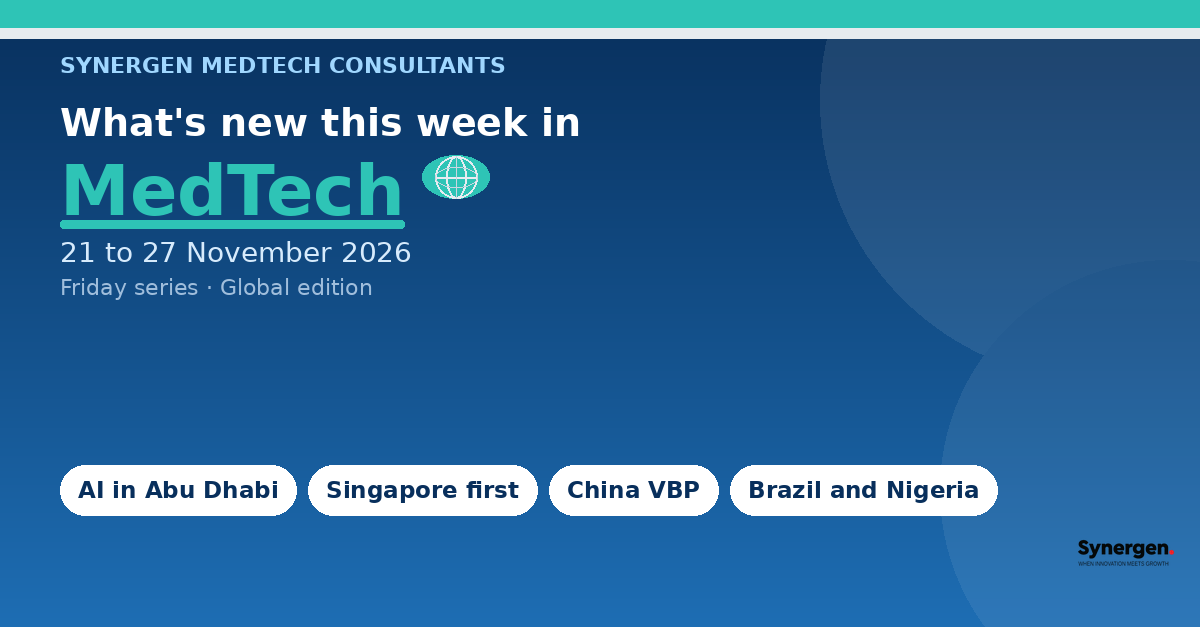
21 to 27 November 2026
A week about choosing the right partner in the right place. Two Korean AI companies opened doors in Abu Dhabi and Brazil, Singapore registered what the company calls its first blood based multi cancer screening kit, China changed the rules for its next round of dental implant procurement, Europe saw a new CE certified product and a public bank loan for a migraine implant, and from Nigeria and India we saw local manufacturing and export ambition working side by side.
1. Lunit and M42 plan to use AI on Abu Dhabi’s existing chest X-rays to find missed lung cancers
- On 23 November Lunit (KRX: 328130) announced a strategic collaboration with M42, the health technology group set up by Abu Dhabi sovereign investor Mubadala and AI group G42, for an AI lung cancer early detection initiative in the United Arab Emirates.
- The idea is to run Lunit INSIGHT CXR on chest X-rays already stored in Malaffi, Abu Dhabi’s health information exchange, which connects more than 3,100 healthcare facilities and holds 14 million unique patient profiles and 4.2 billion clinical records, to find suspicious findings that may have gone undetected.
- M42 will prepare and submit the proposed programme to the Department of Health Abu Dhabi and the Abu Dhabi Public Health Center, and Lunit will provide technical expertise and integration support, and the announcement gives no start date or financial terms.
- It matters because the partner here is not a distributor but the owner of the data and the relationship with the regulator, which is often the fastest way into a Gulf health system.
Source: Lunit
2. Gene Solutions’ SPOT-MAS 10 is registered in Singapore as a blood based multi cancer screening test
- On 27 November Gene Solutions announced that Singapore’s Health Sciences Authority (HSA) registered SPOT-MAS 10 as a Class C in vitro diagnostic, and based on the Singapore Medical Device Register as of 25 November 2026 the company says it is the first blood based multi cancer screening test kit registered as an IVD in Singapore.
- The test analyses cell free DNA methylation and fragmentomic signatures with a machine learning algorithm to look for a signal from ten cancers, including breast, lung, liver, colorectal, gastric, ovarian and pancreatic cancer, and it is intended as an add on for asymptomatic adults aged 40 or older at elevated risk, not as a replacement for standard screening.
- It received FDA Breakthrough Device Designation in May 2026, and the company reports a prospective study of 9,024 adults across 75 hospitals in Vietnam and more than 105,000 people tested in routine practice across 10 Asian countries.
- It matters because a registration from HSA, which WHO recognises at Maturity Level 4, its highest level, gives an Asian diagnostics company a credible reference when it talks to other regulators and laboratory partners.
Source: Gene Solutions
3. China opens the next round of dental implant volume based procurement, with almost twice as many companies
- Sina Finance reported on 21 November that the national alliance follow-on procurement for dental implant systems, run through the Sichuan Healthcare Security Administration, opened demand reporting for hospitals from 23 November to 4 December.
- According to the National Healthcare Security Administration, applying companies rose from 53 in the first round to 101, registration certificates from 269 to 660 and product components from 391 to 1,008, titanium zirconium implants now form their own category, and price competition moves from a bidding model to a public price inquiry with tiered volume allocation.
- The same report notes that the national office began publishing product information on 11 November for spine, intraocular lens and sports medicine consumables ahead of their own follow-on rounds, after first round average price cuts of 84%, 60% and 74%.
- It matters because anyone selling implants or high value consumables in China now has to plan for the second and third round, not only the first, and the rules are shifting from the lowest price towards a reasonable price and stable supply.
Source: Sina Finance
4. Lindis Blood Care wins MDR certification for CATUVAB and launches in Germany and Austria
- On 24 November Lindis Blood Care of Hennigsdorf, Germany, announced CE certification under the EU MDR for CATUVAB, which it describes as the first CE certified product designed to remove tumour cells, including cancer stem cells, from blood salvaged during cancer surgery so that patients can safely receive their own blood back.
- The launch starts immediately in Germany and Austria, distribution agreements covering 14 countries are already signed, licensing discussions are ongoing in China and the FDA process is under way in the US.
- The company says up to 1,000,000 cancer surgeries a year worldwide need donor blood transfusions.
- It matters because the distribution agreements were already in place on the day the certificate was announced, so the company can start selling at once instead of beginning the partner search after approval.
Source: Lindis Blood Care
5. Salvia BioElectronics secures €25 million in venture debt from the EIB for its migraine implant
- On 25 November Salvia BioElectronics of Eindhoven, the Netherlands, announced €25 million in venture debt from the European Investment Bank, supported under the European Commission’s InvestEU programme, to continue clinical development of its MySalvia System for resistant migraine.
- The system uses two ultra thin implants placed just beneath the skin and a small wearable device to stimulate nerves involved in migraine, it is being studied in Europe and in the US pivotal RECLAIM-II study, and it remains an investigational device.
- Salvia completed a €53 million Series B led by Innovation Industries in May 2025.
- It matters because public venture debt can carry a clinical stage company into a pivotal trial without forcing another equity round at a difficult moment.
Source: EU-Startups
6. VUNO launches its retinal AI in Brazil with ANVISA approval and an exclusive distributor
- On 23 November Korea’s VUNO (KOSDAQ: 338220) said it is officially launching VUNO Med-Fundus AI in Brazil after receiving approval from ANVISA and signing an exclusive Brazilian distribution agreement with Adapt, a local distributor of ophthalmic devices.
- The software indicates within seconds whether any of 12 major abnormal findings, such as haemorrhages and vascular abnormalities, are present on a retinal image, and an ophthalmology team at Hospital Israelita Albert Einstein in Brazil independently validated it locally and published the results in May.
- Sales staff training and online marketing have started, and VUNO plans to use Brazil as a base for other major South American countries.
- It matters because VUNO arrived with all three things Brazilian doctors and buyers will ask about, regulatory approval, a specialist distributor and local clinical validation.
Source: Seoul Economic Daily
7. Nigeria’s Ash Biomedical and Korea’s GenBody partner to make HIV self-tests locally
- The Guardian Nigeria reported on 23 November that Ash Biomedical Diagnostics, a Nigerian diagnostics manufacturer, has partnered with South Korea’s GenBody to introduce and locally manufacture the ConfiSign HIV Self-Test, with technology transfer and training included.
- Ash Biomedical will manufacture and distribute the test in Nigeria once its facility in Idu, Abuja, is complete, the structure is finished, equipment is being installed, cleanroom work is under way and commissioning is targeted for the first quarter of 2027, and Nigeria could become a production and distribution base for the wider West African market.
- The company says it has supplied 15 million test kits over 15 years through more than 66 government and institutional contracts across 27 states, and no financial terms were reported.
- It matters because Nigeria is calling for more local manufacturing of essential health products instead of imports, and a foreign technology partner working with an experienced local manufacturer answers that call while building real capacity.
Source: The Guardian Nigeria
8. India’s Axio Biosolutions plans a bigger US push for its haemostatic dressings
- On 24 November The Hindu BusinessLine reported that Bengaluru based Axio Biosolutions, whose chitosan based Axiostat dressing is used by the Indian armed forces and by hospitals in more than 50 countries, wants to grow its presence in the US through new products, local manufacturing and partnerships.
- Its portfolio has received five US FDA clearances, including Axiostat Gauze, MaxioCel and the Ax-Surgi surgical haemostat, and founder Leo Mavely says the company has been a major supplier to first responder kits in US ambulances, while Ax-Surgi is in pilot clinical studies ahead of its US launch.
- Mavely was named this month to TIME’s inaugural TIME100 Next India list.
- It matters because it shows an Indian company moving from exporting products to thinking about manufacturing inside the US market itself.
Source: The Hindu BusinessLine
Gary’s take
What I see this week is that the partner decision is the market access decision. Lunit did not look for a distributor in Abu Dhabi, it went to the group that runs the health data exchange and will talk to the regulator for it, VUNO launched in Brazil with ANVISA approval, a specialist distributor and a local study from Hospital Israelita Albert Einstein already in place, and Lindis had distribution agreements for 14 countries signed on the day it announced its certificate. Nigeria and China show the same thing from the buyer’s side, where local manufacturing with technology transfer, and a reasonable price that can last, count for more than a one off deal. I always tell founders to start the partner conversations much earlier than feels comfortable, because the right partner takes longer to find than the approval takes to arrive.
Which of these developments matters most for your company, and is there an area you would like me to cover in more depth next week? You are always welcome to write to me directly, and you can find more of my articles, and book a short introductory call, at synergenmedtech.com.
If you’d like to follow along, you can find us here:
Website: synergenmedtech.com
LinkedIn: linkedin.com/company/100981535
YouTube: youtube.com/@synergenmedtech
Sources note: all items were found through a public web scan of 21 to 27 November 2026 and each was checked against the linked original source. Amounts and dates are as reported by the companies or the cited media.
Leave a Reply