Category: What’s new in MedTech

  • What’s new this week in Indian MedTech, 2 to 8 November 2026

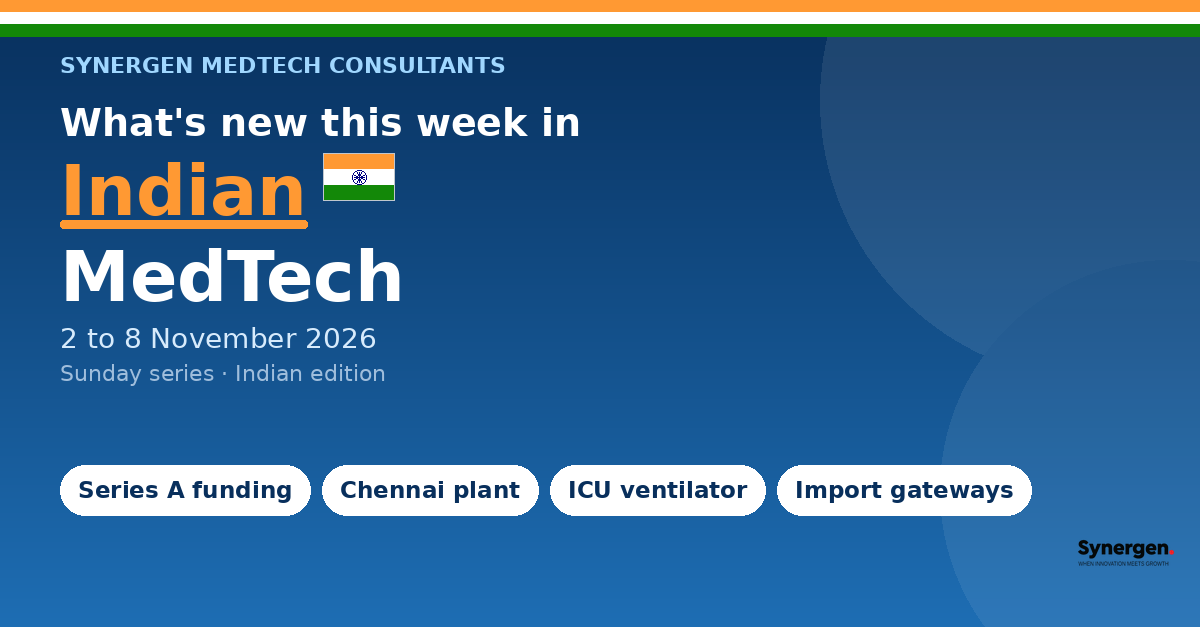
    What’s new this week in Indian MedTech, 2 to 8 November 2026

    2 to 8 November 2026

    A busy Indian week across funding, local manufacturing, critical care launches, import logistics, industry-academia ties and device safety: Clinics On Cloud raised Rs 120 crore in its first institutional round for CDSCO licensed Health ATMs, Omron Healthcare began full-scale production of blood pressure monitors at its first India factory near Chennai, Allied Medical launched the made-in-India ALTUS ventilator series, the health ministry proposed ten new import gateways for drugs and medical devices, the Association of Tamil Nadu Medical Device Industry signed an MoU with Anna University, Sahajanand Medical Technologies approved a further investment of up to USD 7,80,000 in US startup SNP Medical Corp, BTC Health added India to its exclusive Exstent partnership for the ExoVasc PEARS aortic implant, subject to CDSCO import approval, and the Indian Pharmacopoeia Commission disclosed 9,373 serious medical device adverse events since 2020.

    1. Clinics On Cloud raises Rs 120 crore Series A for CDSCO licensed Health ATMs

    Covered on 2 to 4 November, Pune based Clinics On Cloud raised Rs 120 crore (about $12.5 million) in a Series A from Dubai based investors through Model42, a healthcare investment platform powered by Enlightened Minds Investments, at a reported Rs 600 crore valuation. It is the company’s first institutional round after eight bootstrapped years. Founded in 2018 by Abhay Agarwal and Manashrri Agarwal, the firm describes itself as a CDSCO licensed maker of Health ATM screening kiosks, along with Health Lounges, Box Clinics and Mobile Medical Units. It claims more than 3,500 deployments and over 12 million screenings across India and eight other countries, and manufactures at Chakan MIDC near Pune. Proceeds are earmarked for AI and research and development, manufacturing scale, international regulatory work and a UAE led push into Africa, the United States and Southeast Asia. It matters because a CDSCO licensed Indian screening device platform is now using Gulf capital to export connected microclinics, not only sell inside India.

    Source: Indian Startup News and Medical Buyer

    2. Omron Healthcare starts full-scale production at its first India factory near Chennai

    On 30 October, with further coverage on 2 November, Omron Healthcare announced the start of full-scale blood pressure monitor production at the OMRON Group’s first factory in India, at Origins by Mahindra in Puduvoyal, Gummidipoondi, near Chennai. The Hindu reported that the plant was formally inaugurated on 30 October. It is operated by OMRON HEALTHCARE MANUFACTURING INDIA Pvt. Ltd., incorporated in July 2022, and the official announcement lists a site of about 24,000 square metres, five production lines, about 120 employees and capitalisation of INR 1.91 billion. The lines make the HEM-7090, HEM-7181 and HEM-7183T series for the Indian market, using production and quality methods developed at Omron’s Matsusaka factory in Japan and its Vietnam facilities. The Hindu said the plant is designed to make about 300,000 monitors a year, with a plan to raise capacity tenfold to 30 lakh units a year (about 3 million) within two years; the company and later coverage dated that tenfold target to 2028. Omron estimates that about 300 million people in India live with hypertension, while fewer than 5% of households regularly use a home blood pressure monitor. President and CEO Ayumu Okada said the Chennai start is a step toward a stable supply of medical-grade monitors in India. The company also plans to develop Chennai as a supply base for international markets, including exports to Europe, and to add nebuliser production later, though no timeline was given for the nebulisers. It matters because a global home monitor leader is now running full-scale production in Tamil Nadu, which is exactly the kind of high volume manufacturing India says it wants under Make in India.

    Source: Omron Healthcare press release and The Hindu

    3. Allied Medical launches the ALTUS made-in-India ICU ventilator series

    On 2 November Allied Medical Limited launched ALTUS, a new series of ventilators designed and built in India, at an event with the company’s channel partners and staff. Founded in 1982, Allied Medical positioned the series as part of its effort to make advanced critical care technology accessible through indigenous design and manufacturing. The company describes ALTUS as intelligent, adaptive and versatile, with features developed around what clinicians need in intensive care units and emergency settings where patients depend on assisted breathing. Trade coverage named Chairman Dr. Vinod Kohli and Joint Managing Directors Akhil Kohli and Aditya Kohli as the leadership behind the launch. It matters because ventilators remain a strategic, often import heavy category, and a long standing Indian manufacturer putting a new series into ICUs is another step toward serving that demand from home.

    Source: Medgate Today and Exceptional Technology

    4. Health ministry proposes ten new import gateways for drugs and medical devices

    On 4 November ETHealthWorld and Medical Buyer reported that the Union Ministry of Health and Family Welfare has proposed a draft amendment to Rule 43A of the Drugs Rules, 1945, adding inland container depots, a special economic zone and an international airport to the list of authorised entry points for importing drugs, medical devices and cosmetics. The ten proposed additions are ICD Sonipat, ICD Piyala and ICD Harsaru in Haryana; ICD Dadri and Noida International Airport in Uttar Pradesh; ICD Gandhidham/Mundra in Gujarat; ICD Sanath Nagar and ICD Thimmapur in Hyderabad, Telangana; and ICD Whitefield and SEZ Bommasandra in Karnataka. They would join existing authorised points, including the ICDs at Dhannad and Tihi in Indore. The ministry said the change should let importers clear consignments closer to factories, warehouses and distribution centres, cutting inland transport, logistics costs and delays. The Medical Technology Association of India welcomed the proposal, while cautioning that the gains depend on adequate regulatory infrastructure at the new sites. The draft is open for objections and suggestions. It matters because so much of India’s device industry still depends on imported components and finished equipment, and clearance closer to factories and hospitals is a practical cost and time issue, not a slogan.

    Source: ETHealthWorld and Medical Buyer

    5. ATMED and Anna University sign MoU to deepen Tamil Nadu device industry-academia ties

    The Hindu reported on 8 November that the Association of Tamil Nadu Medical Device Industry (ATMED) and Anna University have signed a memorandum of understanding to strengthen industry-academia collaboration in the state’s medical device sector. According to a press release cited by The Hindu, the MoU was exchanged on 3 November at Anna University between V. Kumaresan, registrar of Anna University, and Samuel William George, president of ATMED. The partnership is intended to bridge academic training and industry needs through student internships, industry exposure, employment opportunities, technical training, research, product development and technology commercialisation, as well as joint workshops, seminars, faculty-industry interactions, student innovations and access to Anna University’s technical infrastructure. ATMED said it will use its member-company network to support mentorship, industrial exposure and the development of skilled professionals and indigenous medical technologies. Office bearers of ATMED and professors from Anna University’s Biomedical Engineering Department were present. It matters because device parks and incentive schemes only work if the state also has engineers, technicians and industry-ready graduates, and Tamil Nadu is trying to join those dots directly.

    Source: The Hindu

    6. SMT approves further investment of up to USD 7,80,000 in US startup SNP Medical Corp

    On 5 November the Board of Directors of Sahajanand Medical Technologies Limited approved an investment by its wholly owned subsidiary, Sahajanand Medical Technologies Ireland Limited (SMT Ireland), in SNP Medical Corp., a US medical device startup registered in Delaware on 31 May 2022. An NSE filing signed by Managing Director and CEO Bhargav Dhirajlal Kotadia puts the cash acquisition cost at up to USD 7,80,000, with the price per share to be set from a valuation of SNP. SMT Ireland held a 14.15% stake as on 30 September 2026, and the new investment would raise that holding to up to 17.19%. Completion is tentatively targeted by 31 March 2027. SMT disclosed the deal as a related party transaction at arm’s length, because Priyanka Cohen, a Promoter and Non-Executive Director of SMT, is a Director in SNP. The filing gives SNP’s turnover as USD 3,00,000 in 2025, USD 2,34,960 in 2024 and USD 5,64,930 in 2023, and describes the object as diversification of SMT’s product portfolio within its existing main line of business. It does not name a specific SNP product. It matters because one of India’s newly listed cardiovascular device makers is using a modest further cheque to deepen a US foothold, a reminder that going public is also about building a broader product pipeline.

    Source: NSE filing (Sahajanand Medical Technologies)

    7. BTC Health adds India to its exclusive Exstent partnership for ExoVasc PEARS

    On 6 November ASX-listed BTC Health Limited announced that its wholly owned investee company, BTC Cardio Pty Ltd, has signed a new exclusive distribution agreement with UK-based Exstent Limited for ExoVasc PEARS (Personalised External Aortic Root Support), covering Australia and India. PEARS is a custom-made mesh support, manufactured from each patient’s CT scan and fitted around the aorta to prevent further dilatation. It is used in patients with an enlarged aortic root, including those with Marfan syndrome, and to support the pulmonary autograft in the Ross procedure (Ross-PEARS), preserving the patient’s own aortic root and valve. The new agreement runs for an initial five years, renews automatically for further two-year periods unless either party gives notice, and replaces the April 2024 Australia-only agreement. No upfront or milestone payment is payable to Exstent. In Australia, PEARS revenue grew 20% to $1.10 million in FY26. Sales in India will begin only once CDSCO grants import approval; BTC Cardio said regulatory consultants are engaged, discussions with Indian aortic surgeons have begun, and Exstent will support the submissions. India’s inclusion is subject to obtaining Indian approvals within an agreed timeframe. Executive Chair Dr Richard Treagus said the company had been preparing for India for much of the year and would start with leading surgical centres. Exstent, based in Tewkesbury, Gloucestershire, said the first ExoVasc PEARS was implanted at the Royal Brompton Hospital in London in 2004, and that more than 1,500 patients have since been treated at more than 40 surgical centres worldwide. It matters because a specialised aortic implant is now on a formal path toward India, and the real gate is still CDSCO import approval, not the distribution contract itself.

    Source: BTC Health ASX announcement

    8. IPC discloses 9,373 serious medical device adverse events in India since 2020

    On 6 November The Indian Express reported, with Outlook India repeating the figures the same day, that the Indian Pharmacopoeia Commission has for the first time disclosed the number of Serious Adverse Events caused by medical devices in India since 2020: 9,373, rising from 808 in 2020 to 2,176 in 2025, a nearly three-fold increase over six years. The newspaper said it accessed the data on 27 October after a 10 September part-compliance order by a Central Information Commission bench led by Information Commissioner Jaya Varma Sinha. SAEs are events that may result in life-threatening conditions or prolonged hospitalisation. The IPC has published broader Medical Device Adverse Event totals from 775 monitoring centres under the Materiovigilance Programme of India, launched in 2015, while keeping the serious-event numbers restricted. Manufacturer names and device categories were not released. The IPC argued that disclosure would breach commercial confidence under Section 8(1)(d) of the RTI Act, and the Commission held that brand details could not be shared because it was not conclusively established whether events arose from a procedural lapse or from the device itself. In financial year 2024-2025 the IPC logged 14,584 MDAEs and forwarded only 22 cases to CDSCO; the comparable figures were 10,269 MDAEs and 16 cases in 2023-2024, and 3,868 MDAEs and 12 cases in 2022-2023. It matters because India has now put a public number on serious device-related harm, while still withholding the names of devices and manufacturers, which limits how much hospitals, patients and domestic makers can learn from the data.

    Source: The Indian Express and Outlook India

    Gary’s take

    What stands out for me this week is that Indian medtech is being built in factories and in the unglamorous systems around them, not only in pitch decks. Omron has started full-scale production of blood pressure monitors at its first India plant near Chennai, and Allied Medical has launched a new made-in-India ICU ventilator series. Clinics On Cloud’s first institutional round, Rs 120 crore after eight bootstrapped years, shows that investors will still back a CDSCO licensed screening platform that is already out in the field. At the same time, the health ministry wants more inland gateways so devices and components clear closer to factories and hospitals, Tamil Nadu’s device association is tying itself closer to Anna University, SMT is putting a further sum of up to USD 7,80,000 into a US device startup, and an Australian distributor is preparing ExoVasc PEARS for India once CDSCO grants import approval. Overlay the Indian Pharmacopoeia Commission’s first public count of serious device adverse events, 9,373 since 2020, and the picture is more complete. Capacity is rising. So is the need for faster logistics, honest safety data and regulators who can keep up. If you sell into India, or build here, none of that is optional.

    Which of these Indian stories matters most for your company, and is there a state, therapy area or company type you would like me to cover in more depth next week? You are always welcome to write to me directly, and you can find more of my articles, and book a short introductory call, at synergenmedtech.com.

    If you’d like to follow along, you can find us here:

    Website: synergenmedtech.com

    LinkedIn: linkedin.com/company/100981535

    YouTube: youtube.com/@synergenmedtech

    Sources note: all items were found through a public web scan of the week and each was checked against the linked original source. Omron’s factory opening and start of full-scale production were announced on 30 October, with further coverage on 2 November, and that earlier date is stated in the text.
    Download the full roundup as a PDF

  • What’s new this week in Israeli MedTech, 31 October to 6 November 2026

    What’s new this week in Israeli MedTech, 31 October to 6 November 2026

    What’s new this week in Israeli MedTech

    31 October to 6 November 2026

    A strong Israeli week across funding, exits, hospital AI and clearances abroad: StimCardio raised a large Series A for a wearable AF therapy, TailorMed took a reported quarter billion dollar majority deal, ZOLL Itamar and MeMed both advanced US clearances, Ichilov partnered with Wonderful on AI agents, Sofwave posted profitable growth with China NMPA approval, and Schneider Children’s opened Israel’s first dedicated pediatric health VC.

    1. StimCardio closes a $30M Series A for a wearable atrial fibrillation therapy Announced on 29 October and widely covered in Israeli and US trade press early this week, Israeli medical device company StimCardio closed an oversubscribed $30 million Series A led by Metis Medtech, with Catalyst Health Ventures, corporate strategics and other new and existing investors. The raise funds the NeuroPulse 2 pivotal study of Rhyvive, an investigational wrist worn median nerve stimulation wearable meant to reduce AF recurrence after catheter ablation, and preparation for an FDA De Novo submission. It matters because a home adjunct to ablation is drawing serious cardiac device capital, and recurrence after ablation remains a stubborn clinical gap. Source: StimCardio and MobiHealthNews

    2. TailorMed takes a GrowthCurve Capital majority investment in a reported ~$250M deal On 2 November TailorMed announced a majority investment from New York private equity firm GrowthCurve Capital. Calcalist reported the deal at about $250 million, with most existing shareholders expected to sell; the companies did not disclose the figure. The Israeli founded digital health company connects patients to medication access, affordability and adherence support across more than 950 hospitals, 4,700 clinics and 3,100 pharmacies, and says it has helped secure more than $7.4 billion in patient financial assistance since 2020. It matters because a US focused Israeli digital health platform has reached a real exit scale while keeping its Tel Aviv development centre. Source: TailorMed and Ctech

    3. ZOLL Itamar gets FDA 510(k) for PolySense, taking WatchPAT 400 to home PSG On 2 November ZOLL announced FDA 510(k) clearance for PolySense accessories that expand the WatchPAT 400 from a home sleep apnea test to home polysomnography. Self applied head, cardiac and leg patches record EEG, EOG, EMG, ECG and leg movement, and with the full kit the platform can measure up to 11 channels and 9 parameter categories referenced by the AMA CPT Assistant from 1 January 2027. US availability is planned for early January 2027. It matters because one of Israel’s signature sleep tech platforms, now under ZOLL Itamar, is moving advanced sleep studies out of the lab and into the home. Source: ZOLL

    4. Beckman Coulter wins FDA clearance for Access MeMed BV, the Israeli host response assay On 3 November Beckman Coulter Diagnostics announced US FDA clearance of Access MeMed BV, developed with Haifa based MeMed. The host response blood test measures TRAIL, IP-10 and CRP to help distinguish bacterial from viral infection in adults and children as young as 90 days, with results in as little as 15 minutes on the DxI 9000 analyzer and also available on Access 2. The assay already held a CE mark from April 2026. It matters because an Israeli host response technology is now sitting on major US lab instruments, which is how antimicrobial stewardship tools actually scale. Source: Beckman Coulter

    5. Ichilov partners with Wonderful to build AI agents inside the hospital On 3 November Tel Aviv Sourasky Medical Center (Ichilov) announced a strategic partnership with Israeli AI company Wonderful to develop, test and deploy AI agents across clinical, operational and service workflows on Wonderful’s operating system, including work toward an agentic medical record. Wonderful recently raised $550 million at a $5 billion valuation. Hospital CEO Prof. Eli Sprecher framed the goal as freeing medical teams’ time for patients. It matters because a major Israeli hospital is not only buying AI tools, it is co developing them in a live clinical setting as a model for other systems. Source: Ichilov and Ynet

    6. Sofwave posts $28.5M Q3 revenue (+35%) and China NMPA approval On 3 November TASE listed Sofwave Medical reported third quarter revenue of $28.5 million, up 35% year over year, with usage fee revenue of $13.3 million (+60%) and IFRS net income of $4.1 million. Nine month revenue reached $82.9 million (+41%). In the same quarter China’s NMPA approved the Sofwave System for mid to lower facial wrinkles in adults 22 and older, supported by a 200 subject study in China, with an initial order for 70 systems. It matters because an Israeli founded aesthetics device company is compounding recurring usage revenue while opening one of the largest aesthetic markets. Source: GlobeNewswire (Sofwave)

    7. Schneider Children’s opens Israel’s first pediatric focused VC with a $20M first close On 4 November Calcalist reported that Schneider Children’s Medical Center, with Clalit, is launching Schneider Children’s VC (SCVC), Israel’s first fund dedicated to pediatric healthcare innovation. The fund has raised about $20 million in an initial closing toward a $50 million target, has already invested in three companies at $500,000 to $3 million each, and is anchored by Schneider, Clalit, the Dor Group and managing partner Ronen Gadot. It matters because pediatrics still gets a thin slice of life science capital, and tying a hospital, a payer and a fund together can shorten the path from concept to clinic. Source: Ctech

    Gary’s take

    What stands out for me this week is how Israeli medtech is winning on more than one front at once: fresh device capital for StimCardio, a real digital health exit for TailorMed, and US clearances that put Israeli science on global platforms, as with MeMed on Beckman analyzers and WatchPAT moving into home PSG. On a personal note, I had the privilege of working at Itamar in its early days and opened its first US office with the very first WatchPAT, back when there wasn’t even a CPT code and all the societies were against home sleep testing. So seeing WatchPAT move into home PSG today really warms my heart. The Ichilov and Wonderful partnership is also worth watching, because hospitals that co develop AI in the ward, rather than only buying it from outside, will set the bar for everyone else. And Schneider Children’s new fund is a reminder that if we want better tools for kids, we have to finance them as a category of their own, not as a smaller version of adult care.

    Which of these Israeli stories matters most for your company, and is there an area you would like me to cover in more depth next week? You are always welcome to write to me directly, and you can find more of my articles, and book a short introductory call, at synergenmedtech.com.

    If you’d like to follow along, you can find us here:

    Website: synergenmedtech.com
    LinkedIn: linkedin.com/company/100981535
    YouTube: youtube.com/@synergenmedtech


    Sources note: all items were found through a public web scan of the week and each was checked against the linked original source. Trial edition for the new Saturday Israeli MedTech roundup.

    Download the full roundup as a PDF

  • What’s new this week in MedTech, 31 October to 6 November 2026

    What’s new this week in MedTech, 31 October to 6 November 2026

    What’s new this week in MedTech

    31 October to 6 November 2026

    A busy week for clearances and capital: FDA opened a new non invasive vein care category, Boston Scientific locked in a large heart pump co funding deal, AI imaging raised a major Series B, and Siemens Healthineers set out a path to rename and carve out diagnostics, while real world hypertension data and a long running recall settlement both moved the needle for market access.

    1. Theraclion wins FDA De Novo for Sonovein, a non invasive HIFU treatment for varicose veins On 4 November Theraclion announced FDA De Novo marketing authorization for Sonovein for coagulation of blood vessels in patients with superficial venous reflux in Great Saphenous Vein segments, describing it as the first non invasive high intensity focused ultrasound platform authorized in the United States for this use. The filing was supported by the VEINRESET pivotal study in 70 patients, which reported 96.8% GSV occlusion at 12 months as the primary endpoint, and a Category III CPT code for non invasive HIFU vein procedures has been active since 1 October 2026. It matters because it opens the large US varicose vein market to an incision free modality and creates a new device classification through the De Novo route. Source: Business Wire (Theraclion)

    2. Boston Scientific and Blackstone Life Sciences agree up to $455M to co fund the Vitalyst heart pump On 2 November Blackstone Life Sciences said it will provide up to $455 million to co fund development of Boston Scientific’s VITALYST Temporary Percutaneous Transvalvular Circulatory Support System for acute myocardial infarction cardiogenic shock, the first Blackstone Life Sciences co funding of a Boston Scientific product. Blackstone may receive regulatory and commercial milestones of up to about 2.5 times capital plus royalties, and Boston Scientific has pointed to commercial timing around 2030. It matters because a high mortality indication is getting one of the largest external co funding packages in medtech this year, which is a model more device companies will watch closely. Source: Blackstone and MedTech Dive

    3. Laza Medical raises up to $160M Series B led by GE HealthCare for AI robotic cath lab imaging Announced on 4 November, the Shifamed portfolio company closed a Series B structured financing of up to $160 million led by GE HealthCare, with Unorthodox Ventures, PA MedTech and AMED also participating, to advance its AI powered robotic imaging system for the cath lab. The system is not approved for commercial sale anywhere. It matters because it pairs a large imaging OEM with an AI robotics startup at scale, and it was one of the week’s biggest device financings. Source: PR Newswire (Laza Medical)

    4. FX Shoulder Solutions gets FDA 510(k) for the first stemless reverse shoulder system in the US On 5 November FX Shoulder Solutions announced FDA 510(k) clearance for Easytech Reversed, which it describes as the first and only FDA cleared stemless reverse shoulder arthroplasty system in the United States. Clearance follows an IDE started in 2018 across 7 sites and 90 patients, with follow up completed in 2023, and the design uses peripheral proximal humeral fixation without a conventional diaphyseal stem. It matters because it creates a new US option category in reverse shoulder replacement after a long clinical path. Source: PR Newswire (FX Shoulder Solutions)

    5. Medtronic Symplicity Spyral shows large real world blood pressure drops and gains a labeling update At TCT 2026 on 3 November, Medtronic reported six month results from the US primary cohort of SPYRAL AFFIRM, an FDA designed post approval study: office systolic blood pressure fell 18.2 mmHg, home 9.4 mmHg and 24 hour ambulatory 9.7 mmHg, with medication count unchanged at 3.6 and a composite safety rate of 2.1%. The same day FDA approved a US labeling update that adds clinical evidence for isolated systolic hypertension, chronic kidney disease up to stage 3b (eGFR of 30 or above) and type 2 diabetes, while the indication for use itself is unchanged. It matters because real world evidence and broader labeled evidence help hospitals decide who to treat, even when the formal indication stays the same. Source: Medtronic News

    6. Philips books EUR 288M for a DOJ agreement in principle over the Respironics recall On 3 November, with its Q3 results, Philips said Respironics reached an agreement in principle with the US Department of Justice to resolve criminal and civil investigations tied to the sleep and respiratory device recall, and recorded a provision of EUR 288 million (about $322 million as reported by trade press). Settlement is still subject to final documents, with payment expected in Q1 2027, and a separate US state attorneys general investigation remains open. It matters because one of the industry’s defining recalls is moving toward a criminal and civil resolution, which clears a large overhang even as state level work continues. Source: Philips SEC Form 6-K / Q3 materials and Fierce Biotech

    7. Evident Vascular wins FDA 510(k) for an AI powered peripheral IVUS platform On 4 November Evident Vascular announced FDA 510(k) clearance of the Evident Vascular Guidance System and Evident peripheral imaging catheters for ultrasound examination of intravascular pathology during peripheral vascular interventions. The platform emphasises high fidelity imaging, an AI workstation, flushless plug and play catheters and voice control, with NVIDIA accelerated processing. The company still notes that the system and catheters are not available for sale in the United States. It matters because peripheral IVUS is a workflow critical imaging niche, and an AI forward entrant raises the bar for competitors already in the cath lab. Source: Evident Vascular

    8. Siemens Healthineers to become Healthineers and carve out diagnostics as Olyrian On 5 November Siemens Healthineers said it will become Healthineers after the planned 2027 deconsolidation and spin off from Siemens, with shareholder votes expected in February 2027. Separately, its in vitro diagnostics business begins a carve out under the brand Olyrian Diagnostics, aiming to stand alone by mid 2028 while remaining part of Healthineers during the transition. It matters because one of the largest imaging and diagnostics groups is reshaping its name and structure, which will affect partners, competitors and talent across 117 countries and beyond. Source: Siemens press and Siemens Healthineers (Olyrian)

    Gary’s take

    What stands out for me this week is how many companies are using De Novo and 510(k) not just to get a product cleared, but to open an entirely new category, as Theraclion and FX Shoulder both did, and I would encourage any founder with a real unmet need that does not fit a predicate to look at De Novo early rather than forcing a 510(k) that does not fit. The Blackstone and Boston Scientific co funding model is also worth studying if you are raising for a capital heavy pivotal programme, because sharing late stage cost with a deep pocketed partner can protect your balance sheet without giving away the whole franchise. On the EU and large corporate side, name and structure changes like Healthineers do not change your CE plan overnight, so keep building on today’s rules and treat the spin outs as a signal of where the big groups are placing their bets.

    Which of these developments matters most for your company, and is there an area you would like me to cover in more depth next week? You are always welcome to write to me directly, and you can find more of my articles, and book a short introductory call, at synergenmedtech.com.

    If you’d like to follow along, you can find us here:

    Website: synergenmedtech.com
    LinkedIn: linkedin.com/company/100981535
    YouTube: youtube.com/@synergenmedtech


    Sources note: all items were found through a public web scan of the week and each was checked against the linked original source.

    Download the full roundup as a PDF

  • What’s new this week in MedTech, 23 to 30 October 2026

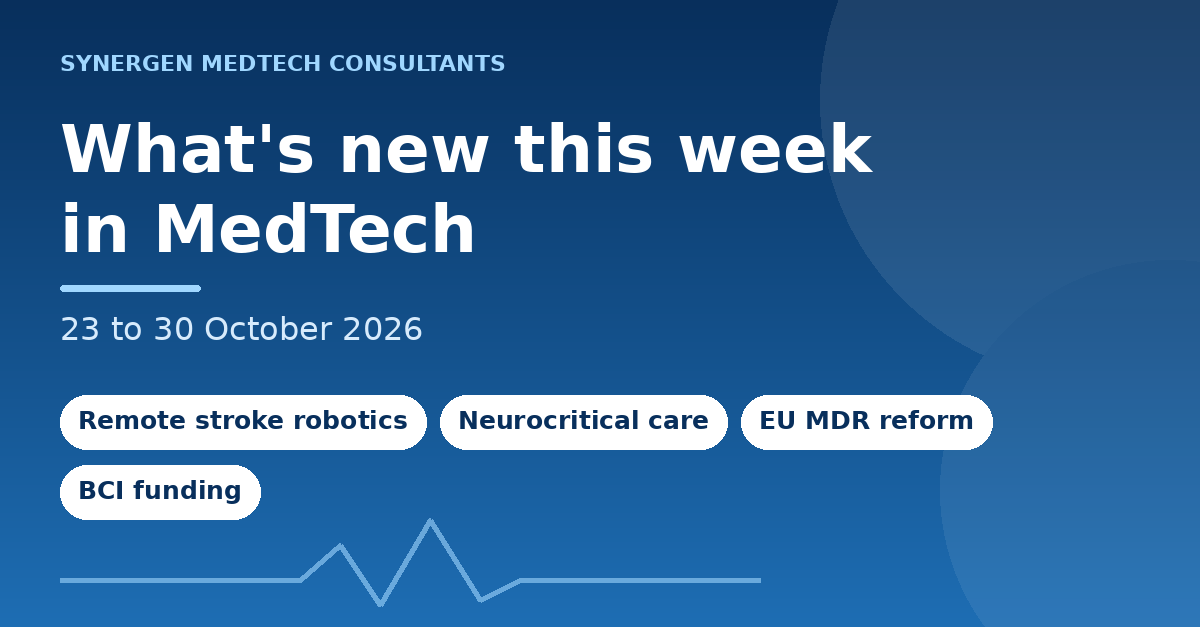
    What’s new this week in MedTech, 23 to 30 October 2026

    23 to 30 October 2026

    World Stroke Day on 29 October set the tone for a week in which remote robotics, AI imaging and new regulatory designations all pushed further into stroke and neurocritical care, while Brussels kept working on the MDR reform and investors put fresh money into brain implants, wearables and virtual testing.

    1. XCath shows the first remote robotic stroke thrombectomy to the world on World Stroke Day On 29 October XCath released a documentary on Operation Robo Angel, in which a neurointerventional surgeon at a control station in Santiago, Panama used the company’s Iris robot to remove a clot from a stroke patient in Panama City on the first pass, a procedure first performed in March and followed by FDA Breakthrough Device designation and entry into the FDA TAP pilot. It matters because most thrombectomy capable hospitals are concentrated in a handful of countries, and remote intervention could bring that care to patients who today have no specialist nearby, although the Iris system is still in development and not cleared for sale. Source: Medical Device Developments and NeuroNews International

    2. FDA gives Breakthrough status to a system that filters blood from spinal fluid after brain bleeds Pharaoh Neuro announced on 28 October that its Neurapheresis CSF Management System, a closed loop external platform that removes blood and its breakdown products from the cerebrospinal fluid of patients after aneurysmal subarachnoid hemorrhage, received FDA Breakthrough Device designation and is also taking part in the TAP pilot. It matters because there is currently no cleared or approved device that actively clears blood from the CSF in this young patient group, and the combination of designation and TAP gives the company a faster, more interactive route with the agency. Source: PR Newswire (Pharaoh Neuro)

    3. Brainomix AI on simple CT scans points to which severe stroke patients may benefit from a new drug In a post hoc analysis of the Phase 3 CHARM trial announced on 28 October, Brainomix used automated non contrast CT analysis in 428 patients and found that the investigational drug CIRARA was significantly associated with better outcomes in the subgroup with an infarct core below 125 mL. It matters because selecting patients with the most widely available stroke scan, rather than advanced imaging, could open trials and future treatments to far more hospitals, although the findings are exploratory and the drug is not approved. Source: PR Newswire (Brainomix)

    4. Empatica launches an FDA cleared and CE marked Parkinson’s wearable for home use Reported on 29 October, WellPD pairs a wrist worn device with an app that turns movement and other signals into daily measures of activity, sleep, tremor, bradykinesia and dyskinesia, lets patients log medication against those changes, and is now available to order in the US and several European countries. It matters because it is a clear example of neurology monitoring moving out of the clinic and into the home, giving clinicians data on what happens between appointments. Source: Medical Device Network

    5. EU Council working party takes up a third compromise on the MDR and IVDR reform On 26 and 27 October the Council’s Working Party on Pharmaceuticals and Medical Devices met in Brussels to exchange views on the Presidency’s third compromise text of the regulation simplifying the medical device rules, with expert panels and the link to the AI Act on the table. It matters because the proposal would replace the five year certificate cycle with risk based reviews, move much medical software from Class IIa to Class I and cut notified body fees for micro and small manufacturers, but it is still a proposal and today’s MDR and IVDR rules apply until a final text is adopted. Source: Council of the EU meeting notice and The European Post

    6. adsilico raises £10M to test devices in AI generated virtual patients The University of Leeds spinout announced on 27 October a Series A led by PXN Ventures to expand its technology, which builds virtual hearts and vessels from anonymised scans and simulates device performance across populations, and to extend it to brain devices such as flow diverters for aneurysms. It matters because in silico evidence could help manufacturers answer questions about diverse patient groups earlier and more cheaply, particularly in neurovascular areas where trials are small. Source: Intelligent Health.tech

    7. StimCardio closes a $30M Series A for a wrist worn atrial fibrillation therapy Announced on 29 October and led by Metis MedTech, the round funds the NeuroPulse 2 pivotal study of Rhyvive, an investigational wearable that delivers non invasive median nerve stimulation to reduce AF recurrence after catheter ablation, and preparation for an FDA De Novo submission. It matters because it shows investors backing non invasive neuromodulation as a therapy category in its own right, a trend that is equally relevant to neurology and rehabilitation devices. Source: PR Newswire (StimCardio)

    8. NeuroXess raises RMB 700M for a fully implanted wireless brain implant The Chinese brain-computer interface company reported on 28 October a Series B co-led by SDIC Juli, Shenzhen Capital Group and Qinzhi Capital, saying it has completed 65 clinical cases and began a registration trial with nearly 20 hospitals in July. It matters because China’s implant developers are moving quickly from clinical cases toward registration and large scale manufacturing, adding real competition to the US led brain-computer interface field. Source: TechNode and 36Kr

    Gary’s take What stands out for me this week is how much of the progress in stroke and neurocritical care is now coming through regulatory tools like Breakthrough designation and the TAP pilot, which give small companies a real seat at the table with FDA long before they file, and I would encourage any neuro startup with a serious unmet need to look at that route early. At the same time the EU reform is getting closer but is not there yet, so my advice remains to plan your CE strategy on today’s MDR and treat the proposed relief for software and small manufacturers as an upside rather than a planning date.

    Which of these developments matters most for your company, and is there an area you would like me to cover in more depth next week? You are always welcome to write to me directly.


    Sources note: all items were found through a public web scan of the week and each was checked against the linked original source.

    Website: synergenmedtech.com | LinkedIn: linkedin.com/company/100981535 | YouTube: youtube.com/@synergenmedtech

  • What’s new this week in MedTech, 17 to 24 October 2026

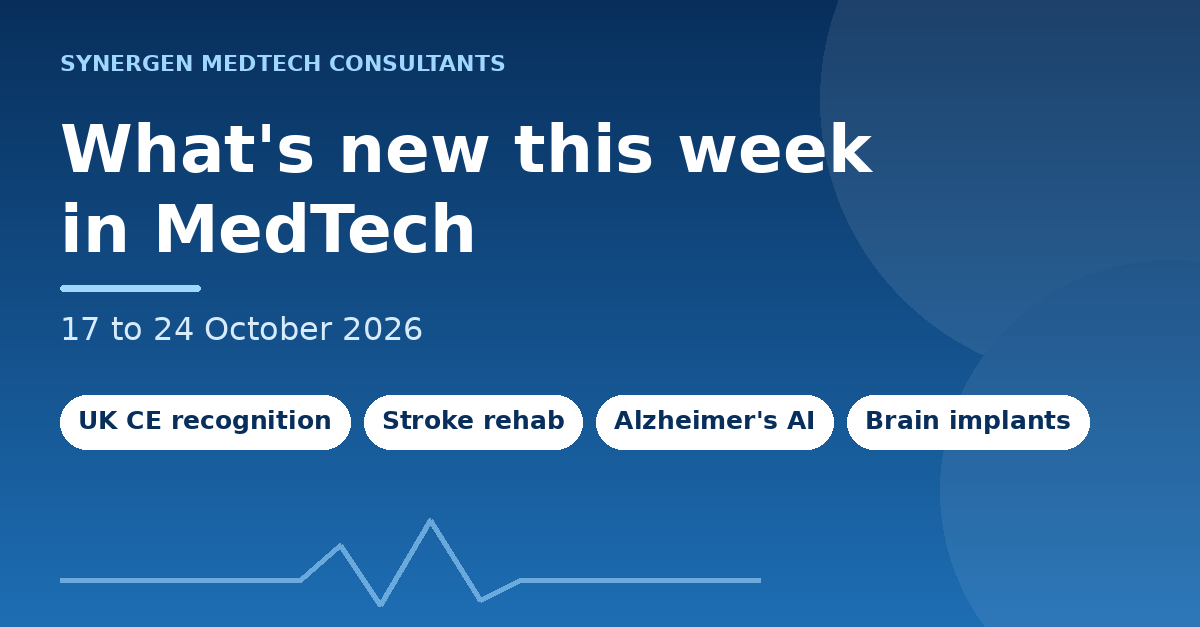
    What’s new this week in MedTech, 17 to 24 October 2026

    17 to 24 October 2026

    This week brought long term certainty for CE marked devices in Britain, a new global standard for stroke rehabilitation, a cleared AI tool for early Alzheimer’s risk, and more signs that regulators and investors are building the rules and the money around brain technology and software.

    1. UK confirms it will keep recognizing CE marked medical devices On 21 October the MHRA confirmed that Great Britain will continue to accept CE marked medical devices and IVDs on a long term basis, so manufacturers already approved for the EU market will not need an additional approval route, while the UKCA route stays alongside it and is being modernised. It matters because it removes a duplication risk that many companies had been planning around, and it gives export strategies for the British market a stable footing. Source: GOV.UK (MHRA)

    2. World Stroke Organization launches a stroke rehabilitation certification program The program, with 55 evidence based criteria and three certification tiers, was scheduled to be launched at the World Stroke Congress in Seoul on 23 October, after a pilot in 15 centers across six countries. It matters because rehabilitation has lagged behind acute stroke care, and a shared standard gives rehab services, and the technology companies that supply them, a common bar to build and prove value against. Source: Curtin University and World Stroke Congress 2026 programme

    3. FDA clears an AI tool that reads brain MRI to help judge Alzheimer’s risk NeuroXT announced on 20 October that its NEXT-Cue software received FDA 510(k) clearance, combining brain MRI, demographics and cognitive test results to help clinicians assess whether a patient with mild cognitive impairment may progress to Alzheimer’s dementia within five years. It matters because prognostic AI is now moving from research papers into cleared clinical software, which raises the evidence bar for every neurology software company that follows. Source: PR Newswire (NeuroXT)

    4. Paradromics and Siemens Healthineers plan a standard imaging workflow for brain implants Announced on 19 October, the collaboration aims to build an end to end imaging package covering candidate selection, surgical planning, navigation and follow up for implantable brain-computer interfaces, starting with speech and motor function. It matters because repeatable implantation workflows are a precondition for taking these devices beyond a few research centers, although this is still a plan and not a product. Source: Paradromics

    5. Coherence Neuro raises $45M for an implant that monitors brain tumors The Series A, co-led by Founders Fund and the OpenAI Startup Fund and reported on 23 October, will fund a first long term human trial in glioblastoma, and the devices remain investigational and not approved by the FDA. It matters because investors keep backing brain-computer interface platforms that reach well beyond paralysis into oncology and other fields. Source: MobiHealthNews

    6. A rehab robot that learns from physical therapists MIT Technology Review reported on 20 October on a Purdue and MIT system that uses generative AI and real-time force feedback to give stroke patients just the right amount of help during reaching and lifting exercises. It matters because therapist shortages limit stroke recovery, and the researchers frame the goal as extending therapists’ reach, with a long term clinical study still to come. Source: MIT Technology Review

    7. FDA finalizes guidance on software tied to prescription drugs Published in the Federal Register on 21 October, the guidance explains that software outputs distributed by or for a drug sponsor can be treated as prescription drug labeling, with consequences for prescribing information and FDA review. It matters because any digital companion built around a drug now has a clearer, and more demanding, set of labeling expectations. Source: Federal Register

    8. Provider groups tell FDA that AI makers, not doctors, should carry the risk Healthcare Dive reported on 22 October that the AHA, AMA and ATA, responding to FDA’s generative AI discussion paper, argued that developers must monitor and answer for the performance of generative AI devices. It matters because the director of FDA’s Digital Health Center of Excellence said draft guidance is planned in the coming months, so this liability debate will shape the rules you build against. Source: Healthcare Dive

    Gary’s take The MHRA decision is the item I would act on first, because regulatory certainty is worth more to a small MedTech company than almost any single product news, and it means a CE mark can remain the backbone of a British entry plan. Alongside it, the NeuroXT clearance shows how quickly AI software that supports a neurology decision can become a cleared product once the intended use is kept honest and narrow, here as supplementary information for the clinician and not a diagnosis on its own, and I expect the generative AI guidance that is coming in the next months to reward exactly that discipline.

    What was the most useful MedTech development you saw this week, and which area should I cover more closely next time? You are also welcome to write to me directly.


    Sources note: items 1, 2 and 4 came from a LinkedIn scan of the week and were checked against their original sources.

    Website: synergenmedtech.com | LinkedIn: linkedin.com/company/100981535 | YouTube: youtube.com/@synergenmedtech