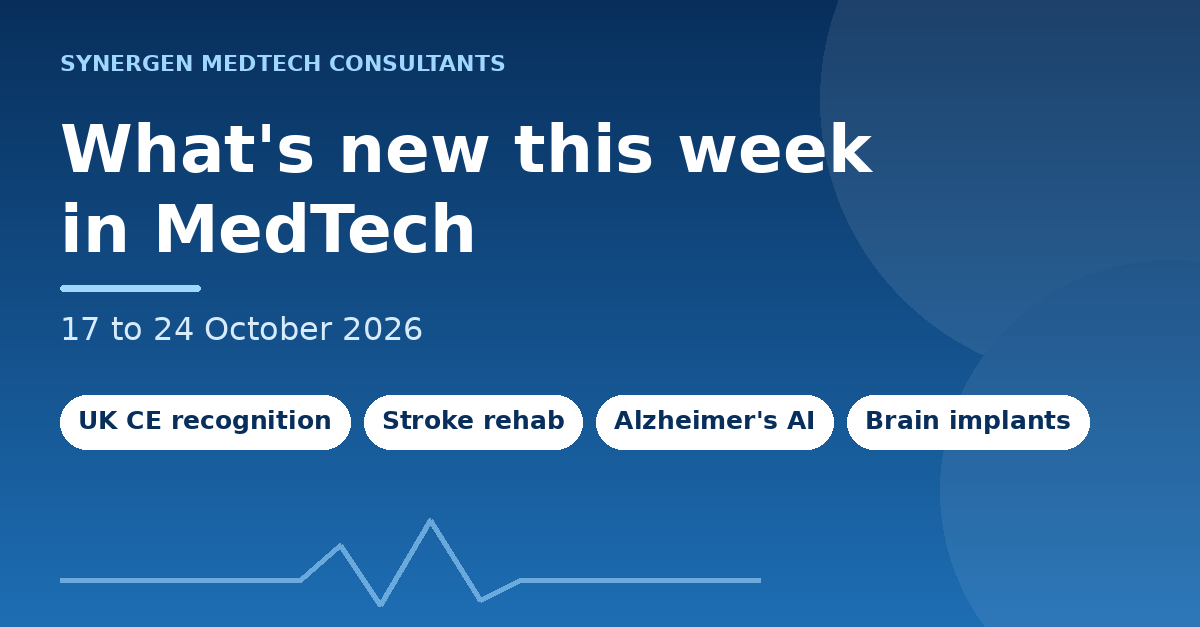
17 to 24 October 2026
This week brought long term certainty for CE marked devices in Britain, a new global standard for stroke rehabilitation, a cleared AI tool for early Alzheimer’s risk, and more signs that regulators and investors are building the rules and the money around brain technology and software.
1. UK confirms it will keep recognizing CE marked medical devices On 21 October the MHRA confirmed that Great Britain will continue to accept CE marked medical devices and IVDs on a long term basis, so manufacturers already approved for the EU market will not need an additional approval route, while the UKCA route stays alongside it and is being modernised. It matters because it removes a duplication risk that many companies had been planning around, and it gives export strategies for the British market a stable footing. Source: GOV.UK (MHRA)
2. World Stroke Organization launches a stroke rehabilitation certification program The program, with 55 evidence based criteria and three certification tiers, was scheduled to be launched at the World Stroke Congress in Seoul on 23 October, after a pilot in 15 centers across six countries. It matters because rehabilitation has lagged behind acute stroke care, and a shared standard gives rehab services, and the technology companies that supply them, a common bar to build and prove value against. Source: Curtin University and World Stroke Congress 2026 programme
3. FDA clears an AI tool that reads brain MRI to help judge Alzheimer’s risk NeuroXT announced on 20 October that its NEXT-Cue software received FDA 510(k) clearance, combining brain MRI, demographics and cognitive test results to help clinicians assess whether a patient with mild cognitive impairment may progress to Alzheimer’s dementia within five years. It matters because prognostic AI is now moving from research papers into cleared clinical software, which raises the evidence bar for every neurology software company that follows. Source: PR Newswire (NeuroXT)
4. Paradromics and Siemens Healthineers plan a standard imaging workflow for brain implants Announced on 19 October, the collaboration aims to build an end to end imaging package covering candidate selection, surgical planning, navigation and follow up for implantable brain-computer interfaces, starting with speech and motor function. It matters because repeatable implantation workflows are a precondition for taking these devices beyond a few research centers, although this is still a plan and not a product. Source: Paradromics
5. Coherence Neuro raises $45M for an implant that monitors brain tumors The Series A, co-led by Founders Fund and the OpenAI Startup Fund and reported on 23 October, will fund a first long term human trial in glioblastoma, and the devices remain investigational and not approved by the FDA. It matters because investors keep backing brain-computer interface platforms that reach well beyond paralysis into oncology and other fields. Source: MobiHealthNews
6. A rehab robot that learns from physical therapists MIT Technology Review reported on 20 October on a Purdue and MIT system that uses generative AI and real-time force feedback to give stroke patients just the right amount of help during reaching and lifting exercises. It matters because therapist shortages limit stroke recovery, and the researchers frame the goal as extending therapists’ reach, with a long term clinical study still to come. Source: MIT Technology Review
7. FDA finalizes guidance on software tied to prescription drugs Published in the Federal Register on 21 October, the guidance explains that software outputs distributed by or for a drug sponsor can be treated as prescription drug labeling, with consequences for prescribing information and FDA review. It matters because any digital companion built around a drug now has a clearer, and more demanding, set of labeling expectations. Source: Federal Register
8. Provider groups tell FDA that AI makers, not doctors, should carry the risk Healthcare Dive reported on 22 October that the AHA, AMA and ATA, responding to FDA’s generative AI discussion paper, argued that developers must monitor and answer for the performance of generative AI devices. It matters because the director of FDA’s Digital Health Center of Excellence said draft guidance is planned in the coming months, so this liability debate will shape the rules you build against. Source: Healthcare Dive
Gary’s take The MHRA decision is the item I would act on first, because regulatory certainty is worth more to a small MedTech company than almost any single product news, and it means a CE mark can remain the backbone of a British entry plan. Alongside it, the NeuroXT clearance shows how quickly AI software that supports a neurology decision can become a cleared product once the intended use is kept honest and narrow, here as supplementary information for the clinician and not a diagnosis on its own, and I expect the generative AI guidance that is coming in the next months to reward exactly that discipline.
What was the most useful MedTech development you saw this week, and which area should I cover more closely next time? You are also welcome to write to me directly.
Sources note: items 1, 2 and 4 came from a LinkedIn scan of the week and were checked against their original sources.
Website: synergenmedtech.com | LinkedIn: linkedin.com/company/100981535 | YouTube: youtube.com/@synergenmedtech
Leave a Reply